
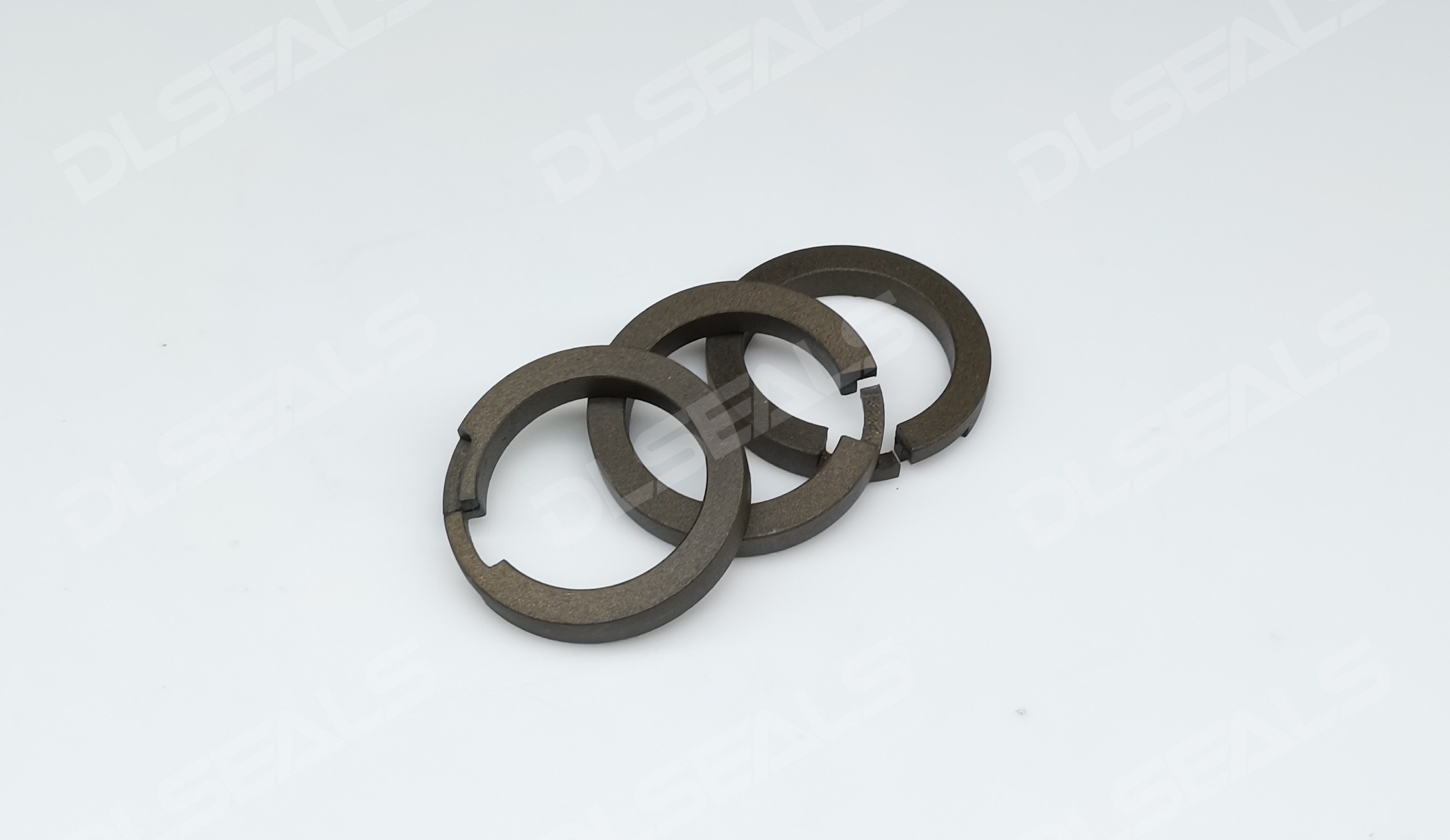
In harsh industrial environments, seals act as the “silent guardians” of critical systems. Their performance directly affects equipment reliability, efficiency, and service life. Polytetrafluoroethylene (PTFE), renowned for its exceptional chemical inertness, wide temperature range, and extremely low coefficient of friction, has long been a vital material in high-end sealing applications. However, pure PTFE has inherent weaknesses: moderate wear resistance, poor thermal conductivity, susceptibility to cold flow deformation, and limited mechanical strength. These limitations have restricted its use in more demanding conditions involving higher loads, speeds, and severity. The incorporation of bronze powder, however, is like infusing this “Plastic King” with a metallic skeleton and soul, initiating a profound performance revolution and propelling PTFE seals to new heights.
I. The Union of Strength and Flexibility: Fundamental Improvement in Mechanical Properties and Dimensional Stability
Pure PTFE is soft and prone to “cold flow” or creep under sustained pressure, leading to loss of sealing force and failure. The introduction of bronze powder fundamentally reshapes its mechanical framework.
- Leap in Creep Resistance and Pressure-Bearing Capacity: Uniformly dispersed bronze particles form a sturdy three-dimensional support network within the PTFE matrix. These hard particles significantly hinder the slippage and rearrangement of PTFE molecular chains, improving the composite material’s resistance to compression set (permanent deformation) by severalfold or even tens of times. The seal can maintain the necessary sealing pressure for much longer under constant static or alternating loads, preventing leaks caused by material relaxation.
- Significant Increase in Hardness and Stiffness: The hardness (e.g., Shore hardness) and elastic modulus of the composite increase linearly with bronze powder content. This gives the seal better load-bearing capacity, allowing it to adapt to higher system pressures while resisting mechanical damage during installation or operation, enhancing overall structural rigidity.
II. The Art of Tribology: Balancing Low Friction with an Ideal Wear Rate
While PTFE itself has an extremely low coefficient of friction, its wear resistance is insufficient. The addition of bronze powder ingeniously unites the seemingly contradictory properties of low friction and high wear resistance.
- Optimized Wear Mechanism: During friction, the PTFE matrix provides primary lubrication, forming a transfer film. The exposed hard bronze particles, on one hand, directly bear part of the load, reducing PTFE wear. On the other hand, their moderate wear helps maintain an ideal roughness at the friction interface, promoting the formation and replenishment of a uniform transfer film, leading to a stable low-friction state. This synergistic effect can improve the wear resistance of the composite by hundreds or even thousands of times compared to pure PTFE, making it particularly suitable for conditions with dust, slight contamination, or poor lubrication.
- Establishment of Thermal Pathways: Frictional heat is a major cause of seal failure. Pure PTFE is an excellent thermal insulator, allowing heat to accumulate easily. The highly thermally conductive bronze particles create efficient heat transfer pathways, quickly conducting and dissipating heat generated at the friction interface. This prevents localized overheating that can cause PTFE softening, decomposition, or charring, significantly enhancing the seal’s capability for high-speed operation and its PV limit.
III. Expansion of Thermal Performance and Safety Margin
- Multiplied Thermal Conductivity: As mentioned, the introduction of bronze powder dramatically increases the thermal conductivity of the composite. This not only aids heat dissipation but also creates a more uniform temperature distribution across the seal’s cross-section, reducing deformation caused by thermal stress and enhancing reliability under thermal cycling conditions.
- Adjusted Coefficient of Thermal Expansion: PTFE has a relatively high coefficient of linear thermal expansion, causing significant dimensional changes with heat. The addition of bronze powder effectively lowers the overall coefficient of thermal expansion of the composite, bringing it closer to that of common metal shaft and housing materials. This reduces changes in fit clearance due to temperature differences, improving sealing stability and predictability.
IV. Comprehensive Enhancement and Deepening of Application Scenarios
Thanks to the comprehensive improvement in core performance, PTFE with bronze powder seals demonstrate irreplaceable application value:
- Performer in Extreme Conditions: They outperform pure PTFE or other soft packing materials in dynamic sealing applications for rotating shafts, reciprocating rods, and valves under high pressure, high speed, high temperature (e.g., bronze filler can increase continuous service temperature), and severe lubrication conditions.
- Guarantee of Long-Term Reliability: They significantly extend maintenance intervals and periods between overhauls, reducing the total lifecycle maintenance costs and unexpected downtime risks of equipment. This is especially valuable in critical industries like energy, chemical, metallurgy, and automotive.
- Enhanced Boundary Condition Tolerance: Their combination of self-lubrication and wear resistance provides a wider safety margin in applications with slight contamination, dry start-up, or difficult maintenance.
Conclusion
The modification of PTFE with bronze powder is far from a simple physical mixture; it is a profound functional design and performance reconfiguration at the materials science level. It precisely compensates for PTFE’s inherent flaws, achieving a comprehensive, leapfrog improvement in mechanical strength, dimensional stability, friction and wear performance, and thermal management through a composite structure that combines strength and flexibility. Thus, PTFE with bronze powder composite seals have evolved from an excellent sealing option to the preferred solution for high-standard, long-cycle, and harsh-environment sealing challenges. They represent a significant direction in the evolution of modern sealing technology towards higher reliability, greater environmental adaptability, and longer service life, continuously pushing the performance boundaries of equipment across various industrial fields. In the future, with further optimization of powder preparation, surface treatment, and compounding processes, this classic combination is bound to unleash even greater potential.
Post time: Dec-08-2025