
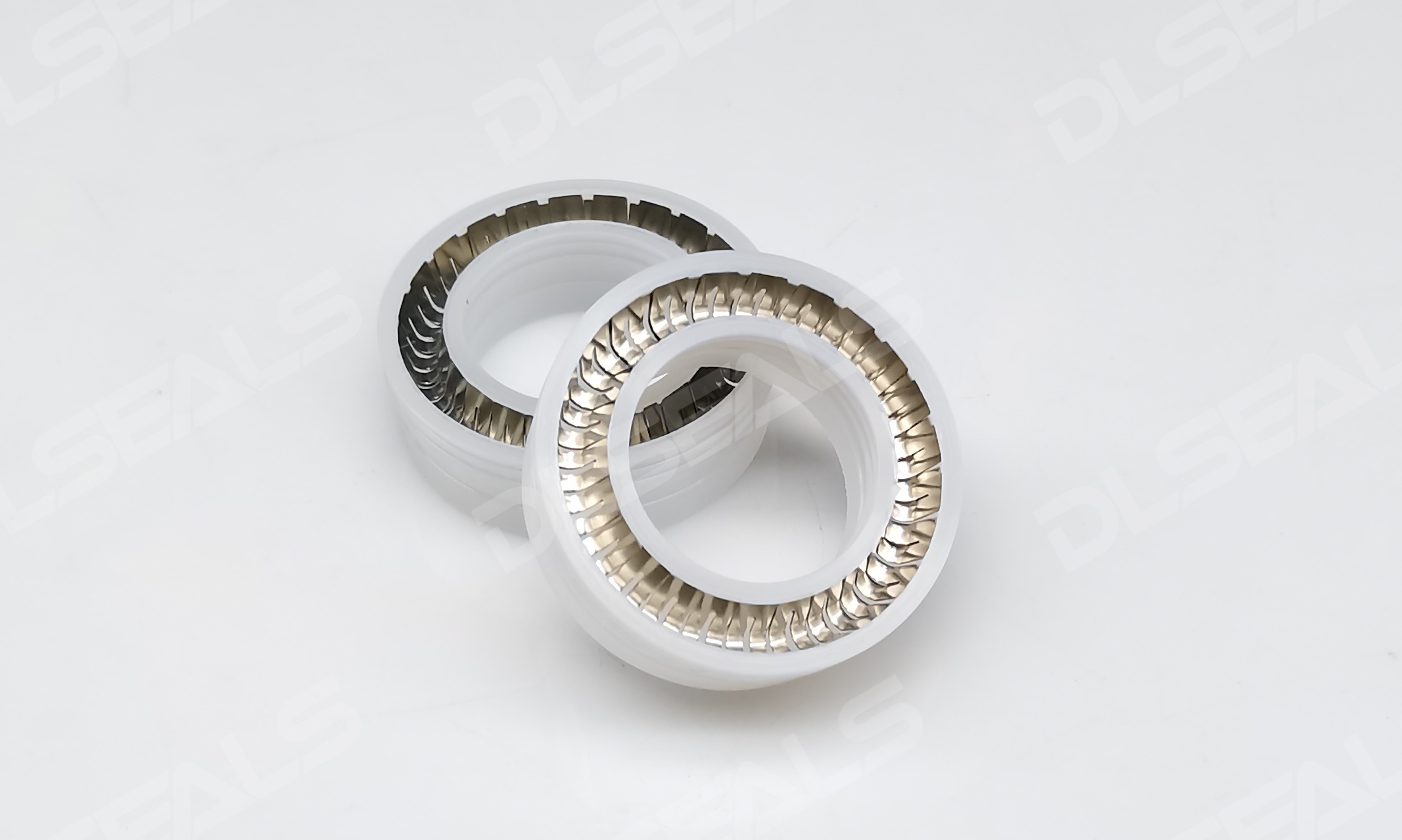
Engineering plastic seals are widely used in hydraulic and pneumatic systems, automotive equipment, chemical processing, semiconductor manufacturing, aerospace, energy systems, and other advanced industrial applications. Compared with conventional rubber seals, engineering plastics can offer higher temperature resistance, wear resistance, chemical resistance, dimensional stability, and lower friction, making them particularly suitable for high-temperature, high-pressure, high-speed, corrosive, and low-friction sealing applications.
However, there is no single engineering plastic that is suitable for every sealing condition. PTFE, PEEK, UHMW-PE, POM, PA, PI, PVDF, PPS, and other materials have different characteristics in terms of temperature resistance, pressure resistance, wear resistance, friction, rigidity, chemical compatibility, and dimensional stability. Material selection should therefore be based on the combined requirements of temperature, pressure, medium, speed, friction, clearance, and sealing structure.
1. PTFE: A Leading Material for Low Friction and Chemical Resistance
PTFE (polytetrafluoroethylene) is one of the most widely used engineering plastics for sealing applications.
Its major advantages include very low friction, excellent chemical resistance, and a wide operating temperature range. PTFE has very low water absorption and provides excellent resistance to many acids, alkalis, solvents, and other aggressive chemicals.
Key Properties
- Very low coefficient of friction
- Excellent chemical resistance
- Good high- and low-temperature performance
- Very low water absorption
- Good weather resistance
- Non-stick characteristics
- Excellent electrical insulation
However, virgin PTFE also has limitations, particularly relatively low rigidity and resistance to creep under high loads. For this reason, filled or modified PTFE is frequently used in engineering applications. Fillers such as carbon fiber, glass fiber, graphite, and bronze can improve wear resistance, load-bearing capacity, and dimensional stability.
Typical Applications
PTFE is particularly suitable for:
- Hydraulic seals
- Pneumatic seals
- Piston seals
- Piston rings
- Guide rings
- Rotary seals
- Sealing systems for corrosive media
- High- and low-temperature sealing
- Food and pharmaceutical equipment
- Chemical processing equipment
Key applications: low friction, chemical resistance, high/low temperature, and dynamic sealing.
2. PEEK: For High-Temperature, High-Pressure, and High-Load Applications
PEEK (polyether ether ketone) is a high-performance engineering thermoplastic. Its major advantages include high temperature resistance, high mechanical strength, excellent wear resistance, and good chemical resistance.
Compared with PTFE, PEEK provides significantly higher rigidity, strength, and resistance to creep. It is therefore particularly suitable for high-load and high-pressure applications.
Key Properties
- High mechanical strength
- Excellent creep resistance
- Good wear resistance
- Excellent high-temperature stability
- Good chemical resistance
- Excellent dimensional stability
- Good fatigue resistance
The main limitations of PEEK are its relatively high material cost and generally higher friction compared with PTFE. For dynamic sealing applications, modified PEEK grades are often used to improve friction and wear performance.
Typical Applications
PEEK is suitable for:
- High-pressure hydraulic seals
- High-temperature seals
- Valve seals
- Pump seals
- Compressor components
- Oil and gas equipment
- Aerospace equipment
- Semiconductor equipment
- Heavy-duty guide rings
- Wear-resistant support rings
PEEK becomes particularly valuable when high temperature, high pressure, and high mechanical load occur simultaneously.
Key applications: high temperature, high pressure, high strength, and creep resistance.
3. UHMW-PE: Combining Excellent Wear Resistance with Low Friction
UHMW-PE (ultra-high-molecular-weight polyethylene) offers excellent wear resistance combined with a relatively low coefficient of friction. It is therefore widely used for seals, guide rings, and wear components.
Compared with PTFE, UHMW-PE generally offers better impact resistance and excellent abrasion resistance, although its maximum operating temperature is lower.
Main Advantages
- Excellent wear resistance
- Low friction
- Excellent impact resistance
- Good water resistance
- Good resistance to many chemicals
- Low material density
Typical Applications
UHMW-PE is particularly suitable for:
- Hydraulic piston seals
- Guide rings
- Support rings
- Construction machinery
- Mining equipment
- Slurry and mud-handling equipment
- Applications containing solid particles
- Low-temperature equipment
For applications involving sand, dust, slurry, or other solid particles, the excellent wear resistance of UHMW-PE can be particularly beneficial.
However, when operating temperatures increase, its mechanical strength and dimensional stability must be reassessed.
Key applications: wear resistance, low friction, impact resistance, and particle-containing media.
4. POM: Excellent Dimensional Stability and Machinability
POM (polyoxymethylene, also known as acetal) provides high rigidity, hardness, dimensional stability, and good wear resistance with relatively low friction.
Compared with PTFE and PEEK, POM has a more limited temperature range, but it offers a good balance of mechanical properties, machinability, and cost.
Key Properties
- High rigidity
- Excellent dimensional stability
- Good wear resistance
- Good friction characteristics
- Good machinability
- Low water absorption
- Relatively controlled material cost
Typical Applications
POM is commonly used for:
- Guide rings
- Support rings
- Back-up rings
- Mechanical components
- Auxiliary sealing components
- Automotive components
- Precision mechanical parts
When the application does not require extreme temperature or chemical resistance but requires dimensional stability, rigidity, wear resistance, and good machinability, POM can be an effective choice.
Key applications: dimensional stability, rigidity, wear resistance, and cost efficiency.
5. PA: High Strength and Good Impact Resistance
PA (polyamide, commonly known as nylon) provides high mechanical strength, toughness, and wear resistance and is widely used in mechanical engineering.
One important characteristic of PA is its tendency to absorb moisture. In precision sealing applications, moisture absorption and the resulting dimensional changes must therefore be considered, particularly when tight clearances are involved.
Main Advantages
- High mechanical strength
- Good toughness
- Good impact resistance
- Good wear resistance
- Good machinability
- Relatively low cost
Typical Applications
PA is commonly used for:
- Guide rings
- Support rings
- Slide rings
- Mechanical wear components
- Auxiliary hydraulic sealing components
- Construction machinery components
PA is particularly suitable for applications requiring high mechanical strength and impact resistance under relatively moderate temperature and chemical conditions.
Key applications: high strength, toughness, impact resistance, and wear resistance.
6. PI: For Extreme Temperatures and High-Performance Friction Applications
PI (polyimide) is a high-performance specialty engineering plastic capable of maintaining good mechanical properties and dimensional stability at elevated temperatures.
Its key characteristics include excellent high-temperature resistance, wear resistance, dimensional stability, and electrical insulation.
Main Advantages
- Excellent high-temperature performance
- Good wear resistance
- High dimensional stability
- Excellent electrical insulation
- Good radiation resistance
- Suitable for extreme environments
Typical Applications
PI seals and related components can be used in:
- Aerospace equipment
- High-temperature machinery
- Semiconductor equipment
- Vacuum equipment
- High-temperature bearings
- High-temperature guide components
- Specialized friction pairs
PI is relatively expensive and generally more difficult to process than conventional engineering plastics, so it is mainly used where exceptional performance is required.
Key applications: extreme temperatures, wear resistance, dimensional stability, and specialized environments.
7. PVDF: Excellent Chemical and Environmental Resistance
PVDF (polyvinylidene fluoride) is a fluorinated engineering thermoplastic known for its chemical resistance, weather resistance, and good mechanical properties.
Although its overall performance differs from PTFE and PEEK, PVDF is widely used in chemical processing equipment, fluid systems, and equipment handling corrosive media.
Key Properties
- Good chemical resistance
- Good weather resistance
- Excellent UV resistance
- Good mechanical strength
- Good aging resistance
Typical Applications
- Chemical processing equipment
- Corrosive fluid systems
- Pumps and valves
- Piping systems
- Semiconductor equipment
- Chemical transfer equipment
Key applications: corrosion resistance, weather resistance, and chemical-fluid handling.
8. PPS: A Balance of High-Temperature and Chemical Resistance
PPS (polyphenylene sulfide) offers good heat resistance, chemical resistance, dimensional stability, and flame-retardant properties.
Its combination of mechanical and thermal performance makes it suitable for demanding industrial environments.
Main Advantages
- High-temperature resistance
- Excellent chemical resistance
- Excellent dimensional stability
- Good flame resistance
- Stable electrical properties
- Good aging resistance
Typical Applications
- Automotive industry
- Chemical processing equipment
- Electrical equipment
- Pumps and valves
- High-temperature mechanical components
- Semiconductor equipment
Key applications: high temperature, chemical resistance, dimensional stability, and electrical insulation.
9. How to Select an Engineering Plastic for Sealing Applications
Different engineering plastics should not simply be ranked from “high performance” to “low performance.” Each material is optimized for different operating conditions.
| Material | Main Advantages | Temperature Resistance | Wear Resistance | Low Friction | Chemical Resistance | Typical Applications |
|---|---|---|---|---|---|---|
| PTFE | Low friction, chemical resistance | ★★★★★ | ★★★★ | ★★★★★ | ★★★★★ | Hydraulic, chemical, rotary seals |
| PEEK | High strength, creep resistance | ★★★★★ | ★★★★★ | ★★★ | ★★★★ | High-pressure, high-temperature, valves |
| UHMW-PE | Wear resistance, impact resistance | ★★ | ★★★★★ | ★★★★ | ★★★★ | Particle-containing media, guide rings |
| POM | Rigidity, dimensional stability | ★★★ | ★★★★ | ★★★★ | ★★★ | Guide rings, support rings |
| PA | Strength, toughness | ★★★ | ★★★★ | ★★★ | ★★★ | Mechanical components, guide rings |
| PI | Extreme-temperature performance, wear resistance | ★★★★★+ | ★★★★★ | ★★★★ | ★★★★ | Aerospace, semiconductor, high-temperature equipment |
| PVDF | Chemical and weather resistance | ★★★ | ★★★ | ★★★ | ★★★★★ | Chemical and fluid systems |
| PPS | High temperature, chemical resistance | ★★★★ | ★★★★ | ★★★ | ★★★★★ | Automotive, chemical, semiconductor |
Note: The ratings above indicate relative performance trends between materials and are not fixed experimental data. Actual performance depends on the specific grade, filler system, formulation, temperature, pressure, and seal design.
10. Material Selection Alone Does Not Determine Seal Performance
In actual sealing design, material selection is only the first step.
For example, PTFE seals made from virgin PTFE, glass-filled PTFE, carbon-fiber-filled PTFE, and graphite-filled PTFE can have significantly different wear resistance, friction characteristics, load-bearing capacity, and dimensional stability.
PEEK can also be modified with carbon fiber, glass fiber, PTFE, and other fillers to optimize wear, friction, and mechanical properties for specific applications.
Therefore, the final performance of an engineering plastic seal depends on:
Base polymer + modification system + seal design + operating conditions + mating material + surface condition.
For example, even if a material has excellent pressure resistance, excessive sealing clearance in a high-pressure hydraulic system can still cause extrusion. Likewise, in a high-speed rotary seal, even a highly wear-resistant material may fail if lubrication is insufficient or frictional heat becomes excessive.
11. Engineering Plastic Seal Selection Process
A practical material selection process can follow these steps:
Step 1: Determine the temperature.
Identify the minimum, normal, and maximum operating temperatures.
Step 2: Identify the medium.
Evaluate compatibility with hydraulic oil, water, steam, fuel, chemicals, gases, or particle-containing media.
Step 3: Determine the pressure.
For high-pressure applications, focus on mechanical strength, creep resistance, and extrusion resistance.
Step 4: Determine the type of motion.
Distinguish between static, reciprocating, rotary, and high-speed dynamic sealing.
Step 5: Determine friction and wear requirements.
High-speed and low-friction applications often favor PTFE and modified PTFE, while high-load wear applications may favor materials such as PEEK or UHMW-PE.
Step 6: Determine the sealing structure.
Select the material according to the specific design, such as O-rings, piston seals, rotary seals, guide rings, support rings, or lip seals.
The final material should then be confirmed based on the specific grade, filler system, hardness, dimensions, and actual testing.
12. Conclusion
The value of engineering plastic seals is not simply to replace rubber seals. Instead, they provide a solution for applications where conventional elastomers cannot meet the required combination of temperature resistance, wear resistance, chemical resistance, creep resistance, and low friction.
The characteristics of the major materials can be summarized as follows:
PTFE: low friction and excellent chemical resistance.
PEEK: high temperature, high pressure, high strength, and creep resistance.
UHMW-PE: wear resistance, low friction, and impact resistance.
POM: rigidity, dimensional stability, and cost efficiency.
PA: high strength, toughness, and impact resistance.
PI: extreme-temperature performance and high-performance friction applications.
PVDF: chemical resistance and fluid-media compatibility.
PPS: high temperature, chemical resistance, and dimensional stability.
Therefore, the correct approach to engineering plastic seal selection is not to search for the material with the “highest performance,” but to identify the material system that best matches the actual temperature, pressure, medium, speed, friction, wear, and sealing structure.
For high-temperature, high-pressure, high-speed, highly corrosive, or high-cleanliness applications, further evaluation of the modification system, seal geometry, groove design, and actual testing is recommended.
Post time: Sep-20-2026


