
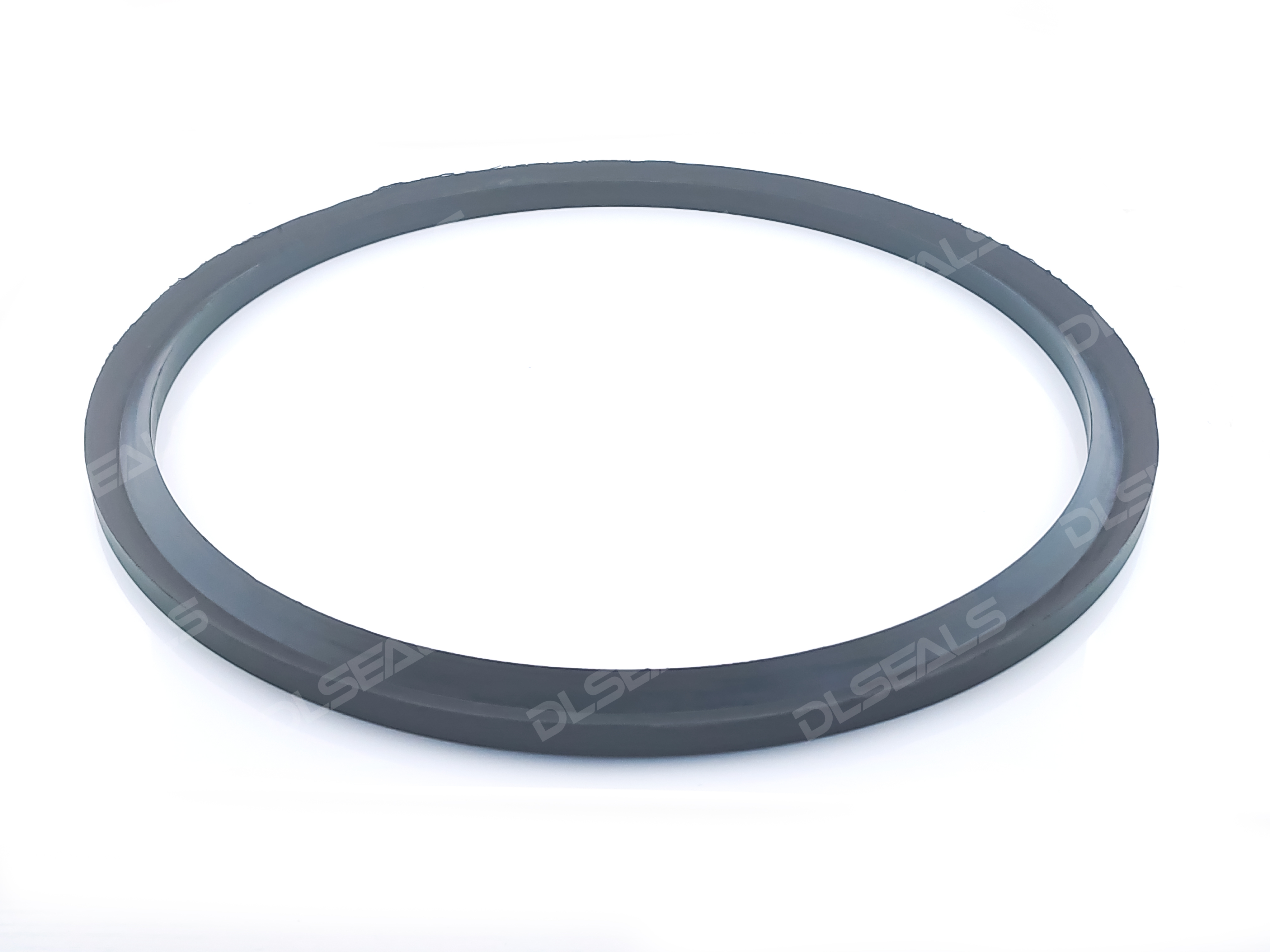
In hydraulic equipment, heavy machinery, and industrial reciprocating sealing systems, seals must not only withstand operating pressure but also accommodate repeated movement, shock loads, equipment vibration, and long-term friction and wear. In demanding applications such as large hydraulic cylinders, hydraulic presses, and metallurgical equipment, conventional rubber seals may suffer from extrusion, excessive wear, or insufficient structural support.
Fabric Reinforced V-Packing Seals are composite sealing elements manufactured by combining elastomeric materials with reinforcing fabric layers. Their V-shaped cross-section utilizes lip deformation, installation preload, and fluid pressure to establish sealing contact. The fabric reinforcement improves mechanical strength, extrusion resistance, and structural stability.
These seals are commonly installed in multiple-ring arrangements, also known as Fabric Reinforced Chevron Packing or V-Packing Seal Sets. By adjusting material formulations, the number of sealing rings, and the configuration of supporting components, they can accommodate different operating pressures, movement speeds, and equipment requirements.
1. Structure and Sealing Principle of Fabric Reinforced V-Packing Seals
The primary characteristics of fabric reinforced V-packing seals are their V-shaped cross-section and fabric-elastomer composite construction.
Unlike conventional one-piece rubber seals, V-packing systems typically consist of multiple V-shaped sealing rings combined with adapter and support rings.
V-Shaped Sealing Rings
The V-shaped sealing ring is the primary working component. Its cross-section forms inner and outer sealing lips, which contact the piston rod or plunger surface and the sealing housing, respectively.
When axial preload is applied during installation, the V-shaped structure deforms, causing the sealing lips to expand against their corresponding contact surfaces and establish an initial seal.
As operating pressure acts on the V-shaped profile, it further energizes the sealing lips, increasing contact pressure and improving sealing effectiveness.
Adapter Rings and Support Rings
A typical V-packing assembly includes male and female adapter rings, which function as compression and support elements.
The compression element transmits axial preload to the V-shaped sealing rings, while the supporting element helps maintain the assembly geometry and limits undesirable deformation.
Depending on the application, adapter rings may be manufactured from fabric-reinforced elastomers, engineering plastics, or other suitable materials.
Multiple-Ring Sealing Configuration
In heavy-duty hydraulic applications, fabric reinforced V-packing seals are frequently installed in stacked arrangements.
Multiple V-shaped rings create several sealing contact zones along the axial direction, allowing the packing assembly to accommodate operating pressure and a certain amount of wear.
However, increasing the number of rings does not necessarily improve performance. Excessive packing rings may increase friction, installation space requirements, and heat generation.
The basic sealing principle can be summarized as follows:
Axial installation preload → Expansion of V-shaped sealing lips → Initial sealing contact → Pressure-assisted sealing → Structural support from fabric reinforcement.
2. Material Properties of Fabric Reinforced Rubber
Fabric reinforced V-packing seals are generally manufactured from rubber compounds combined with woven fabric reinforcement.
The reinforcing layers are embedded within the elastomeric matrix to improve mechanical performance under pressure, friction, and repeated deformation.
Common elastomeric materials include nitrile rubber (NBR) and other compounds selected according to fluid compatibility and operating conditions. Reinforcing fabrics may include cotton or synthetic fiber textiles.
High Mechanical Strength
Fabric reinforcement restricts excessive deformation of the rubber under pressure and improves the structural strength of the sealing ring.
Compared with unreinforced rubber compounds, properly designed fabric-reinforced materials generally provide better load-bearing performance, especially in high-pressure applications involving larger sealing cross-sections.
Improved Extrusion Resistance
In high-pressure sealing systems, elastomeric materials may be forced into the clearance gap between mating components, causing extrusion, tearing, or localized damage.
The reinforcing fabric improves resistance to excessive deformation and can reduce extrusion risks under suitable conditions.
However, extrusion resistance still depends on operating pressure, clearance gap, temperature, material formulation, and supporting structure.
Wear Resistance and Tear Resistance
Fabric reinforcement can improve the wear and tear resistance of sealing rings under certain operating conditions, making them suitable for heavy-duty reciprocating applications.
Actual wear performance depends on fabric type, rubber formulation, lubrication conditions, and the surface finish of mating components.
Not every fabric-reinforced material necessarily offers better wear resistance than polyurethane or other specialized sealing materials.
Balanced Elasticity and Structural Stability
The rubber matrix provides elasticity and sealing lip conformity, while the fabric layers supply mechanical reinforcement and dimensional support.
This combination helps balance sealing flexibility and load-bearing capability.
However, fabric-reinforced seals may have lower flexibility and low-pressure conformability than certain unreinforced rubber seals.
3. Fabric Reinforced V-Packing vs. Conventional Rubber V-Packing
| Property | Conventional Rubber V-Packing | Fabric Reinforced V-Packing |
|---|---|---|
| Material structure | Primarily elastomeric | Elastomer with fabric reinforcement |
| Mechanical strength | Depends on rubber formulation | Generally improved through reinforcement |
| Extrusion resistance | Limited by rubber hardness and design | Generally better |
| Wear resistance | Depends on material and operating conditions | Advantageous in certain heavy-duty applications |
| Elastic deformation | Generally higher | Restricted by reinforcing fabric |
| High-load capability | Requires structural evaluation | Suitable for reinforced heavy-duty packing designs |
| Typical applications | General reciprocating sealing | Heavy-duty hydraulic and industrial reciprocating systems |
The primary advantage of fabric reinforced V-packing is not simply increased sealing lip elasticity, but improved structural stability under pressure and mechanical loading.
For lower-pressure applications, systems requiring minimal friction, or installations with limited space, conventional rubber, polyurethane, or other specialized sealing designs may be more suitable.
4. Main Advantages of Fabric Reinforced V-Packing Seals
1. Suitable for Heavy-Duty and High-Pressure Applications
Fabric reinforcement improves the mechanical load-bearing capability of the sealing rings.
When combined with a properly designed multi-ring packing arrangement, these seals can be used in large hydraulic cylinders and industrial pressure equipment.
In applications involving significant pressure fluctuations or mechanical shocks, the reinforced material and supporting structure can help improve sealing reliability.
2. Flexible Sealing Configuration
One of the major advantages of fabric reinforced V-packing is its configurable construction.
The number of V-rings, material combinations, cross-sectional dimensions, and adapter ring configurations can be adjusted according to equipment requirements.
This flexibility is particularly valuable for large industrial equipment where maintenance and replacement are important considerations.
3. Adaptability to Reciprocating Motion and Long Strokes
Fabric reinforced V-packing seals are widely used in piston rods, plungers, and other reciprocating components.
Their V-shaped sealing lips maintain contact through installation preload and fluid pressure, while the fabric reinforcement helps withstand repeated mechanical loading.
4. Suitable for Large-Diameter Sealing Applications
Fabric reinforced V-packing seals can be manufactured for large hydraulic cylinders, heavy-duty presses, and specialized industrial equipment.
For large-diameter seals, particular attention must be paid to cross-sectional consistency, fabric distribution, joint quality, and installation compression to avoid uneven loading.
5. Typical Industrial Applications
Hydraulic Cylinders and Heavy-Duty Hydraulic Equipment
Fabric reinforced V-packing seals are commonly used in piston rod and plunger sealing systems for large hydraulic cylinders, hydraulic presses, and heavy-duty actuators.
These applications frequently involve substantial loads and pressure fluctuations, requiring sealing materials with good mechanical strength, extrusion resistance, and structural stability.
A properly designed multi-ring V-packing assembly can provide reliable sealing performance under demanding operating conditions.
Metallurgical and Steel Manufacturing Equipment
Hydraulic systems in metallurgical equipment may operate under vibration, shock loading, dust contamination, and challenging environmental conditions.
Fabric reinforced V-packing seals can be used in suitable hydraulic actuators and reciprocating sealing positions.
Where equipment is exposed to radiant heat, abrasive particles, or severe side loads, additional dust protection, guidance, and thermal management may be required.
Construction and Mining Machinery
Mining machinery, construction equipment, and large industrial actuators frequently experience heavy mechanical loads and complex operating cycles.
Fabric reinforced chevron packing can serve as a heavy-duty reciprocating sealing solution by combining reinforced materials with a multi-component sealing structure.
For high-frequency or high-speed reciprocating applications, frictional heat, breakaway force, and seal wear must be carefully evaluated.
Marine and Large Industrial Equipment
Fabric reinforced V-packing seals are also used in selected marine hydraulic systems, large plunger equipment, and industrial pressure machinery.
For applications involving water, oil, or specialized process fluids, the elastomer compound and reinforcing fabric must be selected according to the specific medium.
Conventional NBR-based fabric reinforced packing should not be assumed compatible with every fluid.
6. Key Factors in Selecting Fabric Reinforced V-Packing Seals
The performance of fabric reinforced V-packing seals depends on the interaction between material properties, sealing geometry, and installation conditions.
Operating Pressure and Clearance Gap
Operating pressure affects sealing lip contact pressure and material deformation.
Under higher pressures, the axial packing length, supporting structure, and extrusion clearance must be properly designed to prevent excessive deformation or localized damage.
Reciprocating Speed and Frictional Heat
Fabric reinforced V-packing seals are primarily designed for reciprocating motion, but they are not suitable for unlimited operating speeds.
As sliding speed and installation preload increase, frictional heat may rise, potentially affecting elastomer elasticity, wear behavior, and service life.
Material formulation, operating pressure, lubrication conditions, and movement speed must therefore be considered together.
Operating Temperature and Fluid Compatibility
The temperature resistance of fabric reinforced V-packing depends on the elastomer matrix, reinforcing fabric, and manufacturing process.
For example, NBR-based fabric reinforced seals are suitable for many mineral-oil hydraulic systems, but their allowable operating temperatures depend on the specific compound.
For high-temperature oils, special chemicals, or water-based hydraulic fluids, material compatibility must be reassessed. Alternative elastomer and fabric combinations may be required.
Installation Preload
Installation preload directly affects the contact pressure of the V-shaped sealing lips.
Insufficient preload may cause leakage at low pressure, while excessive preload can increase friction, breakaway force, and wear.
Axial compression should therefore follow the packing assembly’s design requirements.
Increasing compression force without evaluating the underlying cause is not an appropriate solution to seal failure.
Surface Finish of Mating Components
The roughness, hardness, and geometric accuracy of piston rods, plungers, and sealing housings all influence seal performance.
For reciprocating equipment, mating surfaces should be free from scratches, burrs, and excessive misalignment.
Proper guiding components should also be incorporated where necessary.
7. Common Failure Modes and Improvement Measures
During long-term operation, fabric reinforced V-packing seals may experience sealing lip wear, extrusion damage, ring deformation, fabric layer damage, and increased leakage.
Abnormal Lip Wear
Excessive wear may result from high installation preload, rough mating surfaces, insufficient lubrication, or contamination entering the sealing area.
Extrusion and Localized Tearing
These failures may be associated with excessive operating pressure, oversized clearance gaps, or inadequate supporting structures.
Fabric Layer Separation or Damage
Delamination or reinforcement damage may be related to insufficient bonding quality, repeated deformation, excessive temperature, or incompatible process fluids.
Low-Pressure or Startup Leakage
Leakage during startup or low-pressure operation may be caused by insufficient initial preload, incorrect sealing dimensions, improper installation orientation, or damaged sealing surfaces.
To address these problems, engineers should evaluate the material formulation, V-shaped profile, number of packing rings, installation preload, extrusion clearance, and actual operating conditions.
Simply increasing the number of V-rings does not necessarily resolve sealing failures and may introduce additional friction and heat.
Conclusion
Fabric Reinforced V-Packing Seals are industrial sealing components that combine elastomeric flexibility, fabric reinforcement, and pressure-assisted V-shaped sealing geometry.
Compared with conventional rubber seals, their principal advantages include improved mechanical load-bearing capability, extrusion resistance, structural stability, and suitability for heavy-duty reciprocating applications.
Through appropriate combinations of multiple V-shaped rings, adapter rings, and supporting elements, these sealing systems can be configured for different pressures, equipment sizes, and operating requirements.
As a result, fabric reinforced chevron packing is widely applicable to large hydraulic cylinders, hydraulic presses, metallurgical machinery, construction equipment, and other industrial systems.
However, fabric reinforced V-packing is not suitable for every high-pressure or high-speed application. Proper selection must account for operating pressure, sliding speed, temperature, fluid compatibility, extrusion clearance, and installation preload.
By matching material properties, V-packing geometry, and actual operating conditions, engineers can make effective use of the wear resistance, extrusion resistance, and heavy-duty sealing capabilities of fabric reinforced V-packing seals, improving overall equipment reliability and service life.
Post time: Oct-19-2026


