
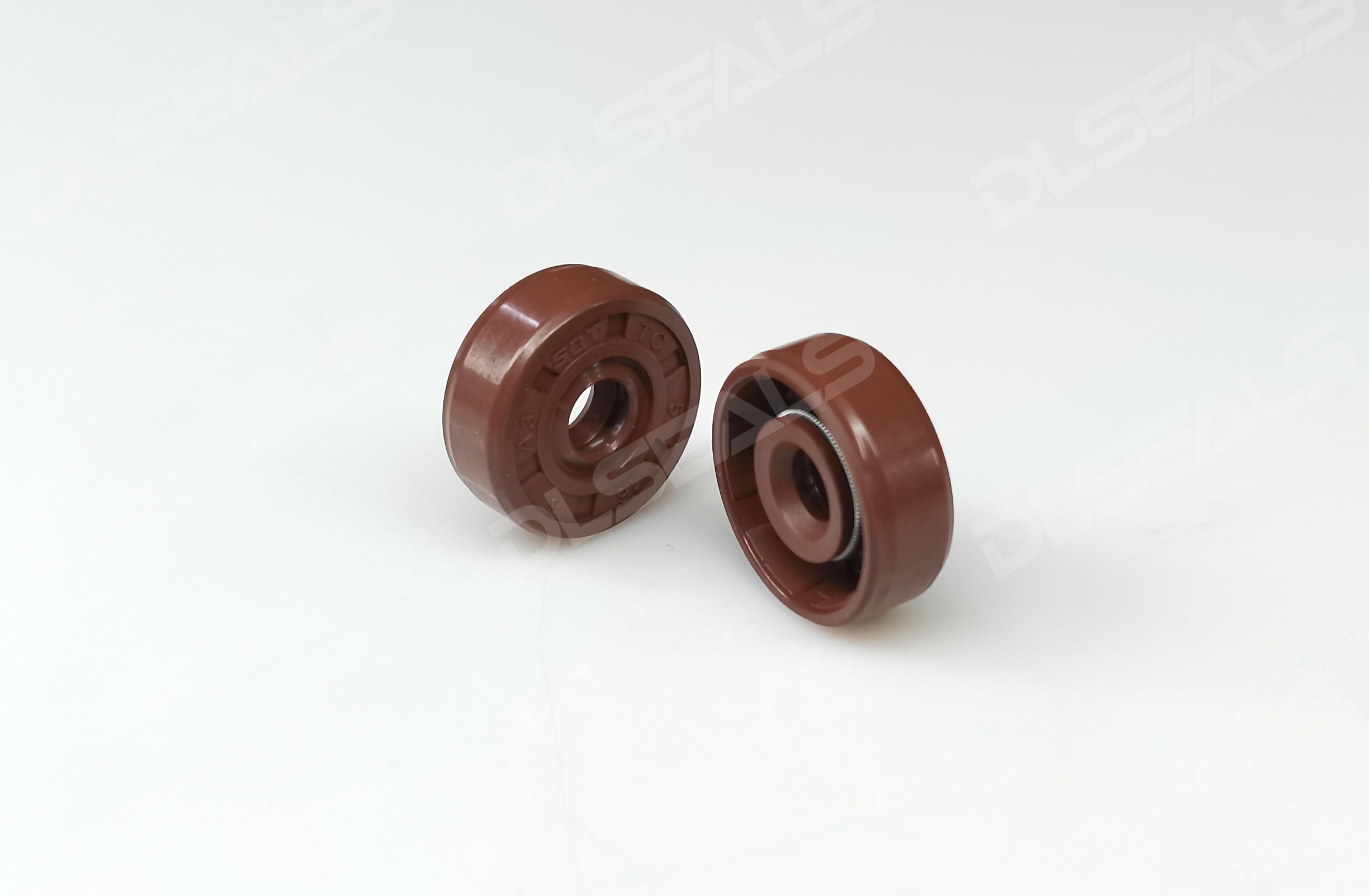
In air compressor systems, sealing rings are critical components that ensure efficient, stable, and long-term operation. When the working environment becomes harsh, the selection of sealing materials poses a significant challenge. The core question is: For use in an air compressor, under operating conditions of 10BAR pressure, 180°C temperature, and air as the medium, what material should be chosen for the sealing ring?
This article will analyze these conditions in depth and provide you with professional and reliable material selection solutions.
1. Operating Condition Analysis: What are the Challenges?
- High Temperature (180°C): This is the primary challenge for this selection. Common rubber materials like Nitrile Rubber (NBR) have a maximum continuous service temperature typically around 100°C to 120℃. At 180°C, they would quickly harden, lose elasticity, undergo permanent deformation, leading to seal failure.
- Medium (Air): Compressed air contains oxygen, which is highly oxidative at elevated temperatures and accelerates the aging of most rubber materials. Additionally, air may contain trace moisture and oil, requiring the material to have good aging resistance and certain medium resistance.
- Pressure (10BAR): Equivalent to approximately 1.0MPa, this falls into the low to medium-pressure range. This pressure itself does not pose extreme requirements on the mechanical strength of the seal material, but it must be considered in combination with the high temperature. Material strength decreases at high temperatures, so it is essential to ensure that the material maintains sufficient compressive strength and anti-extrusion capability at 180°C.
Conclusion: Under these conditions, the sealing material must primarily meet the basic requirements of long-term resistance to 180°C heat and resistance to air oxidation.
2. Candidate Material Analysis and Recommendations
Based on the above analysis, the following materials are viable and mainstream choices, each with its advantages and disadvantages, suitable for different priorities.
Primary Recommendation: Polytetrafluoroethylene (PTFE) and Composites
- Advantages:
- Excellent Temperature Resistance: Very wide continuous service temperature range (-180°C to +250°C), fully meets the 180°C requirement with stable performance.
- Very Low Coefficient of Friction: Excellent self-lubrication, significantly reducing startup and running torque, saving energy, especially suitable for dynamic sealing applications.
- Superb Chemical Stability: Resistant to almost all chemical media, including oxidative air, and does not age.
- Anti-stick Properties: Low tendency for carbon buildup, high cleanliness.
- Disadvantages:
- Poor Elasticity: Pure PTFE is a plastic lacking the elasticity of rubber. It often needs to be designed as a spring-energized seal or rely on structural preload for sealing.
- Best Practice: Using filled PTFE composites (e.g., filled with glass fiber, copper powder, carbon fiber) can significantly improve mechanical strength, wear resistance, and anti-creep properties, making it the most comprehensive and reliable choice for these conditions.
Strong Candidate: Perfluoroelastomer (FFKM)
- Advantages:
- Combination of Rubber Elasticity and Extreme Temperature Resistance: Combines excellent rubber elasticity with superior high-temperature resistance (continuous service temperature up to 250°C and beyond).
- Excellent Chemical Inertness: Resistance to chemicals and solvents surpasses all other rubbers, providing absolute resistance to high-temperature oxidation.
- High Sealing Reliability: As an elastomer, it provides excellent static sealing.
- Disadvantages:
- Very High Cost: One of the most expensive sealing rubber materials, typically used in extreme applications where cleanliness and reliability are paramount.
- Application Scenario: If your application demands absolute sealing reliability and no contamination (e.g., food, pharmaceutical, semiconductor industries) and the budget is sufficient, FFKM is the undisputed best choice.
Economical-Practical Choice: Fluorosilicone Rubber (FVMQ)
- Advantages:
- Good Temperature Resistance: Continuous service temperature typically ranges from -60°C to +200°C. 180°C is at the upper limit of its range. It may be acceptable for short-term or intermittent duty, but long-term continuous operation at 180°C will shorten its service life.
- Excellent Ozone and Weather Resistance: Good resistance to oxidation from compressed air.
- Moderate Cost: Significantly cheaper than FFKM and more cost-competitive than high-temperature FKM.
- Disadvantages:
- Risk at Temperature Upper Limit: Long-term exposure to the extreme temperature of 180°C will accelerate the decline of its physical properties, with a risk of premature hardening.
- Average Mechanical Strength: Wear and tear resistance and anti-tear strength are inferior to FKM.
- Application Scenario: If the actual operating temperature fluctuates around 170°C-180°C, and cost is a sensitive factor, fluorosilicone rubber can be considered as an economical option, but its service life must be monitored closely.
Common but Requiring Caution: High-Temperature Grade Fluoroelastomer (FKM/Viton®)
- Advantages:
- Good Overall Performance: One of the most commonly used rubber sealing materials in high-temperature environments, resistant to oils and most chemicals.
- Balance of Cost and Performance: Priced lower than FFKM, technologically mature, and widely used.
- Disadvantages:
- Challenge of Temperature Limit: The maximum continuous service temperature for standard grade FKM is usually around 200°C. Although 180°C is theoretically feasible, long-term exposure at this temperature, especially for average quality FKM, can significantly increase hardness and compression set, leading to loss of sealing force. It is necessary to select a specialized high-temperature grade (e.g., peroxide-cured) FKM and ensure it has excellent compression set properties.
- Recommendation: If choosing FKM, clearly state the operating conditions to the supplier and request test reports for the material’s compression set after prolonged aging at 180°C. If the data is not satisfactory, its use is not recommended.
3. Summary and Final Recommendations
| Material | Approx. Continuous Temp. | Advantages | Disadvantages | Recommendation Index |
|---|---|---|---|---|
| PTFE Composite | Up to 250°C+ | Excellent temp resistance, low friction, chemically inert | Not elastic, requires special design | ★★★★★ (Best Overall) |
| Perfluoroelastomer (FFKM) | Up to 300°C+ | Top performance, rubber elasticity, high reliability | Extremely expensive | ★★★★☆ (First choice if budget allows) |
| Fluorosilicone Rubber (FVMQ) | -60°C ~ +200°C | Economical, good oxidation resistance | 180°C is at the limit, lifespan risk | ★★☆☆☆ (Backup for temporary/intermittent use only) |
| High-Temp FKM (FKM) | -20°C ~ +200°C | Balanced performance, widely used | Compression set at 180°C is critical | ★★★☆☆ (Requires strict material grade verification) |
Final Recommendations:
- For Dynamic Seals (e.g., piston seals, rod seals): Strongly recommend filled Polytetrafluoroethylene (PTFE) composites. Their low friction coefficient and excellent temperature resistance are ideal for these conditions, effectively reducing wear and energy consumption.
- For Static Seals (e.g., O-rings for face seals): If ultimate sealing reliability and long service life are the priorities regardless of cost, Perfluoroelastomer (FFKM) is the best choice. For a balanced cost-performance ratio, a rigorously vetted high-temperature grade Fluoroelastomer (FKM) is also an option, but its compression set performance at high temperatures must be guaranteed.
Important Note: During actual selection, be sure to communicate with professional seal suppliers or materials engineers, provide complete operating condition information (including whether the temperature is constant or intermittent, peak temperatures, cycle times, etc.), and conduct necessary sample testing to ensure the final choice is foolproof.
Post time: Dec-02-2025