
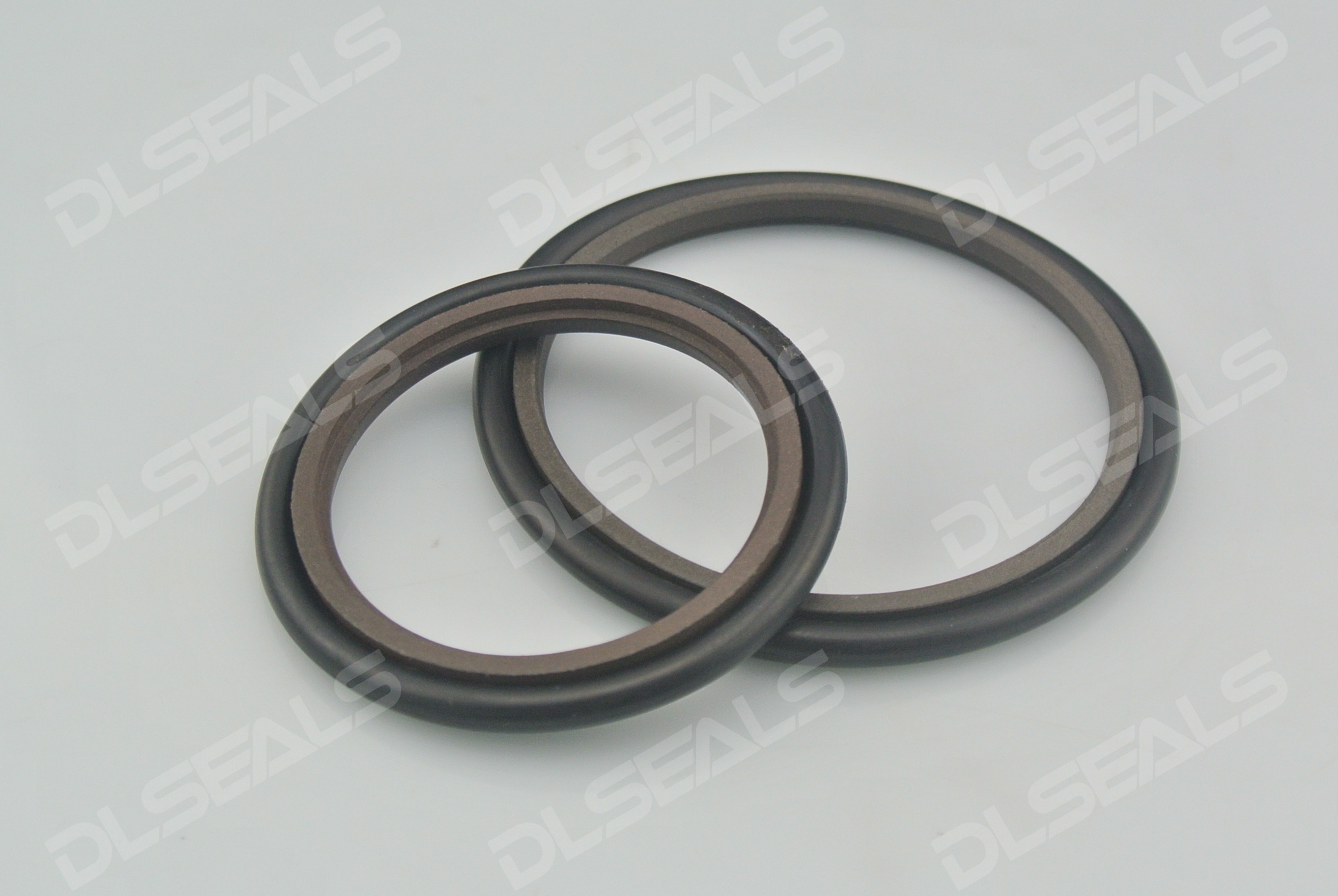
The GSJ rod step seal is a commonly used combination seal for hydraulic piston rods and other reciprocating applications. It is primarily used in hydraulic cylinders and similar equipment. Its typical construction consists of a stepped PTFE sliding ring and an elastic energizing element. As the main sealing material, PTFE filled with bronze offers low friction, good wear resistance, and dimensional stability, making it suitable for medium- and high-pressure applications involving frequent reciprocating movement.
Compared with conventional rubber seals, the GSJ rod step seal uses a PTFE composite material as the primary sliding sealing element, while an elastic component provides preload. This combination helps balance sealing performance and friction characteristics.
1. Structure of the GSJ Rod Step Seal
The GSJ rod step seal generally features a compact combination design consisting of two main components:
1. PTFE + Bronze Filled Sealing Ring
The sealing ring usually has a stepped or asymmetrical cross-sectional design and serves as the main working component of the sealing system. It is generally made from PTFE filled with bronze powder. The bronze filler improves the mechanical properties and wear resistance of the material.
PTFE itself has a low coefficient of friction and excellent chemical resistance. However, pure PTFE is prone to creep and cold flow under sustained pressure. Adding bronze powder can improve its load-bearing capacity, resistance to deformation, and wear performance, making it more suitable for reciprocating hydraulic rod applications.
2. Elastic Energizing Element
A conventional GSJ configuration commonly uses a rubber O-ring installed behind the PTFE sealing ring. The O-ring provides radial preload to the sealing ring. After installation, the O-ring is compressed and generates an elastic force that keeps the PTFE sliding ring in contact with the rod surface.
As the sealing ring gradually wears, the elasticity of the O-ring can compensate for part of the wear within a certain range, helping maintain sealing contact.
Depending on the operating medium and temperature, the O-ring can be made from materials such as NBR or FKM. The actual configuration should be confirmed according to the product drawing and order specifications.
2. Working Principle of the GSJ Rod Step Seal
The GSJ rod step seal achieves sealing through the combined effects of elastic preload and system pressure.
At low pressure, or before system pressure is established, the O-ring behind the PTFE ring provides elastic compression. This pushes the stepped PTFE ring against the rod surface, creating initial sealing contact pressure.
When hydraulic pressure builds up, the working fluid acts on the sealing structure and increases the contact force between the PTFE ring and the sealing surface, thereby enhancing the sealing effect. As system pressure changes, the structure can adjust its contact condition within a certain operating range.
Since the PTFE ring slides directly against the rod surface, its low coefficient of friction helps reduce movement resistance, starting friction, and frictional wear during operation.
It should be noted that a conventional rod step seal is generally a unidirectional pressure seal designed to prevent hydraulic fluid from leaking from the pressure side to the external environment. If the equipment must withstand pressure from both directions, a back-to-back arrangement or another suitable bidirectional sealing solution may be required.
3. Performance Advantages of PTFE + Bronze Material
The performance of a GSJ rod step seal is closely related to its PTFE compound formulation. Compared with virgin PTFE, bronze-filled PTFE offers certain advantages in mechanical strength and friction and wear performance.
1. Good Wear Resistance
Bronze filling can improve the load-bearing and wear characteristics of PTFE. This helps the sealing ring withstand prolonged reciprocating movement of the hydraulic rod. In hydraulic equipment with frequent movement and long strokes, this characteristic can contribute to longer seal service life.
2. Low Friction Coefficient
PTFE has excellent low-friction properties. With bronze-filled PTFE, the sealing ring can retain good sliding characteristics, helping reduce frictional resistance during rod movement.
Compared with conventional rubber seals, this type of structure generally offers lower starting friction and can help reduce stick-slip behavior during low-speed movement, contributing to smoother hydraulic actuator operation.
3. Improved Resistance to Deformation
Although virgin PTFE has excellent chemical stability, it is susceptible to cold flow and creep under sustained compression and high pressure. Bronze filling increases material rigidity and resistance to compressive deformation, helping reduce dimensional changes under long-term loading.
However, bronze filling does not completely eliminate PTFE creep. Proper control of sealing clearances, groove dimensions, and operating pressure remains essential.
4. Good Chemical Resistance
The PTFE matrix provides resistance to many chemical media. Therefore, bronze-filled PTFE can be used in various hydraulic fluid environments. However, the presence of bronze does not mean the material is compatible with every corrosive medium. The compatibility of the bronze component must also be considered, particularly in strongly corrosive environments.
4. Suitable Applications of GSJ Rod Step Seals
GSJ rod step seals are primarily designed for reciprocating hydraulic rod sealing, particularly in equipment requiring good friction characteristics, wear resistance, and pressure performance.
- Construction machinery hydraulic systems: Rod sealing in hydraulic cylinders used in excavators, bulldozers, loaders, and lifting equipment. These applications often involve frequent reciprocating movement, pressure fluctuations, and impact loads.
- Hydraulic presses and pressure equipment: Suitable for rod sealing positions in hydraulic presses, forging equipment, and industrial pressure systems requiring reliable sealing performance.
- Injection molding and forming equipment: Hydraulic actuators in injection molding machines, die-casting equipment, and other forming machinery, where frequent operation creates friction and wear.
- Metallurgical and heavy machinery: Can be considered for certain rolling mill equipment, heavy-duty hydraulic systems, and industrial control equipment, depending on pressure, speed, and fluid conditions.
- High-frequency reciprocating systems: Suitable for hydraulic actuators that require reduced starting friction, smooth movement, and good wear resistance.
For actual applications, selection must take into account rod diameter, radial clearance between the rod and groove, operating speed, pressure, temperature, fluid, and installation groove dimensions. The performance range cannot be determined from the GSJ designation alone.
5. GSJ Rod Step Seals Compared with Conventional Rubber Seals
Conventional rubber U-cup and Y-shaped seals generally rely on the elasticity of the rubber and their lip geometry to achieve sealing. In contrast, the GSJ rod step seal uses PTFE composite material as the primary sliding sealing element, with an elastic component providing preload. The two designs therefore differ in both construction and performance.
| Comparison | GSJ Rod Step Seal (PTFE + Bronze) | Conventional Rubber Seal |
|---|---|---|
| Main material | Bronze-filled PTFE + elastic energizer | NBR, FKM, and other elastomers |
| Friction characteristics | Low | Generally higher |
| Wear resistance | Good, depending on formulation | Depends on compound and design |
| Extrusion resistance | Good potential; still affected by clearance and pressure | Often requires backup rings under high pressure |
| Low-speed operation | Helps reduce stick-slip | Some designs may experience stick-slip or crawling |
| Elastic recovery | Mainly provided by the rear energizer | Provided by the rubber itself |
| Construction | Combination design | Usually a one-piece design |
The main advantages of the GSJ step seal are low friction, wear resistance, and good adaptability to high-pressure conditions. It is particularly suitable for hydraulic systems requiring frequent reciprocating movement. However, it is not necessarily superior to rubber seals in every application. For low-pressure equipment with simple sealing requirements and cost constraints, conventional rubber seals can still be an economical solution.
6. Selection and Installation Considerations
To ensure reliable sealing performance and service life, several factors should be considered when selecting a GSJ rod step seal.
First, the operating pressure and radial clearance between the rod and sealing groove must be evaluated. Under high-pressure conditions, excessive clearance may cause extrusion or localized damage to the PTFE sealing ring. The mating clearance should therefore be designed according to the pressure requirements. Appropriate anti-extrusion measures may be necessary.
Second, the rod surface finish is important. Excessive surface roughness can accelerate seal wear, while scratches or an unsuitable surface profile may create leakage paths. The rod surface roughness, hardness, and machining quality should comply with the sealing design requirements.
The O-ring material must also be selected according to the working fluid and temperature. Even if the PTFE sealing ring offers a wide range of chemical and temperature resistance, the rear O-ring may become the limiting component of the entire sealing assembly.
For high-frequency operation, long strokes, or pressure surges, additional attention should be paid to seal wear, lubrication conditions, guide support, and installation quality. Proper groove design and correct installation are essential for long-term sealing stability.
Conclusion
The GSJ rod step seal is a combination sealing solution designed for reciprocating hydraulic rod applications. It uses bronze-filled PTFE as the main sealing ring and an elastic energizing element to provide initial sealing force, achieving a practical balance between low friction, wear resistance, and pressure performance.
Compared with conventional rubber seals, it is more suitable for hydraulic equipment requiring smooth operation, good wear resistance, and reliable sealing under relatively high pressure. Typical applications include construction machinery, hydraulic presses, injection molding equipment, and heavy industrial machinery.
For different pressure, temperature, fluid, and movement conditions, the PTFE filler formulation, O-ring material, and sealing structure must be selected appropriately. DLSEALS provides customized PTFE + bronze rod step seals and other combination sealing products according to customer dimensions, operating conditions, and technical drawings.
Post time: Nov-18-2026


