
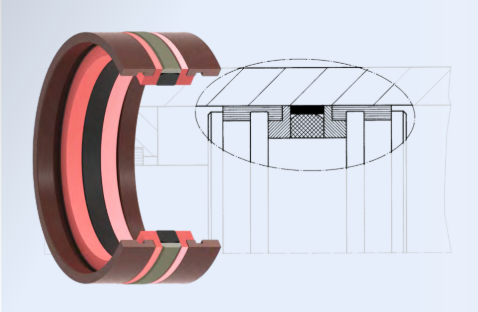
In modern industrial hydraulic systems—especially in demanding environments like coal mine hydraulic supports, heavy excavators, and large forging equipment—piston sealing systems must withstand not only extremely high static pressure but also severe pressure pulses and complex radial loads. The GDKK 5-Piece Compact Seal has become the preferred solution for these extreme conditions due to its unique integrated design.
1. The Logic of GDKK Structure: From “Segmented” to “Integrated”
Traditional piston seals often require separate machining for sealing grooves and guide ring grooves, which increases the axial length of the piston and elevates manufacturing costs. The core design philosophy of the GDKK is to integrate three major functions into a single groove: primary sealing, anti-extrusion, and radial guidance.
The structure consists of five precision components:
-
Multi-Lobed Elastomer (Core Seal): Located at the center, typically made of high-performance Nitrile Rubber (NBR). The multi-lip design creates multiple contact points under high pressure, effectively enhancing sealing reliability.
-
L-Shaped Support Rings (Symmetrically Distributed): Positioned on both sides of the elastomer, made of high-hardness Polyester Elastomer (TPE). These rings fill the sealing gap and protect the elastomer from “root extrusion” under pressures exceeding 35 MPa.
-
Integrated Guide Rings (Outer Support): Located on the outermost layers, made of high-strength Polyoxymethylene (POM) or modified Nylon. In addition to acting as the final anti-extrusion barrier, they provide the radial support function between the piston and the cylinder bore.
2. Core Technical Advantages
Superior Anti-Impact and Anti-Extrusion Performance
During the reciprocating motion of heavy machinery, instantaneous impact pressures often far exceed the system’s rated pressure. The GDKK’s L-shaped support rings and guide rings form a stepped support system. When the central rubber deforms under pressure, the force is transmitted layer by layer, ensuring the primary seal remains securely contained even when larger extrusion gaps are present.
Maximum Compression of Axial Space
Because the GDKK includes built-in guiding functions, engineers do not need to reserve additional space for guide strips on the piston. This allows for a shorter, more compact piston design, reducing material costs and enabling cylinder placement in restricted spaces.
Elimination of “Metal-to-Metal Contact” Risks
Under high loads, pistons are prone to eccentric movement. The wide-faced POM guide rings of the GDKK offer excellent load-bearing capacity and self-lubrication. They absorb radial forces and prevent the metal piston components from directly scratching the inner wall of the cylinder, significantly extending the service life of the cylinder barrel.
3. Key Technical Specifications
4. Application and Installation Recommendations
Fields of Application: GDKK seals are widely used in mobile machinery and heavy industry where working conditions are extremely harsh, particularly for double-acting piston cylinders that require strict leakage control and face significant vibration or shock.
Installation Points:
-
Groove Inspection: Before installation, strictly check the grooves and the lead-in chamfer of the cylinder barrel. Ensure there are no burrs to prevent scratching the guide rings.
-
Installation Sequence: Install the central elastomer first, then symmetrically insert the L-shaped support rings, and finally snap the split-type guide rings into place.
-
Lubrication: It is recommended to apply the system’s compatible hydraulic oil to the surface of the seals before assembly to reduce initial assembly friction.
5. Conclusion
As a highly integrated sealing system, the GDKK 5-Piece Compact Seal achieves a perfect balance between performance and space through scientific material pairing and tight structural coupling. For hydraulic equipment pursuing long life and high stability, the GDKK is not just a sealing component—it is a core guarantee for the continuous output of power in high-pressure environments.
Post time: Apr-01-2026