
Hollow Metal O-Rings, also known as hollow metal sealing rings or metal O-ring seals, are annular static sealing elements precision-formed from high-strength thin-walled seamless metal tubing. Their cross-section is typically circular (customizable to C-shaped, elliptical, etc.) and they are widely used in aerospace, nuclear power, petrochemical, semiconductor vacuum equipment, and high-temperature high-pressure valves. Compared with traditional rubber O-rings or solid metal gaskets, the most distinctive feature of hollow metal O-rings is their unique self-adaptive sealing principle: through the synergistic effect of tube wall elastic-plastic deformation and system pressure, they achieve full-process sealing from initial contact to pressure self-enhancement. This article focuses on the sealing principle of hollow metal O-rings, providing a professional and detailed technical analysis covering basic structure, working mechanism, deformation characteristics, pressure self-adaptive effect, comparison of different types, and design essentials.
1. Basic Structure and Sealing Interface
The core of a hollow metal O-ring is a thin-walled hollow tubular structure, with wall thickness typically 0.1–0.5 mm and tube diameter 0.5–10 mm. During installation, it is placed in a metal groove and compressed by axial or radial preload. The sealing interface is primarily formed by the outer surface of the tube wall in contact with the groove or flange face.
In the initial state, the hollow tube has a circular cross-section. Under compression, the tube wall undergoes local flattening deformation, forming a sealing band of certain width in the contact zone. This deformation simultaneously generates initial contact stress (generally 5–50 MPa), which is sufficient to fill microscopic surface irregularities (Ra 0.8–1.6 μm) and achieve preliminary gas-tight or liquid-tight sealing.
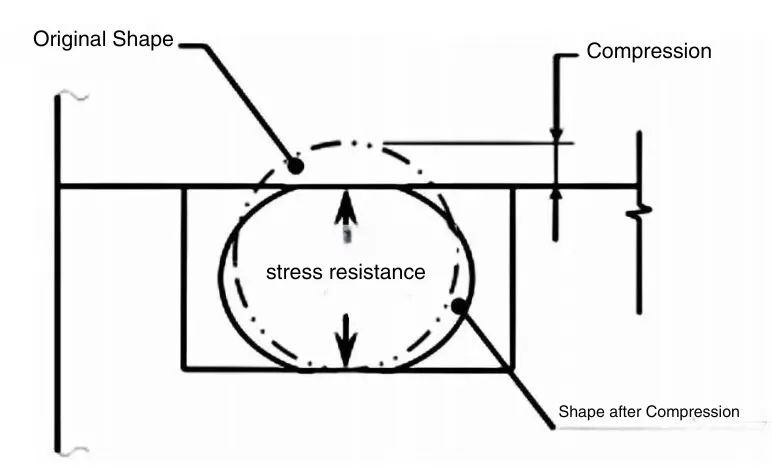
(The above image is a schematic diagram of hollow metal O-ring compression deformation, clearly showing the change from original shape to compressed shape and stress distribution.)
2. Core Sealing Principle: Compression Deformation + Pressure Self-Adaptation
The sealing principle of hollow metal O-rings can be divided into two stages:
1. Initial Compression Sealing Stage Preload is applied during installation (typical compression ratio 10%–35%), causing elastic deformation of the tube wall (partially entering the plastic zone). According to Hooke’s law and finite element analysis, contact stress σ mainly comes from the bending stiffness and resilience of the tube wall. At this stage, sealing relies on the metal’s elastic modulus (much higher than rubber) to maintain contact pressure, remaining effective even in low-temperature or high-vacuum environments without material aging.
2. System Pressure Self-Adaptive (Self-Energizing) Stage When internal system pressure increases, the sealing principle exhibits significant self-adaptive characteristics:
- Self-Energized Type (with holes): Micro-holes in the tube wall allow medium pressure to enter the hollow interior directly, pushing the tube wall outward from inside and further increasing contact zone stress. The higher the pressure, the greater the contact stress, creating a “pressure self-tightening” effect.
- Non-Self-Energized Type: Medium pressure acts directly on the outer wall, also increasing contact width through tube wall deformation.
- Gas-Filled Type: Pre-filled with inert gas (e.g., nitrogen). As temperature rises, internal pressure increases synchronously, compensating for contact stress reduction caused by thermal expansion—particularly suitable for high-temperature cycling conditions.
Finite element simulation shows that as compression δ increases from 0 to 0.9 mm, the Von Mises stress distribution shifts from uniform to concentrated in the contact zone, with contact width increasing by 20%–50%, significantly reducing leakage rate to the order of 10⁻⁹ mbar·L/s.
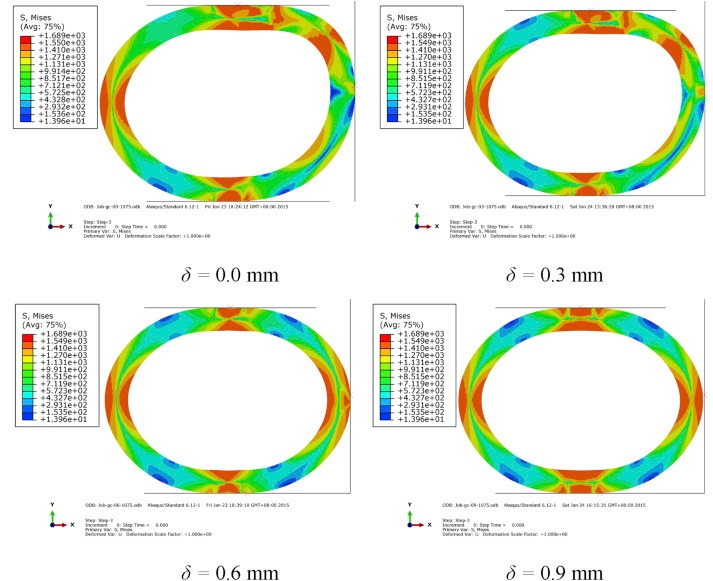
(The above image shows Von Mises stress cloud diagrams of metal O-rings under different compression amounts, clearly illustrating stress concentration and distribution changes during compression.)
3. Comparison of Sealing Mechanisms Among Different Types of Hollow O-Rings
- Basic Type (Plain Hollow O-Ring): No holes, sealing relies purely on compression deformation. Suitable for medium to low pressure (≤40 MPa), with sealing force mainly from preload.
- Self-Energized Type (Self-Energized / Pressure-Filled): With holes, system pressure assists in enhancing contact force. Suitable for high pressure (>50 MPa), with pronounced self-tightening effect.
- Gas-Filled Type (Gas-Filled / Inflated): Internally pre-pressurized with gas. Internal pressure adjusts synchronously with temperature changes to maintain constant contact stress, ideal for high-temperature and high-pressure cycling (e.g., nuclear reactors, gas turbines).
- Coated Enhanced Type: Surface plated with silver, gold, or PTFE to further reduce initial friction and leakage, improving sealing performance in high-vacuum or clean environments.
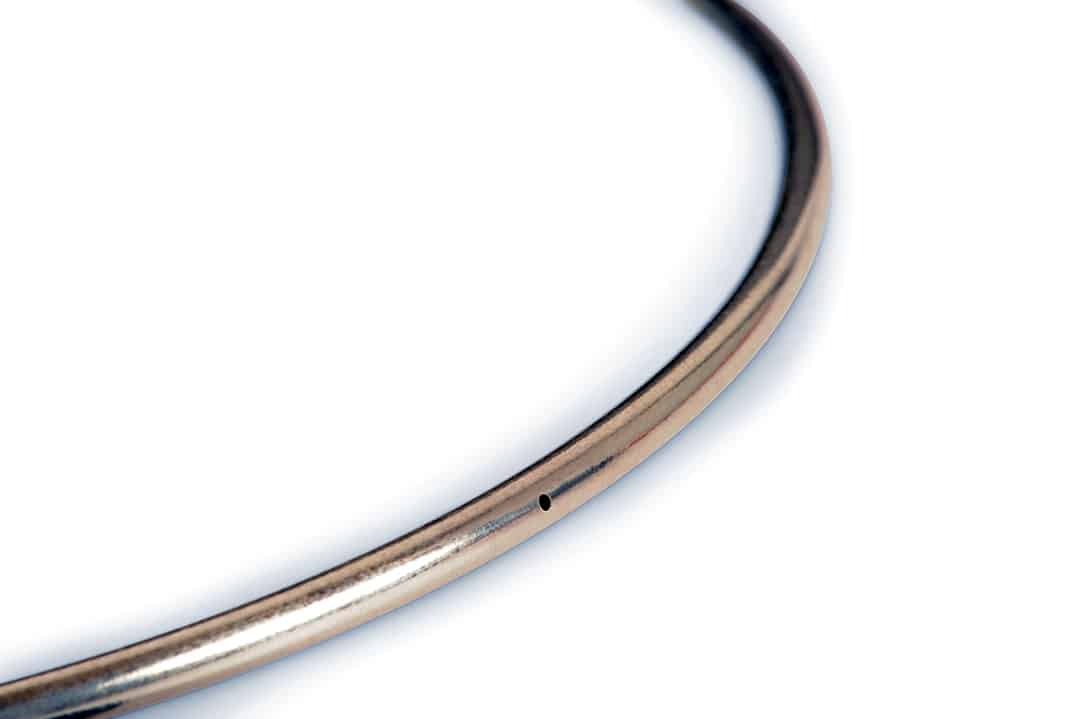
(The above images show physical examples of different types of hollow metal O-rings and details of the perforated self-energized type.)
4. Factors Affecting Sealing Performance and Design Essentials
Sealing effectiveness depends on the following key factors:
- Compression Ratio: Too low causes initial leakage; too high leads to permanent plastic deformation. Recommended range is 10%–35%, optimized specifically by FEA.
- Groove Design: Groove width, depth, and surface roughness (Ra ≤0.8 μm) directly affect contact width and stress distribution. Sharp corner stress concentrations must be avoided (fillet R ≥0.2 mm).
- Material Selection: Inconel 718/625 (high temperature and pressure), SUS316L (corrosion resistance), titanium alloy (lightweight high vacuum).
- Medium and Operating Conditions: Self-energizing effect is more pronounced under high pressure; thermal expansion matching must be considered at high temperatures.
Leakage rate is usually measured by Helium Mass Spectrometer detection, combined with contact stress models for prediction. In practical engineering, nonlinear contact simulation using ANSYS or ABAQUS is recommended to verify sealing reliability under different pressures and temperatures.
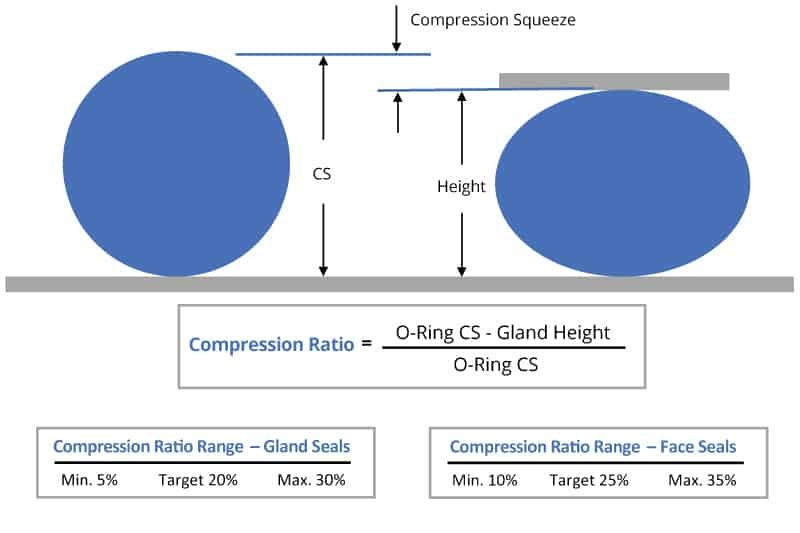
(The above image is a schematic diagram of O-ring compression ratio calculation; metal hollow O-ring design can refer to similar compression mechanisms.)
5. Application Advantages and Limitations
Advantages:
- Extreme temperature range (-270°C to 1000°C+);
- Compatibility with ultra-high pressure and high vacuum;
- No aging, no extrusion, no contamination;
- Reusable with low maintenance cost.
Limitations:
- Precise preload control is required during initial installation;
- Not suitable for high-speed relative motion (primarily static sealing);
- Higher manufacturing cost than rubber O-rings.
Conclusion
The core sealing principle of hollow metal O-rings lies in the synergistic self-adaptation of thin-walled tubular elastic deformation and system pressure. Initial compression provides basic sealing force, while the pressure self-energizing (or gas-filled compensation) mechanism achieves the dynamic response of “higher pressure, more reliable sealing.” This principle makes it one of the most reliable static sealing solutions for extreme conditions in aerospace, nuclear power, and petrochemical industries. For engineers, a deep understanding of its deformation characteristics, stress distribution, and self-tightening mechanism is key to groove optimization, material selection, and reliability design. In practical applications, it is recommended to combine finite element analysis, bench testing, and helium leak detection to ensure sealing performance meets design requirements.
Post time: Apr-21-2026


