
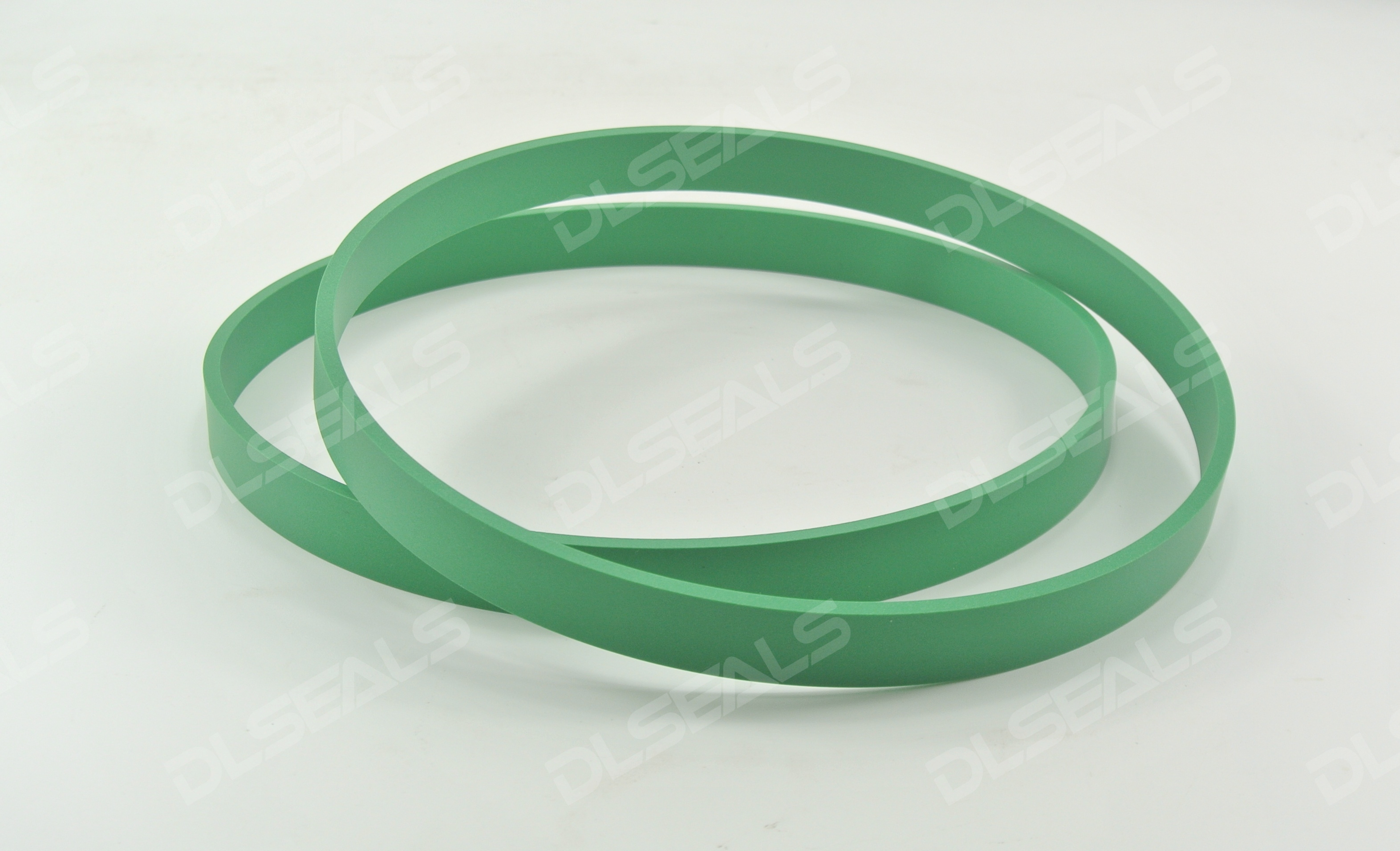
Guide strips and guide rings are among the most critical guiding elements (also commonly called wear rings, support rings, guide rings, or wear bands / guide strips) in hydraulic and pneumatic cylinder systems. Though small in size, they directly impact the service life, motion smoothness, sealing reliability, and overall system performance of cylinders.
I. Basic Definitions and Differences
- Guide Ring Typically a closed circular ring (or an open ring with a scarf cut for easy installation), directly embedded into dedicated grooves on the piston or piston rod. It has a fixed shape and forms a complete circumferential support once installed.
- Guide Strip / Guide Tape Supplied in coil form or as straight strips; cut to the required length on-site according to the shaft or bore diameter, then wrapped or placed into the groove. Some high-end guide strips feature 30° or 45° scarf cuts at both ends for precise butt-jointing, creating a near-closed ring.
Quick mnemonic: Rings are ready-to-install finished products; strips are cut and wrapped in the field.
II. Core Functions (Why They Are Indispensable?)
Modern hydraulic and pneumatic systems have long moved away from traditional metal-to-metal direct guidance (e.g., bronze bushings), because side loads (radial forces) can cause severe consequences. Guide strips and rings are the key components that solve this problem. Their primary functions include:
- Bearing radial loads (side forces) and protecting primary seals from eccentric extrusion.
- Preventing metal-to-metal contact (between piston/piston rod and barrel/gland), avoiding scoring, galling, scratches, or cylinder bore damage.
- Ensuring coaxiality and linear motion accuracy of the piston and piston rod.
- Reducing frictional resistance, minimizing breakaway force and stick-slip phenomena.
- Absorbing vibration and shock, lowering system noise.
- Extending seal service life (by reducing uneven wear, extrusion, and premature failure).
- In some designs, providing auxiliary limiting or dust-scraping functions.
One-sentence summary: Without good guidance, there can be no reliable sealing or long-lasting hydraulic cylinders.
III. Common Material Comparison
Current mainstream materials for guide strips and rings fall into three main categories:
| Material Type | Representative Composition | Load Capacity | Speed Rating | Temperature Range | Key Features & Typical Applications | Relative Price |
|---|---|---|---|---|---|---|
| Filled Modified PTFE | PTFE + Bronze / Graphite / Carbon Fiber | ★★★★ | ★★★★★ | -60°C ~ +260°C+ | Lowest friction, self-lubricating, best wear resistance, ideal for high speeds | Medium-High |
| Polyoxymethylene (POM) | Pure POM or modified POM | ★★★★ | ★★★ | -40°C ~ +120°C | High strength, excellent dimensional stability, highest cost-performance | Medium-Low |
| Phenolic Resin + Fabric | Phenolic resin-impregnated fabric (cloth) | ★★★★★ | ★★ | -50°C ~ +130°C | Highest load-bearing capacity, preferred for heavy-duty, low-speed applications | Medium |
- Premium brands (e.g., Trelleborg Slydring®, SKF, Hallite) predominantly use bronze-filled PTFE or specially modified PTFE for an optimal balance of low friction and high load capacity.
- Mid-to-low-end or heavy-load applications often rely on phenolic fabric or high-strength POM.
IV. Typical Installation Locations
- Piston guidance: Installed in grooves on both sides of the piston (usually flanking the piston seals).
- Piston rod guidance: Installed in grooves on the piston rod (typically before the rod seal, close to the gland/bushing position).
Most modern cylinder designs incorporate dual guidance — both piston guidance and rod guidance — for enhanced stability.
V. Key Selection Points Often Overlooked
- Wall thickness vs. groove depth matching — Too thin leads to deformation; too thick interferes with seals.
- Cut/joint style — 30°/45° scarf joints are far more stable than straight butt joints.
- Surface structure — Dimpled / spiral-grooved / smooth; smooth offers lowest friction but poorer oil retention; grooved versions perform better in contaminated environments.
- Operating temperature and medium — High-temp applications favor pure PTFE bases; low-temp or water-based fluids require careful POM selection.
- Actual side-load estimation — Many engineers focus only on working pressure, yet real radial forces can be 1.5–3 times higher.
VI. Final Summary
Guide strips and guide rings are the “low-profile yet decisive” components in hydraulic and pneumatic systems — they don’t seal directly, but they determine whether the entire moving assembly can maintain coaxiality, low wear, low noise, and high efficiency over the long term. Choosing the right guidance elements often extends cylinder life far more effectively than simply upgrading seals.
In design and maintenance practice, follow this golden rule: Better to pay a little more than allow metal-to-metal contact. The cost of repairing a scored cylinder almost always far exceeds the price of high-quality guide strips or rings.
Post time: Jan-20-2026