
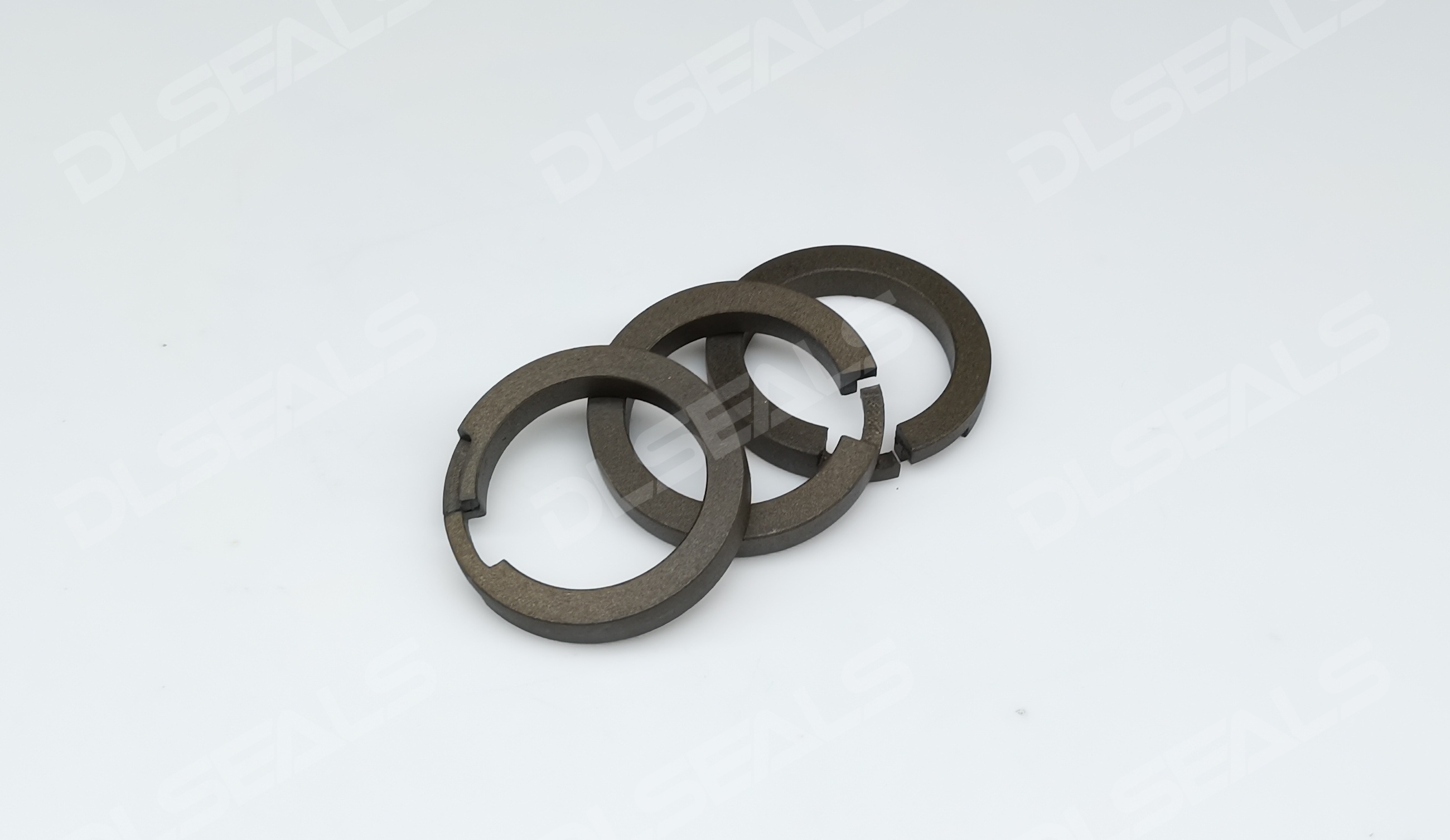
In the field of industrial sealing, Polytetrafluoroethylene (PTFE) is renowned as the “Plastic King” due to its exceptional chemical resistance, broad temperature range, and extremely low coefficient of friction. However, pure PTFE material also has significant weaknesses, such as susceptibility to creep (cold flow), average wear resistance, and poor thermal conductivity. To overcome these drawbacks and meet more demanding industrial requirements, filled and modified PTFE materials were developed. Among them, the PTFE with Carbon Fiber Sealing Ring is a shining star among modified materials, achieving a comprehensive breakthrough in performance through a powerful synergy.
1. Performance Enhancements: A Leap from “Excellent” to “Outstanding”
Compared to pure PTFE seals, the addition of carbon fibers brings a transformative change to PTFE, mainly reflected in the following aspects:
1. Significantly Enhanced Wear Resistance (Core Breakthrough)
- Pure PTFE: Relatively soft, prone to wear and deformation under repeated friction and high pressure, limiting its service life.
- PTFE + Carbon Fiber: The carbon fibers act like countless microscopic “reinforcing bars” embedded in the PTFE matrix. Their high hardness and strength drastically enhance the composite material’s resistance to abrasion. Its wear resistance can be hundreds of times greater than pure PTFE, making it particularly suitable for high-speed reciprocating and rotary sealing applications, significantly extending service life.
2. Improved Mechanical Strength and Creep Resistance (Anti-Cold Flow)
- Pure PTFE: Exhibits significant cold flow, meaning it undergoes slow plastic deformation under sustained pressure, leading to seal force decay and leakage.
- PTFE + Carbon Fiber: Carbon fibers significantly increase the material’s compressive strength and modulus, greatly enhancing its resistance to permanent deformation. The sealing ring can better maintain its shape and preload under long-term high pressure, ensuring more durable and reliable sealing.
3. Improved Thermal Conductivity
- Pure PTFE: A poor conductor of heat. In conditions with significant frictional heat generation, heat can accumulate, causing material aging, softening, and accelerated failure.
- PTFE + Carbon Fiber: Carbon fibers have good thermal conductivity, allowing them to rapidly dissipate frictional heat away from the sealing interface. This effectively lowers the operating temperature, preventing seal failure due to overheating and broadening its application in high-speed, high-pressure, and high-power-density scenarios.
4. Significantly Higher Limiting PV Value
The PV value is a key indicator for sealing materials, where P represents Pressure and V represents Velocity. A high PV value means the material can withstand higher combinations of speed and pressure.
- Pure PTFE: Has a relatively low PV value, limiting its application range.
- PTFE + Carbon Fiber: Thanks to its excellent wear resistance and thermal conductivity, its limiting PV value is greatly increased, enabling it to handle more severe operating conditions, making it an ideal choice for dynamic seals.
Despite these enhancements, note that: The addition of carbon fiber slightly reduces the material’s elasticity, and due to increased hardness, it demands higher surface hardness and finish on the mating shaft or cylinder bore. Also, carbon fibers might be unsuitable in specific media involving strong oxidizing agents (e.g., concentrated nitric acid), requiring careful selection.
2. Summary of Core Advantages
Synthesizing the above performance enhancements, PTFE with carbon fiber seals offer the following significant advantages:
- Extended Service Life: Superior wear resistance translates to less downtime for replacements and reduced maintenance costs.
- High Reliability: Excellent creep resistance and mechanical strength ensure stable sealing under fluctuating pressures.
- Broad Application Range: High PV value allows it to handle both high-speed and high-pressure challenges simultaneously.
- Retains Inherent PTFE Advantages: Maintains excellent chemical resistance (except to few media), a wide temperature range (approximately -50°C to +250°C), and self-lubrication (low friction coefficient).
3. Common Application Scenarios
Leveraging their comprehensive performance, PTFE with carbon fiber seals are widely used in high-demand sectors:
1. Automotive Industry
- Engine: Turbocharger bearing seals, Exhaust Gas Recirculation (EGR) systems, resisting high temperatures and media corrosion.
- Transmission: Rotary shaft seals, handling high-speed rotation and gear oil.
- Braking Systems: Vacuum pump seals, requiring low friction and long life.
- New Energy Vehicles: Key components in high-pressure fuel cell systems, such as hydrogen circulation pumps and air compressors.
2. Chemical and Process Industry
- Shaft seals for various corrosion-resistant pumps, compressors, and agitators, handling corrosive media like acids, alkalis, and organic solvents, while withstanding pressure and speed.
3. Aerospace and Defense
- Aircraft landing gear actuators, engine-related accessories, missile hydraulic systems, where seals must perform flawlessly under extreme temperatures, high pressure, and severe shock.
4. Heavy Machinery and Hydraulic Systems
- Hydraulic cylinder piston rod seals in construction machinery (e.g., excavators, loaders), enduring high pressure, frequent reciprocating motion, and external contamination.
5. Food and Pharmaceutical Machinery
- Used in rotating equipment requiring hygiene standards and harsh conditions (e.g., homogenizers, high-speed mixers), leveraging wear resistance and resistance to cleaning agents (using food-grade compliant raw materials is essential).
Conclusion
The PTFE with carbon fiber sealing ring is not a simple replacement for traditional PTFE seals but a strategic upgrade for high-end industrial applications. It perfectly combines PTFE’s chemical inertness and low friction with the high strength, wear resistance, and thermal conductivity of carbon fibers, successfully addressing the key pain points of pure PTFE in dynamic sealing. In an era that prioritizes equipment reliability, long operational cycles, and low maintenance costs, it has become the preferred sealing solution for demanding applications, continuously driving progress in industrial technology.
Post time: Dec-01-2025