
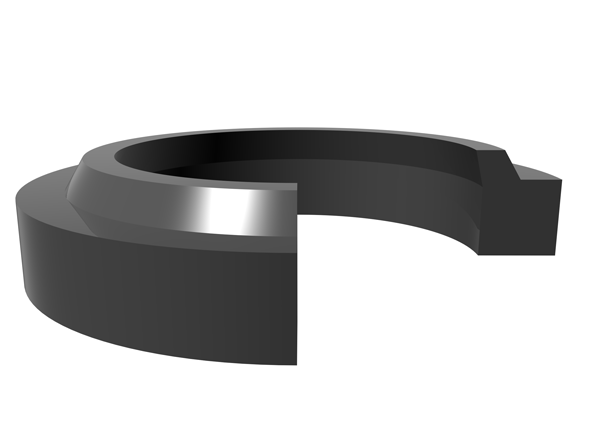
In hydraulic and pneumatic transmission systems, contamination control is crucial for ensuring system reliability and extending component service life. As the first line of defense, the role of the scraper seal is paramount. Among the various types of dust seals, the J-Scraper (or J-Type Wiper) is one of the most widely adopted solutions due to its simple structure, reliable performance, and cost-effectiveness.
I. Definition and Basic Structure of the J-Scraper
The J-Scraper, named for its cross-section resembling the letter “J”, is a uni-directional, lip-type sealing element designed for excluding contaminants. Its basic structure consists of two functional parts:
- Sealing Lip (Wiping Lip): A flexible lip with a sharp or rounded edge that creates an interference fit with the piston rod or shaft surface. This is the core component responsible for scraping off contaminants.
- Installation and Support Section: A thicker base that provides structural strength and facilitates secure installation, often featuring a groove-clamping design.
Common materials include:
- Nitrile Rubber (NBR): The most common choice, offering good wear resistance, compatibility with mineral oils and greases, and high cost-effectiveness.
- Polyurethane (PU/AU): Available in a wide range of hardnesses, it provides excellent wear and extrusion resistance, suitable for heavy-duty, high-pressure, and harsh conditions.
- Fluorocarbon Rubber (FKM): Used for extreme temperature environments and resistance to corrosive media (e.g., phosphate ester hydraulic fluids).
II. Working Principle and Core Functions
The J-Scraper operates on the principle of scraping and retention:
- Positive Scraping (Primary Function): As the piston rod retracts from the external environment into the system, contaminants such as dust, moisture, and chips adhering to the rod surface are effectively scraped off by the sharp edge of the sealing lip. The scraped-off contaminants accumulate in front of the lip (outside), preventing them from entering the system.
- Reverse Sealing (Secondary Function): Some J-Scraper designs offer a degree of reverse sealing capability. When internal pressure is low or the rod is stationary, the lip can lightly contact the rod surface to prevent excessive leakage of internal lubricating oil film. However, its primary function is notpressure sealing.
Its core function is clearly defined: Specifically designed for dust exclusion, with the auxiliary function of scraping excess oil film from the rod to maintain cleanliness. It is not intended to act as the primary seal against system operating pressure.
III. Typical Application Scenarios
The J-Scraper is a standard component in the following equipment:
- Hydraulic and Pneumatic Cylinders: Installed in the wiper seal groove of the cylinder end cover, it is an essential part of both hydraulic and pneumatic cylinders, especially in construction machinery (excavator, loader cylinders), agricultural equipment, and machine tools.
- Linear Motion Guide Mechanisms: Used at the ends of lead screws, linear guide shafts, etc., to prevent dust ingress that could affect precision and lifespan.
- Automotive Industry: Applied in shock absorber piston rods, clutch release bearings, etc.
- General Industrial Equipment: Required wherever rods or shafts reciprocate and are exposed to the external environment.
In practical applications, it is often used in combination with the primary seal (e.g., Step Seal, Glyd Ring, U-Cup) and guide rings/strips to form a complete piston rod sealing system.
IV. Key Points for Design, Selection, and Installation
To ensure optimal performance of the J-Scraper, the following technical requirements must be followed:
- Operating Condition Analysis:
- Contaminant Type: Dust, mud, water, chemical splash, etc.
- Ambient Temperature and Media Compatibility: Select material based on temperature range and contact media (oil, water, chemicals).
- Reciprocating Speed and Frequency: Affects lip wear and heat generation.
- Structure and Material Selection:
- NBR is suitable for standard dusty environments.
- Polyurethane should be prioritized for heavy-duty, high-wear, or environments with gritty mud/water (e.g., construction machinery).
- J-Scrapers with metal casings can be chosen for enhanced stability in limited installation spaces.
- Installation and Groove Design:
- Installation Direction is Critical: The lip must face the external environment. Reversed installation will scrape contaminants intothe system, accelerating failure.
- Groove dimensions must comply with national standards (e.g., GB/T 10708.3) or industry specifications to ensure proper compression and fill ratios.
- During installation, the piston rod end should be chamfered or rounded, and installation tools should be used to prevent lip damage or rolling during passage over threads or grooves.
- Maintenance Points:
- Regularly inspect the scraper lip for hardening, cracking, severe wear, or rolling.
- During replacement, thoroughly clean the installation area and inspect the piston rod surface for scratches, corrosion, or wear. A damaged rod will quickly destroy a new scraper.
Conclusion
As a mature and classic sealing technology, the value of the J-Scraper lies in solving the fundamental problem of contaminant ingress for moving parts with an extremely simple structure and reliable performance. In system design, correctly understanding its functional limits (primarily for dust exclusion, not pressure sealing), scientifically selecting it based on specific operating conditions, and strictly following installation and maintenance specifications are the cornerstones for maximizing its effectiveness and ensuring the long-term stable operation of the entire hydraulic or pneumatic system. The role of this fundamental component cannot be overlooked in the pursuit of high reliability and long service life in modern industrial equipment.
Post time: Feb-25-2026