
Crystallization equipment is widely used in the chemical, pharmaceutical, food processing, environmental protection, and fine chemical industries. It is primarily designed for solution concentration, solute separation, and crystal production. Common equipment includes MVR evaporative crystallizers, vacuum crystallizers, stirred crystallizers, forced circulation crystallizers, and pharmaceutical crystallization systems.
These systems often operate under demanding conditions involving elevated temperatures, vacuum, pressure fluctuations, corrosive media, and solid-liquid mixtures. Sealing performance at critical locations such as flange connections, end covers, inspection windows, heating assemblies, and rotating shafts directly affects equipment reliability, product quality, and operational safety.
Conventional rubber seals may be sufficient for some standard applications. However, when equipment is exposed to high temperatures, significant pressure variations, stringent vacuum requirements, or aggressive media, metal seals can offer important advantages.
1. Special Sealing Requirements in Crystallization Equipment
Although different crystallizers operate according to different principles, they share several common sealing challenges.
High Temperatures and Thermal Cycling: MVR evaporative crystallizers and some forced circulation systems require continuous heat exchange. Equipment may operate at elevated temperatures for extended periods and experience frequent heating and cooling cycles. Seals must withstand these temperatures and accommodate dimensional changes caused by thermal expansion and contraction.
Vacuum and Gas-Tightness Requirements: Vacuum crystallizers must maintain a stable internal pressure environment. Even minor leakage at flanges, end covers, inspection windows, and other connections can affect vacuum levels and equipment efficiency. These locations therefore require sealing solutions with sufficiently low leakage rates.
Corrosive Media: Chemical and pharmaceutical crystallization processes may involve acids, alkalis, salt solutions, and other aggressive process media. Sealing materials must not only withstand the required temperature and pressure but also maintain chemical compatibility with the actual media.
Crystal Particles and Solid-Liquid Mixtures: Crystallization processes may generate solid particles, deposits, and high-concentration slurries. In rotating components such as agitator shafts and circulation pump shafts, particles can accelerate seal-face wear and interfere with normal sealing operation.
Cleaning and Hygienic Requirements: Pharmaceutical crystallization equipment often requires cleaning, sterilization, and strict contamination control. Sealing structures should minimize media retention and hard-to-clean areas, while materials and surface finishes must meet the requirements of the specific process.
Therefore, sealing design for crystallization equipment must consider not only the seal itself but also the equipment structure, installation location, and actual operating conditions.
2. Metal Hollow O-Rings: High-Tightness Static Sealing
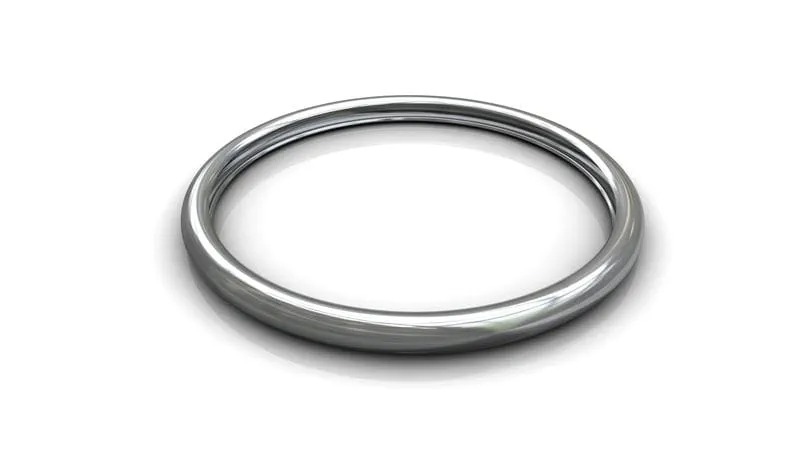
A metal hollow O-ring is a metallic sealing component with a hollow cross-section. It is typically manufactured from metal tubing or thin-walled metal structures and formed into a ring. Sealing is achieved through controlled compression during installation.
Compared with solid metal rings, the hollow structure can provide elastic deformation under relatively low compression loads. Its recovery force helps maintain contact pressure at the sealing interface.
In crystallization equipment, metal hollow O-rings are worth considering for:
- Flange and end-cover sealing in vacuum crystallizers
- High-temperature connections in MVR evaporative crystallizers
- Static sealing of heating chambers and specialized process vessels
- Equipment interfaces requiring low leakage rates
Metal hollow O-rings offer good high-temperature capability, structural stability, and gas-tight sealing performance. By selecting suitable metal materials, wall thicknesses, cross-sectional dimensions, and internal gas-filling configurations, they can be designed for different pressure and temperature conditions.
For vacuum applications, particular attention should be paid to welding quality, material outgassing characteristics, surface condition, and compression requirements. Manufacturing defects or improper installation may compromise the final leakage performance.
3. Metal C-Rings: High-Temperature and High-Pressure Sealing
Metal C-rings feature an open C-shaped cross-section and rely on the elastic deformation of metal to generate sealing contact pressure. Depending on the application, different opening orientations, cross-sectional dimensions, and spring characteristics can be designed.
During installation, compression produces an elastic restoring force that maintains contact pressure at the sealing interface. Certain designs can also incorporate pressure-energized features or specialized cross-sectional geometries to improve sealing performance under specific pressure conditions.
In crystallization equipment, metal C-rings can be considered for:
- Flange sealing in high-temperature evaporators and crystallizers
- End covers, pressure chambers, and equipment connections
- Metallic joints exposed to significant temperature variations
- Static sealing locations requiring long-term sealing stability
Compared with conventional elastomer seals, metal C-rings offer clear material advantages in high-temperature environments. With appropriate material, cross-sectional, and compression design, they can meet the sealing requirements of different equipment configurations.
However, elastic recovery depends heavily on the material, cross-sectional geometry, and compression level. For equipment exposed to frequent thermal cycling, long-term springback performance and repeated sealing capability should be carefully evaluated.
4. Metal W-Type and E-Type Rings: Specialized Sealing Structures
Metal W-type and E-type rings are specialized metallic sealing designs with distinctive cross-sectional geometries. Their shapes and elastic characteristics can be customized according to specific application requirements.
Compared with conventional metal O-rings and C-rings, W-type and E-type structures allow designers to adjust the sealing contact areas, compression behavior, and load distribution through cross-sectional optimization. This makes them suitable for applications with specific installation spaces and sealing requirements.
In crystallization equipment, these seals can be evaluated for:
- High-temperature flanges and equipment interfaces with specialized geometries
- Vacuum chambers and high-tightness connections
- Sealing locations with non-standard groove configurations
- Connections requiring specific installation space, compression loads, or recovery characteristics
The actual performance of W-type and E-type rings depends on their cross-sectional design, material selection, manufacturing precision, and installation conditions. Their pressure capability and sealing performance cannot be determined from the cross-sectional designation alone.
For customized crystallization equipment, these seals can be engineered according to flange configurations, groove dimensions, operating pressure, and temperature range to achieve compatibility with the equipment design.
5. Metal Bellows Seal Assemblies: Dynamic Sealing for Rotating Shafts
In stirred crystallizers, forced circulation crystallizers, and certain MVR-related systems, rotating components such as agitator shafts and pump shafts are critical sealing locations.
Unlike static flange seals, rotating shaft seals must control leakage during continuous operation while accommodating axial displacement, vibration, pressure variations, and temperature changes.
Metal bellows seal assemblies can serve as key elastic components in mechanical seal systems. Through axial deformation, the bellows provide compensation and transmit the closing force required at the sealing faces.
Their main advantages include:
- Elastic Compensation: Accommodates a certain range of axial movement and sealing-face wear.
- Temperature Resistance: Metal bellows can be manufactured from materials suitable for elevated-temperature environments.
- Reduced Dependence on Auxiliary Seals: Properly designed bellows structures can reduce the need for conventional dynamic secondary sealing elements, lowering leakage risks at certain auxiliary sealing locations.
- Compact Design: Different configurations can be developed according to shaft diameter, installation space, and sealing requirements.
For crystallization equipment, metal bellows seal assemblies are particularly worth considering for agitator shafts, circulation pump shafts, and other continuously rotating components.
However, crystallization media may contain solid particles and deposits that can interfere with mechanical seal faces. Actual designs must therefore consider the media characteristics and may require flushing, isolation, cooling, or other auxiliary systems. The bellows alone cannot solve every dynamic sealing challenge.
6. Selecting the Right Metal Seal for Different Operating Conditions
Different metal seals have distinct structural characteristics and application areas. Selection should be based on the equipment type, sealing location, and actual operating conditions.
| Seal Type | Main Structural Features | Typical Applications |
|---|---|---|
| Metal Hollow O-Ring | Hollow cross-section, compression and elastic recovery | Vacuum chambers, flanges, end covers |
| Metal C-Ring | C-shaped cross-section, elastic contact | High-temperature flanges, pressure chambers |
| Metal W/E-Type Ring | Specialized cross-section, customizable elastic structure | Non-standard interfaces, special grooves |
| Metal Bellows Seal Assembly | Elastic compensation through metal bellows | Agitator shafts, circulation pump shafts, and other rotating components |
During the selection process, the following parameters should also be confirmed:
- Operating Temperature: Normal operating temperature, maximum temperature, and thermal cycling range.
- Operating Pressure: Positive pressure, negative pressure, vacuum level, and pressure fluctuations.
- Media Characteristics: Media composition, corrosiveness, viscosity, and the presence of crystal particles.
- Installation Dimensions: Inner and outer diameters, cross-sectional dimensions, groove geometry, and available installation space.
- Sealing Requirements: Allowable leakage rate, vacuum retention requirements, and equipment operating cycle.
- Material Requirements: Suitable stainless steels, nickel-based alloys, or other corrosion-resistant materials selected according to the media and temperature.
For pharmaceutical crystallization equipment, additional considerations include hygienic material suitability, surface finishing, cleaning and sterilization compatibility, and the potential for media retention within the sealing structure.
Conclusion
Sealing in crystallization equipment involves static connections, vacuum retention, high-temperature operation, and dynamic sealing of rotating components. Different sealing locations require different structural solutions.
For DLSEALS, metal hollow O-rings, metal C-rings, metal W/E-type rings, and metal bellows seal assemblies represent promising product development directions.
Metal hollow O-rings and C-rings can be targeted at high-temperature, vacuum, and static flange sealing applications. W-type and E-type rings can provide customized solutions for specialized installation structures. Metal bellows seal assemblies offer opportunities in rotating shaft sealing applications for stirred crystallizers and forced circulation equipment.
By tailoring sealing solutions to equipment design, media characteristics, pressure and temperature conditions, and installation dimensions, DLSEALS can provide more suitable metal sealing solutions for MVR evaporative crystallizers, vacuum crystallizers, stirred crystallizers, forced circulation crystallizers, and pharmaceutical crystallization equipment.
Post time: Nov-09-2026


