
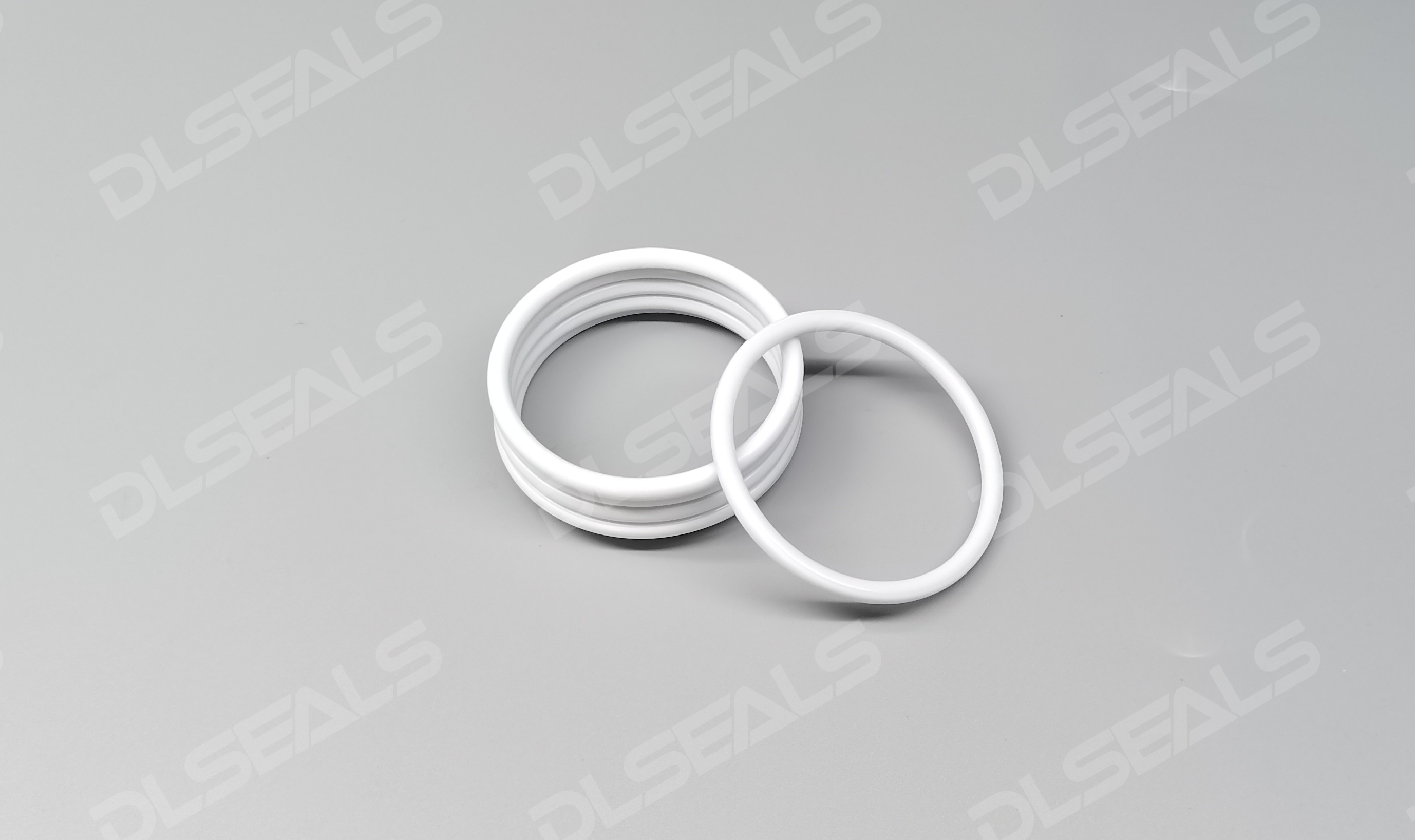
Selecting the right material is essential to ensuring the sealing performance, service life, and operational reliability of an O-ring. Different operating conditions place different demands on elastomer materials. Factors such as temperature, media compatibility, pressure, movement, and environmental exposure must all be considered.
Common O-ring materials include NBR, FKM, EPDM, silicone, HNBR, and FFKM. Each has its own advantages and limitations. Understanding their properties helps engineers select the most suitable material for a specific application.
1. Common O-Ring Materials and Their Characteristics
| Material | Main Advantages | Typical Applications | Limitations |
|---|---|---|---|
| NBR (Nitrile Rubber) | Good resistance to mineral oils, fuels, and hydraulic fluids; cost-effective | Hydraulic systems, fuel systems, general industrial equipment | Limited resistance to ozone, weathering, and high temperatures |
| FKM (Fluoroelastomer) | Excellent heat resistance and broad chemical resistance; good resistance to oils and fuels | Automotive, chemical processing, high-temperature equipment | Not suitable for every chemical, particularly certain strong alkalis and amines |
| EPDM | Excellent resistance to water, hot water, steam, ozone, and weathering | Water systems, HVAC, outdoor equipment | Generally incompatible with mineral oils and petroleum-based fluids |
| Silicone | Excellent flexibility at low temperatures and good heat resistance | Food equipment, medical devices, low-temperature applications | Relatively poor tear strength, abrasion resistance, and extrusion resistance |
| HNBR | Improved heat, aging, and mechanical properties compared with conventional NBR | Automotive systems, oil and gas equipment, hydraulic applications | Chemical compatibility and temperature limits depend on the compound |
| FFKM (Perfluoroelastomer) | Exceptional chemical and thermal resistance | Semiconductor, pharmaceutical, chemical, and demanding industrial applications | High material cost; performance depends on the specific compound |
Material properties can vary significantly with formulation, curing system, hardness, and manufacturer. The table provides general guidance rather than universal performance ratings.
2. Material Selection Based on Temperature
Temperature is one of the primary factors affecting O-ring performance. Excessive heat may accelerate aging, hardening, and compression set, while low temperatures can reduce elasticity and cause the seal to lose contact pressure.
High-temperature applications: FKM is commonly used where resistance to heat, oils, and fuels is required. HNBR may also be suitable for certain elevated-temperature applications. For more demanding chemical and thermal environments, selected FFKM compounds may be considered.
Low-temperature applications: Silicone offers excellent flexibility at low temperatures. Certain specially formulated NBR, HNBR, and FKM compounds can also be used in low-temperature environments. The actual minimum operating temperature should always be verified for the selected compound.
For equipment exposed to repeated temperature changes, engineers should also consider compression set, thermal expansion, and the ability of the material to maintain sealing contact after temperature cycling.
3. Material Selection Based on Working Media
Chemical compatibility is critical when selecting an O-ring. A material that performs well in one fluid may swell, harden, soften, or deteriorate rapidly in another.
| Working Medium | Common Material Options | Selection Considerations |
|---|---|---|
| Mineral oil and hydraulic oil | NBR, HNBR, FKM | Consider oil composition, temperature, and operating pressure |
| Gasoline, diesel, and fuels | NBR, HNBR, FKM | Check fuel composition and resistance to swelling |
| Hot water and steam | EPDM, selected FKM compounds | Verify temperature, pressure, and steam exposure conditions |
| Water-glycol mixtures | EPDM, selected NBR or HNBR compounds | Confirm compatibility with the specific glycol formulation |
| Strong acids and alkalis | Selected FKM compounds, FFKM, specialty materials | Compatibility depends heavily on concentration, temperature, and chemical composition |
| Refrigerants | Dedicated NBR, HNBR, or FKM compounds | Evaluate compatibility with both the refrigerant and refrigeration oil |
| Organic solvents | FKM, FFKM, and other specialty compounds | Solvent compatibility varies considerably; testing is recommended |
| Air and ozone exposure | EPDM, silicone | Consider ozone resistance, aging, and outdoor exposure |
It is important to note that no elastomer is universally resistant to all chemicals. For example, EPDM generally performs poorly in mineral oils and petroleum-based fuels, while some FKM compounds may be unsuitable for certain strong alkaline solutions or amines. For demanding chemical applications, material compatibility should be verified through chemical resistance data or actual testing.
4. Material Selection Based on Movement
The type of movement directly affects friction, wear, and heat generation at the sealing interface.
Static sealing: O-rings are widely used in static applications, such as flange connections, valve bodies, and equipment housings. NBR, FKM, and EPDM are common choices, depending on the medium and temperature.
Reciprocating sealing: In hydraulic and pneumatic cylinders, O-rings may be used for reciprocating sealing under suitable conditions. However, friction, surface finish, lubrication, pressure, and extrusion clearance must be considered. For long strokes, high speeds, or demanding operating conditions, dedicated piston or rod seals may provide better performance.
Rotary sealing: O-rings are generally more suitable for static or low-speed applications than for high-speed rotary sealing. High rotational speed can cause frictional heating, wear, and twisting of the O-ring. Special designs and operating conditions must be evaluated before using an O-ring in a rotary application.
5. Pressure and Special Operating Conditions
Pressure affects the deformation and extrusion behavior of an O-ring. Under high pressure, elastomer material may be forced into the clearance between mating components, causing extrusion damage or premature failure.
For high-pressure applications, engineers should evaluate the O-ring hardness, cross-sectional dimensions, groove design, and extrusion clearance. Backup rings may be required to reduce the risk of extrusion.
Other special conditions also require attention:
- Vacuum applications: Consider gas permeability, outgassing, compression set, and the required leakage rate.
- Food and pharmaceutical equipment: Select materials that meet the relevant food-contact or pharmaceutical requirements.
- Radiation environments: Evaluate radiation-induced hardening, embrittlement, and loss of elasticity.
- Outdoor environments: Consider resistance to ozone, ultraviolet radiation, moisture, and long-term aging.
6. Other Key Factors in O-Ring Selection
In addition to material compatibility, several design parameters directly affect sealing reliability:
- Hardness: Common O-ring hardness values include 70, 75, and 90 Shore A. Higher hardness can improve resistance to extrusion, but may increase installation difficulty and reduce conformity to surface irregularities.
- Cross-sectional diameter: The O-ring cross-section determines the available compression and contact area. It must match the groove dimensions and required squeeze.
- Groove design: Groove width, depth, clearance, and surface finish all influence sealing performance.
- Compression set: A material with poor compression-set resistance may gradually lose its contact force during long-term service.
- Service life: Operating temperature, pressure fluctuations, movement frequency, lubrication, and maintenance conditions should be considered together.
Conclusion
There is no single O-ring material suitable for every operating condition. NBR is commonly selected for oil-based applications, FKM for many high-temperature and chemical environments, EPDM for water and weather exposure, silicone for low-temperature flexibility, HNBR for demanding mechanical and thermal conditions, and FFKM for particularly aggressive chemical environments.
The correct selection should be based on the actual medium, temperature range, pressure, movement, groove structure, and service-life requirements. For critical applications, testing the selected compound under representative operating conditions is the most reliable way to confirm sealing performance.
SEO Title: O-Ring Material Selection Guide: How to Choose Between NBR, FKM, and EPDM
URL Slug: o-ring-material-selection-guide
Keywords: O-Ring Material Selection, O-Ring Selection Guide, NBR O-Ring, FKM O-Ring, EPDM O-Ring, FFKM O-Ring, O-Ring Applications
Post time: Nov-24-2026


