
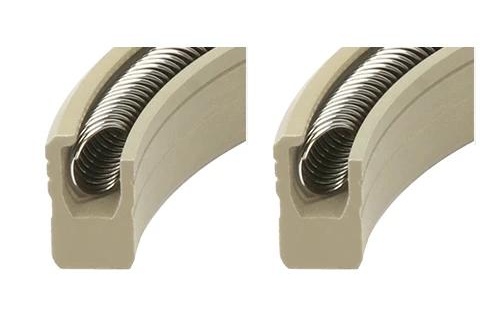
1. What Is a PEEK Spring-Energized Seal?
A PEEK spring-energized seal is a sealing component that uses polyether ether ketone (PEEK) as its primary sealing material and incorporates a spring to provide continuous preload. By combining the excellent mechanical properties, high-temperature resistance, and dimensional stability of PEEK with the compensation capability of a spring-energized structure, this seal is suitable for equipment requiring high strength, wear resistance, and reliable performance under demanding operating conditions.
Unlike conventional rubber O-rings, which rely on their own elasticity to generate contact pressure, a spring-energized seal uses an internal spring to apply continuous force to the sealing lip. This helps maintain initial sealing contact under low-pressure conditions, at low speeds, or during extended equipment shutdowns. As system pressure increases, the fluid pressure can also act on the sealing lip to enhance sealing contact.
It is important to understand that a PEEK spring-energized seal is not simply a conventional PTFE spring-energized seal made from a different material. PEEK has significantly higher rigidity and hardness but relatively limited elastic deformation. Therefore, the sealing lip thickness, spring preload, and overall structural design must be optimized according to the material’s characteristics.
2. Key Advantages of PEEK in Spring-Energized Seals
1. Excellent Mechanical Strength and Dimensional Stability
PEEK offers high strength, stiffness, and creep resistance. It can maintain relatively stable dimensions under sustained loading and elevated temperatures. In sealing structures exposed to continuous pressure and mechanical loads, PEEK helps reduce the impact of material deformation on sealing performance.
2. High-Temperature Performance
PEEK has excellent thermal stability and can be used in elevated-temperature industrial environments when the material grade and seal design are properly selected. Compared with many conventional elastomers, PEEK retains its mechanical properties more effectively at high temperatures, making it suitable for certain specialized sealing applications in valves, pumps, and industrial equipment.
However, the temperature capability of the raw material should not be confused with the actual operating temperature limit of the complete sealing assembly. The spring, mating components, process media, and friction-generated heat can all affect the service temperature range.
3. Wear Resistance and Extrusion Resistance
PEEK provides good wear resistance and high mechanical strength. Under suitable operating conditions, it can withstand certain levels of contact loading and friction. Its resistance to deformation also makes it a potential choice for some high-pressure sealing structures and support components.
Nevertheless, PEEK does not necessarily outperform filled PTFE under every friction condition. For high-speed applications, low-friction requirements, or insufficient lubrication, the friction coefficient, counterface material, surface finish, and PV value must all be evaluated.
4. Suitability for Specialized Environments
PEEK demonstrates good chemical stability in many industrial media. Compared with certain fluoropolymers, it may also offer advantages in some radiation environments. Consequently, PEEK can be considered as a candidate sealing material for nuclear industry applications, specialized chemical equipment, and certain high-temperature or radiation-exposed environments.
However, PEEK is not chemically inert to every substance. Compatibility with strong acids, specific solvents, and high-temperature chemical environments must be verified.
3. What Is the Difference Between PEEK and PTFE Spring-Energized Seals?
PEEK and PTFE are two important polymer materials used in spring-energized seals. However, their material properties differ significantly, resulting in different application advantages.
| Comparison | PEEK Spring-Energized Seal | PTFE Spring-Energized Seal |
|---|---|---|
| Material rigidity | High | Relatively low |
| Mechanical strength | High | Relatively lower |
| Creep resistance | Good | Relatively lower |
| Friction characteristics | Depends on grade and operating conditions | Generally low friction |
| Wear resistance | Good, depending on counterface conditions | Can be improved through fillers |
| Elastic deformation | Relatively limited | Relatively greater |
| Typical applications | High-load, high-temperature, and specialized environments | Low-friction, chemically demanding, and general dynamic sealing |
From an application perspective, PTFE offers a low coefficient of friction and excellent chemical resistance. It is often suitable for applications requiring low operating resistance, good sealing-lip conformity, and broad media compatibility.
PEEK is more suitable for applications requiring high mechanical strength, creep resistance, and structural stability.
Therefore, a PEEK spring-energized seal should not automatically be considered superior to a PTFE version. Material selection should be based on operating pressure, temperature, movement speed, process media, and required service life.
4. Common Applications of PEEK Spring-Energized Seals
High-Temperature Valves and Control Equipment
In high-temperature valves, control valves, and other fluid-control equipment, seals may be exposed to continuous pressure, temperature fluctuations, and friction caused by stem or spool movement. PEEK spring-energized seals can be considered for positions requiring high mechanical strength and dimensional stability. Media compatibility, stem surface conditions, and seal geometry must also be evaluated.
High-Pressure Fluid Equipment
In certain high-pressure pumps, hydraulic equipment, and fluid-control systems, sealing materials are affected by fluid pressure, extrusion gaps, and sustained mechanical loads. PEEK’s high rigidity and resistance to deformation provide potential advantages. However, actual pressure capability depends on the seal cross-section, spring design, groove dimensions, and extrusion clearance.
Nuclear Industry and Radiation Environments
In certain radiation environments, conventional polymers may experience molecular degradation, embrittlement, or a reduction in mechanical properties. PEEK offers promising radiation resistance and can be considered for specialized sealing applications. Nevertheless, radiation dose, radiation type, temperature, and exposure duration all affect material performance and must be verified under actual operating conditions.
Precision Machinery and Specialized Industrial Equipment
PEEK spring-energized seals can also be used in precision machinery and specialized industrial equipment requiring wear resistance, dimensional stability, and long-term sealing reliability. They are particularly worth considering when conventional elastomers cannot meet the required mechanical performance.
5. Design and Selection Considerations
The main design challenge of a PEEK spring-energized seal is balancing the material’s rigidity with the flexibility required at the sealing lip.
First, the sealing lip thickness must be carefully controlled. If the lip is too thick, the spring may not generate sufficient deformation to establish effective contact pressure. If the lip is too thin, its wear resistance and pressure-bearing capability may be reduced. This is particularly important under high-temperature and high-pressure conditions.
Second, the spring structure should be selected according to the operating pressure and movement type. Common spring configurations include cantilever V-springs, canted coil springs, and helical springs. These designs differ in preload, deflection range, friction characteristics, and dynamic response. Spring materials must also be selected according to operating temperature, media corrosiveness, and fatigue life. Common options include stainless steel and nickel-based alloys.
Other important selection parameters include:
- Operating Pressure: Confirm continuous pressure, pressure peaks, and pressure fluctuation frequency. Evaluate pressure resistance and extrusion risk.
- Operating Temperature: Consider ambient temperature, process media temperature, and friction-generated heat. Do not determine the operating range solely from the temperature rating of raw PEEK material.
- Motion Type: Distinguish between reciprocating, rotary, and static sealing applications. Consider speed, stroke, and operating frequency.
- Media Compatibility: Identify the media composition, concentration, and the presence of lubricants, cleaning agents, or other additives.
- Installation Groove: Properly design groove width, depth, clearance, and surface finish to prevent installation damage and abnormal wear during operation.
6. When Should You Choose a PEEK Spring-Energized Seal?
PEEK spring-energized seals are worth considering when equipment requires high mechanical strength, creep resistance, wear resistance, or reliable performance in specialized environments.
However, if the main requirements are low friction, broad chemical compatibility, low starting resistance, or better sealing-lip conformity, a filled PTFE spring-energized seal may be a more suitable option.
For certain high-pressure applications, another possible solution is to combine a PTFE sealing element with a PEEK backup ring. In this configuration, PTFE provides the primary sealing function, while PEEK provides additional support and extrusion resistance.
DLSEALS provides material and structural selection support for PEEK spring-energized seals and other high-performance polymer sealing products based on actual equipment requirements. For customized solutions, customers are encouraged to provide seal dimensions, groove geometry, operating pressure, temperature, media, and movement type to enable more accurate material selection and design.
The key value of a PEEK spring-energized seal lies not simply in the use of a high-performance material, but in the proper combination of material properties, spring preload, and sealing geometry to achieve more reliable performance under demanding operating conditions.
Post time: Nov-27-2026


