
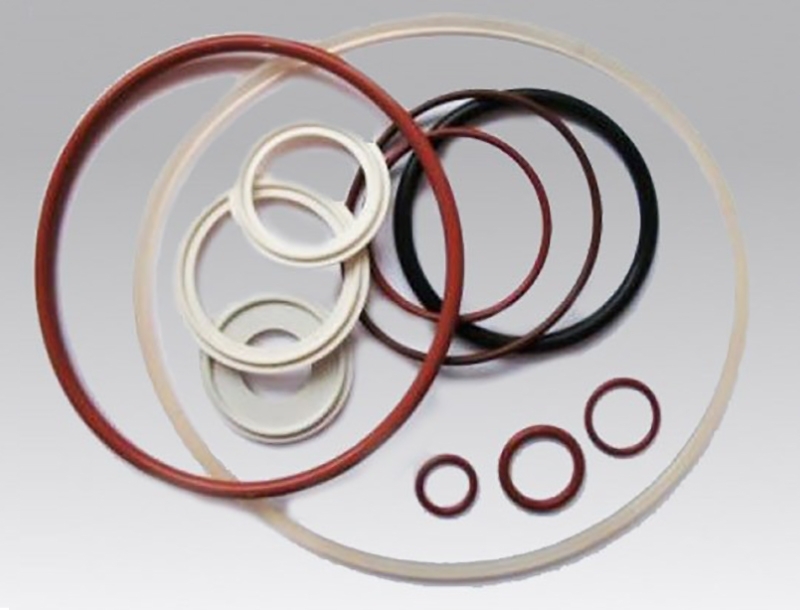
1. Overview: The “King of Elastomers”
In industrial environments with extreme temperatures, strong corrosion, and high pressure, perfluoroelastomers (often called perfluoroether rubbers) are recognized as the “king of elastomers” due to their nearly impeccable performance. While conventional rubbers fail quickly, perfluoroelastomer seals define the performance limits of elastomeric materials with their unique molecular structure, serving as the “silent guardians” ensuring the safety and reliability of critical systems.
2. Analysis of Core Properties
2.1 Extreme Chemical Resistance
- Origin: Almost all hydrogen atoms in its molecular chain are replaced by fluorine atoms, forming strong carbon-fluorine bonds with very high bond energy.
- Performance: Resists erosion from over 1,800 chemical media, including:
- Strong Acids and Bases: Such as fuming nitric acid, concentrated sulfuric acid, and molten alkalis.
- Strong Oxidizing Agents: Such as nitrogen tetroxide and liquid oxygen.
- Organic Solvents: Excellent stability against ketones, esters, ethers, etc.
- Aerospace Fuels: Such as hydrazine and nitrogen tetroxide.
2.2 Exceptional Thermal Stability
- Operating Temperature: Long-term service range from -25°C to +325°C, with short-term resistance exceeding 327°C.
- Property Retention: Maintains physical properties far better than standard fluororubber after prolonged exposure to 300°C; thermal decomposition temperature exceeds 400°C.
2.3 Extremely Low Gas Permeability
- Gas permeability is 1-2 orders of magnitude lower than standard fluororubber, providing excellent barrier properties even against small molecules like helium, making it the primary choice for ultra-high vacuum systems.
2.4 Long-lasting Sealing Reliability
- Excellent compression set resistance at high temperatures ensures long-term sealing effectiveness.
- Combines good elasticity with wear resistance, suitable for both static and dynamic sealing applications.
3. Performance Comparison: Why It’s Irreplaceable
The advantages of perfluoroelastomers compared to other common sealing materials are clear:
| Performance Dimension | Perfluoroelastomer (FFKM) | Fluororubber (FKM) | Silicone Rubber (VMQ) | Nitrile Rubber (NBR) |
|---|---|---|---|---|
| Long-term Heat Resistance | Excellent (≤325°C) | Good (≤200°C) | Very Good (≤230°C) | Fair (≤120°C) |
| Chemical Resistance | Excellent (Nearly Universal) | Very Good (Resists most oils, acids) | Poor (Poor oil/solvent resistance) | Fair (Oil resistant, poor against strong media) |
| Plasma Resistance | Excellent | Poor | Poor | Poor |
| Gas Barrier Property | Excellent | Good | Poor | Fair |
| Cost | Very High | Medium-High | Medium | Low |
Conclusion: In extreme operating conditions involving strong corrosion, high temperature, plasma, or requiring ultra-high purity, perfluoroelastomers are the only or optimal choice.
4. Core Application Areas
Their exceptional performance dictates their use in the most technologically advanced and demanding environments:
- Semiconductor Manufacturing:
- Applications: Dry etching, Chemical Vapor Deposition (CVD) equipment.
- Role: Resists high-temperature etching gases (e.g., CF₄, WF₆) and plasma erosion, ensuring ultra-high purity and equipment reliability in chip production.
- Aerospace:
- Applications: Engine fuel and hydraulic systems, environmental control systems.
- Role: Withstands aviation fuels, hydraulic fluids, and high-temperature air, meeting stringent material stability requirements for supersonic aircraft.
- Petrochemical & Energy:
- Applications: Deep-sea drilling blowout preventers, high-temperature/high-pressure reactors, oil and gas exploration equipment.
- Role: Resists the combined effects of H₂S, CO₂, acidic media, and high temperature/pressure, ensuring safety in extreme extraction environments.
- Pharmaceutical & Bioengineering:
- Applications: Aseptic filling lines, bioreactors, systems requiring repeated Steam-In-Place (SIP) sterilization.
- Role: Tolerates repeated sterilization and various pharmaceutical fluids, ensuring sterile conditions in drug manufacturing.
5. Challenges and Future Trends
Current Challenges
- High Cost: Expensive raw materials and complex manufacturing processes result in prices 5-10 times higher than standard fluororubber.
- Processing Difficulty: Requires specialized curing systems and precise process control.
- Limited Low-Temperature Elasticity: Low-temperature performance of standard grades is a relative weakness.
Future Development Trends
- Performance Expansion: Developing new grades with better low-temperature performance or higher thermal stability through molecular design.
- Process Optimization: Improving processing techniques to increase efficiency and reduce costs.
- Sustainability: Exploring environmentally friendly alternative monomers, recycling technologies, and processes that reduce PFC emissions.
Conclusion
Perfluoroelastomer seals are not merely a high-performance material; they are key enablers allowing modern high-tech industries to advance towards more extreme and precise frontiers. From micron-scale chips to the deep ocean, from laboratory reactors to rockets heading into space, they silently guard the safety boundaries of technological progress with their “absolute protection” reliability. As materials science continues to advance, this “king of elastomers” will undoubtedly continue to expand the limits of human engineering in the future.
Post time: Dec-15-2025