
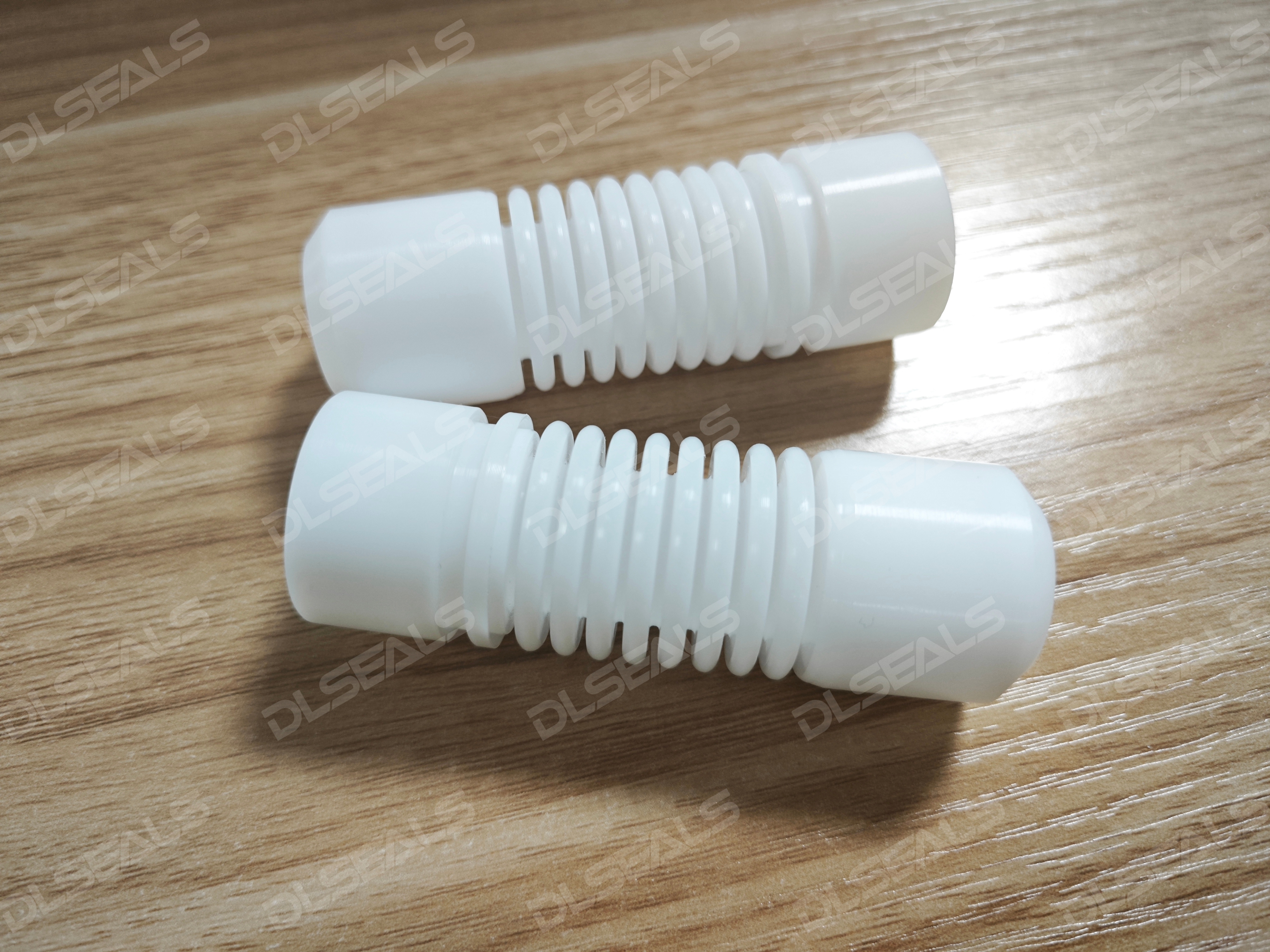
In modern industrial fluid systems, balancing chemical stability, flexibility, and temperature resistance is a constant technical challenge. PTFE bellows, with their unique geometric structure and superior material properties, have become the preferred component for handling highly corrosive media, ultra-clean fluids, and high-frequency vibration environments.
I. Material Properties: The Core Advantages of PTFE
PTFE (commonly known as “the king of plastics”) is the ideal substrate for bellows due to its stable molecular structure of carbon-fluorine bonds:
-
Extreme Chemical Inertness: Resists almost all chemical reagents (including strong acids, bases, and organic solvents), reacting only with molten alkali metals or fluorinating agents at high temperatures.
-
Wide Temperature Range: Maintains physical stability from -60℃ to +260℃
-
Low Coefficient of Friction: Smooth inner walls prevent material buildup and bacterial growth.
-
Excellent Aging Resistance: Unaffected by ozone or UV, offering an exceptionally long service life.
II. Structural Design: The Logic of the Bellows Form
Standard rigid PTFE tubing lacks flexibility and is prone to kinking. The corrugated (bellows) design transforms the mechanics of the tube to provide:
-
Displacement Compensation: Absorbs axial, lateral, or angular movement caused by thermal expansion and contraction.
-
Vibration Damping: Acts as a flexible connection for pumps and compressors, blocking vibration transfer to the network.
-
Tight Bend Radius: Allows for sharp turns in confined spaces without reducing the flow area.
III. Key Manufacturing Processes
-
Extrusion: PTFE fine powder mixed with lubricant is extruded into a base tube.
-
Bellows Forming: The base tube is heated and shaped using blow molding or mechanical radial compression.
-
Sintering: Performed at approximately $370^\circ\text{C}$ to reorganize molecular chains, set the shape, and enhance mechanical strength.
IV. Reinforcement and Protection
For high-pressure or specialized environments, PTFE bellows are often reinforced:
-
External Braiding: Usually Stainless Steel (SUS304/316) to increase pressure resistance and prevent the bellows from elongating under pressure.
-
Anti-static Lining: Carbon black is added to the PTFE to dissipate static electricity generated by high-speed fluid friction.
-
Flanged Fittings: Flaring the PTFE over the flange face ensures “zero metal contact” for pure fluid transport.
Post time: Apr-07-2026