
In modern manufacturing, press machines are core equipment in fields such as metalworking and automotive manufacturing. Their performance directly impacts production efficiency and product quality. The air spring, an innovative elastic component with unique cushioning and damping characteristics, is becoming a key technology for enhancing press machine performance. This article comprehensively explores the technical features and application value of press machine air springs from the perspectives of technical principles, core advantages, application scenarios, and future development.
Working Principle and Technical Features of Air Springs
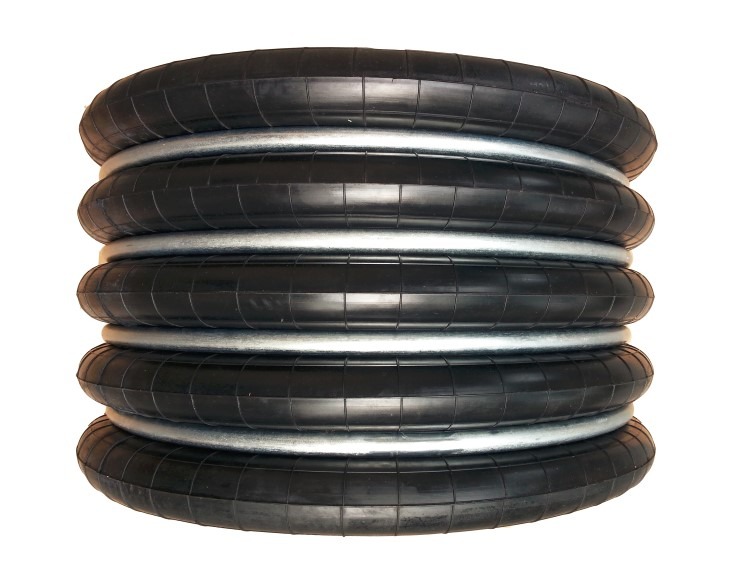
An air spring is a device that utilizes compressed air as an elastic medium. Its basic structure consists of a bladder made of rubber or fabric, filled with compressed gas. When the press machine operates, the mechanical vibration transmitted is cushioned by the compression and release of the air inside the spring, effectively reducing the equipment’s vibration amplitude.
Compared to traditional metal springs, air springs feature an adjustable elastic coefficient. By adjusting the air pressure inside the bladder, the stiffness and supporting force of the spring can be flexibly changed. This characteristic allows air springs to be precisely adjusted according to the varying working loads of the press machine, achieving ideal damping effects under various operating conditions.
Core Advantages of Air Springs in Press Applications
1. Excellent Damping Performance
The damping effect of air springs far exceeds that of ordinary metal springs or hydraulic dampers. They can adapt to changes in various impact forces, responding quickly and absorbing high-frequency vibrations generated during press operation. Research shows that applying air springs to walking beam pumping units can achieve a 13.59% reduction in the average value of larger loads and a 16.46% reduction in the average value of alternating loads. This not only effectively protects precision components inside the equipment but also significantly improves machining accuracy.
2. Adjustable Load Adaptability
Since the elastic coefficient of an air spring can be changed by adjusting the air pressure inside its bladder, it can be flexibly regulated according to the different working loads of the press machine. This adjustability greatly enhances the applicability of air springs, enabling them to achieve ideal damping effects under different working conditions. For the high impact forces generated by heavy-duty press machines, the air pressure in the air spring can be increased for adaptation; for light-duty press machines, the pressure can be appropriately reduced to achieve optimal damping.
3. Extended Equipment Service Life
Press equipment is prone to wear under frequent vibration and high-impact forces. Air springs can significantly reduce vibration, protecting mechanical components and thereby extending the equipment’s service life. Through damping and load regulation, air springs can markedly reduce the fatigue of mechanical parts, lower the frequency of equipment maintenance, and save considerable maintenance costs for enterprises.
Key Technical Parameters and Selection Guide for Air Springs
Selecting the appropriate air spring model is crucial for ensuring the efficient operation of press machines. The following key factors must be considered during selection:
Working Load: Different press operations require different supporting forces. The air pressure adjustment range of the air spring should cover the equipment’s load requirements. The main parameters of ZF-type press-specific air springs need to be determined based on indoor statics experimental research, especially the hysteresis characteristics under different pressure conditions.
Impact Frequency: For press machines performing frequent high-speed impacts, the response speed and damping effect of the air spring are key selection criteria. It is necessary to provide customized solutions based on the specific operational requirements of the press machine, rather than relying solely on standard products.
Environmental Adaptability: Factors such as temperature, humidity variations, and dust in the press working environment can affect air spring performance. Therefore, products with strong durability should be chosen. In recent years, high-strength, wear-resistant rubber composite materials have been widely used in air spring manufacturing, significantly improving the durability and load capacity of the springs.
Innovative Technology: Adjustable-Frequency Air Spring Vibration Isolators
To address the issue of traditional air springs potentially causing resonance due to fixed specifications coinciding with machine vibration frequencies, the newly developed air spring vibration isolator for press machines incorporates an innovative adjustable design. This isolator changes the lifting height of the upper housing assembly by adjusting the position of a conical buffer, thereby altering the overall height of the air spring vibration isolator and serving to change the system’s natural frequency.
This innovative design allows the air spring vibration isolator to avoid resonance caused by coincidence with the machine tool’s operating frequency over a wide range, effectively preventing isolation failure. Furthermore, some new isolators are equipped with a friction assembly. By supplying air to a small air spring to increase pressure, the friction between the friction blocks and the friction separator plate is enhanced, further improving the buffering effect.
Application Practice of Air Springs in Different Types of Press Machines
Rack and Pinion Presses
In rack and pinion presses, air springs are primarily used for damping and buffering, and load regulation and balancing. During press operation, especially in work stages with high impact forces, air springs can effectively absorb vibrations and impact forces from the rack and pinion transmission system, reducing wear on mechanical components and improving equipment stability.
Automatic CNC Presses
For automatic CNC presses, the application of air springs focuses more on precision control and automatic adjustment capabilities. By precisely controlling air pressure, air springs ensure load balance and impact absorption, thereby improving stamping accuracy and machining quality. Simultaneously, air springs also help enhance operator safety by preventing equipment failures caused by uneven load or excessive vibration of the press.
Hydraulic Presses
In hydraulic presses, air springs bear the vibration and impact loads generated during the stamping process, providing a buffering effect and reducing damage to mechanical structures. Particularly in high-load operations like high-speed stamping and precision forming, air springs can precisely control the press load and reaction force by regulating air pressure, improving operational accuracy and product quality.
Advances in Rubber Material Technology for Air Springs
With advancements in rubber technology, especially research on highly elastic materials, the sealing and durability of air springs have been greatly enhanced. The application of rubber in the sealing parts of the spring allows better resistance to external environmental influences such as moisture and temperature changes, ensuring the stability of air springs during prolonged operation.
The application of new high-strength, wear-resistant rubber composite materials has significantly improved air spring performance. These materials not only enhance the durability and load capacity of the springs but also markedly extend their service life. As rubber and air spring technologies continue to integrate, the applicability range of air springs has expanded. Their adaptability, especially in high and low-temperature environments, provides more powerful solutions for the diverse needs of mechanical press machines.
Future Development Trends of Air Springs
Intelligent Control Systems
With the continuous advancement of industrial technology, intelligent control systems are beginning to integrate with air springs, enabling automatic air pressure adjustment and further improving equipment damping performance. This innovation offers more possibilities for intelligent production workshops, allowing mechanical equipment to operate efficiently in quieter and more stable environments. Intelligent air spring systems can adjust parameters in real-time based on the operating status of the press machine, achieving optimal damping effects.
Material and Structural Innovations
The materials and structural design of air springs are also continuously improving. The application of high-strength composite materials further enhances the durability of air springs under high-frequency vibrations. More lightweight designs improve damping performance while reducing equipment load, gradually becoming an indispensable basic component in modern industry.
Integrated Solutions
Future air springs will place greater emphasis on overall integration with the press machine system, providing complete damping solutions. For example, by combining air springs with active control systems, the working status of the press can be monitored in real-time, and air spring parameters can be automatically adjusted for dynamic optimization. Such integrated solutions will further improve the precision, efficiency, and reliability of press equipment.
Conclusion
As a key supporting component of press equipment, air springs, with their excellent damping, buffering, and load regulation functions, have become critical components for improving press performance and extending equipment service life. With the continuous development of materials science and technology, air spring performance will be further enhanced, providing more efficient supporting solutions for various types of mechanical press machines.
For modern enterprises focusing on production efficiency and equipment protection, press machine air spring technology is a key technology worth investing in. It can effectively dampen vibrations, reduce noise, extend equipment service life, and improve production efficiency. By rationally selecting and using air springs, enterprises can create a more stable and comfortable working environment and achieve higher economic benefits. With the development of intelligentization, material innovation, and integration technologies, the application prospects of air springs in the field of pressing are even broader.
Post time: Jan-06-2026