
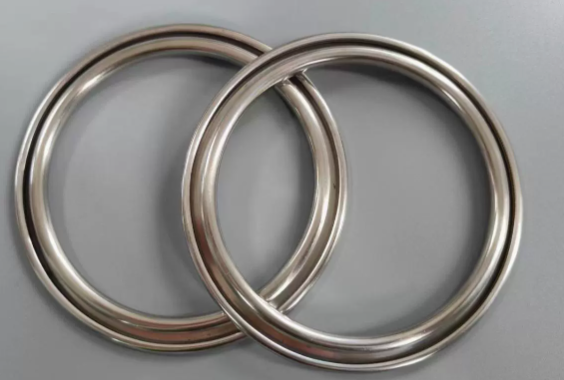
As shown in the image, metal seal rings for marine valves (also known as metal O-rings, hollow metal O-rings, or metal C-rings) are core sealing components in ship valve systems. They are primarily used in ball valves, butterfly valves, gate valves, check valves, and other critical marine valves. These seals provide reliable metal-to-metal or assisted sealing under extreme conditions such as high pressure, high temperature, seawater corrosion, vibration, and shock, ensuring zero leakage and long-term safe operation of valves on vessels.
Special Structural Design
The metal seal ring typically features a circular hollow tubular cross-section (wall thickness 0.2–0.8 mm). It is formed by bending metal tubing into a closed ring and then welding it (or using seamless forming). The example in the photo displays a smooth, mirror-polished surface with precise circular geometry, with ring diameters ranging from tens to hundreds of millimeters.
Key special structural features include:
- Hollow self-energizing design: The interior is a hollow cavity. Under medium pressure, the tube wall undergoes elastic radial expansion, automatically increasing contact pressure with the valve seat or ball (pressure-energized principle).
- Optional C-shaped or E-shaped openings: Some high-end models feature a C- or E-shaped notch on one side of the ring, further enhancing radial elasticity for easier installation and compensation of thermal expansion.
- Surface coating structure: The base is often coated with silver, gold, PTFE, or chromium carbide (thickness 5–20 μm) to reduce friction coefficient, prevent cold welding, and improve initial sealing performance.
- Dual-ring or stacked installation: As illustrated by the two interlocked rings in the photo, dual-seal configurations (inner + outer ring) are commonly used in actual valves to create redundancy and enhance safety.
These features allow the seal ring to maintain effective sealing contact even under installation tolerances of ±0.1 mm and thermal deformation.
Working Principle
The metal seal ring operates based on a dual mechanism of elastic deformation + pressure self-energization:
- During installation, the ring is compressed into the valve groove, generating initial preload (radial compression 0.1–0.3 mm) and forming an initial line-contact seal.
- When medium pressure is applied, it enters the hollow cavity (or through the C-shaped opening), causing the tube wall to expand outward. Contact pressure increases synchronously with medium pressure (contact stress can reach 200–500 MPa).
- In high- or low-temperature conditions, the thermal expansion coefficient of the metal matches that of the valve body material (typically aluminum alloy or stainless steel), preventing clearance widening or binding.
This principle makes it particularly suitable for marine applications with large pressure fluctuations and temperature variations (such as fuel systems, ballast water systems, and fire-fighting pipelines), significantly outperforming rubber or PTFE seals under extreme conditions.
Commonly Used Materials and Properties
Marine environments demand materials with excellent seawater corrosion resistance, high-pressure capability, and wide temperature range. Mainstream materials include:
- 316L / 316Ti stainless steel: Cost-effective choice with good resistance to chloride corrosion; temperature range –196°C to +550°C; commonly used in medium- and low-pressure valves.
- Inconel 625 / Inconel 718: Nickel-based high-temperature alloys resistant to chloride stress corrosion and high-temperature oxidation; maximum temperature up to 980°C; ideal for LNG valves and steam systems.
- Hastelloy C276: Super corrosion-resistant alloy with near-zero corrosion in seawater and acidic media; suitable for chemical tankers and oil tanker valves.
- Titanium alloy (TC4): Lightweight with exceptional seawater corrosion resistance; used in lightweight marine valve designs.
Surface treatments often include silver plating (to reduce friction) or nitriding (to increase hardness to HV 800+). All materials must comply with classification society certifications such as ABS, DNV, CCS, etc.
Performance Advantages
Compared to traditional non-metallic seals, typical performance parameters of metal seal rings are:
- Pressure resistance: Static pressure >1000 bar; dynamic conditions maintain zero leakage at 500 bar (meeting API 6D / API 598 leakage class A).
- Temperature range: –253°C (liquid hydrogen) to +800°C (high-temperature steam), with no aging or decomposition.
- Corrosion and wear resistance: Corrosion rate <0.01 mm/year after 5000 hours immersion in seawater; coated versions achieve friction coefficients as low as 0.08.
- Service life and reliability: >100,000 open/close cycles without leakage; vibration-resistant (meeting IEC 60068 marine standards).
- Leakage rate: Helium leak detection can reach 10⁻⁹ mbar·L/s, far superior to the 10⁻⁴ level of rubber seals.
Application Notes and Common Issues
In marine valves, metal seal rings are mainly installed in valve seat grooves or on valve ball surfaces. Installation requires strict control of groove dimensions (tolerance ±0.02 mm) and surface roughness Ra 0.4 or better to avoid scratching the coating. Common failure modes include:
- Coating peeling (when medium contains particles)
- Permanent deformation from over-compression (excessive installation force)
- Cold welding at high temperatures (without coating)
Regular inspection via ultrasonic thickness measurement or pressure testing can detect issues early. Replacement must use original-specification, classification-society-certified products to ensure system safety.
Thanks to its unique hollow self-energizing structure, excellent high-temperature/high-pressure performance, and seawater corrosion resistance, the metal seal ring has become an irreplaceable core sealing element in modern marine valves. When selecting, match the appropriate material and structure to the valve’s pressure rating, medium type, and temperature range to achieve optimal sealing performance and longest service life.
Post time: Mar-12-2026