
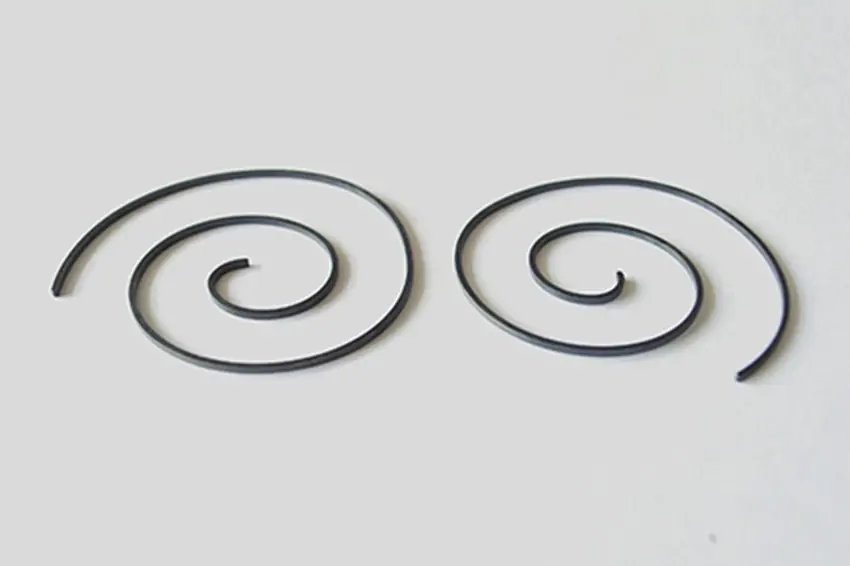
The tip seal (also known as tip seal strip or apex seal) is a critical axial sealing component in scroll compressors. It directly affects the gas tightness of the compression chambers, volumetric efficiency, and overall performance. This article provides a factual analysis from the perspective of seal manufacturing and application, covering its function, materials, design essentials, typical performance, and common failure factors.
Role of Tip Seals in Scroll Compressors
Scroll compressors rely on a pair of meshing orbiting and fixed scrolls. Through eccentric orbiting motion, they form multiple successively shrinking compression pockets to achieve gas compression. The tip seal is embedded in the groove at the tip (apex) of the scroll wraps and primarily provides axial sealing to block leakage of high- and low-pressure gas between adjacent compression pockets.
Without a tip seal — or when it fails — the main leakage path is the axial clearance (between the scroll wrap tip and the opposing base plate), resulting in:
Reduced volumetric efficiency (typically a loss of 5–15%)
Increased compression work
Higher discharge temperature
Lower overall energy efficiency (COP or EER)
The tip seal achieves dynamic sealing through sliding contact with the end plate of the opposing scroll. During operation, it must withstand pressure differences of 10–30 bar, temperatures up to 150–200°C, and cyclic frictional loads. The presence of tip seals enables scroll compressors to maintain high efficiency even under oil-free or low-lubrication conditions, making them especially suitable for air conditioning, heat pumps, and oil-free air compressors.
Commonly Used Materials and Their Properties
The most widely used material for tip seals is filled modified polytetrafluoroethylene (filled PTFE). PTFE is chosen due to its extremely low friction coefficient (typically 0.05–0.15), excellent self-lubricating properties, outstanding chemical resistance, and wide temperature range (−200°C to +260°C).
Common filler formulations include:
PTFE + glass fiber: Improves mechanical strength and wear resistance, but may increase wear on the mating surface.
PTFE + carbon fiber / graphite: Enhances thermal conductivity and creep resistance, suitable for higher temperature or load conditions.
PTFE + bronze / molybdenum disulfide (MoS₂): Improves wear resistance and friction reduction, commonly used in high-speed or dry-friction environments.
PTFE + PEEK or other high-performance polymer composites: Offers better heat resistance and strength under extreme conditions.
In other cases, materials such as polyetheretherketone (PEEK), polybenzimidazole (PBI), or carbon-based composites are used in specific high-end applications, though at higher cost and with narrower applicability.
Filled PTFE tip seals, when paired with hard anodized aluminum or specially coated scroll surfaces, provide a good wear balance: the seal itself wears slowly while minimizing damage to the scroll wraps. Real-world testing shows that high-quality filled PTFE tip seals can achieve low wear rates under typical air compressor conditions, supporting thousands to tens of thousands of hours of operation.
Structural Design and Manufacturing Key Points
Tip seals follow the involute spiral shape of the scroll wrap and fit precisely into the tip groove. The typical cross-section is rectangular or near-rectangular, with height and width determined by the scroll design (usually height 3–8 mm, width 1–3 mm).
Key design considerations include:
Thermal expansion matching: The coefficient of thermal expansion of the seal material should be as close as possible to that of the scroll base material (aluminum alloy) to avoid excessive clearance change or binding at high temperatures.
Back-pressure balancing: Some designs incorporate back-pressure chambers or structural features to ensure uniform loading on the seal and prevent localized excessive deformation.
Slit or notched structures: Certain tip seals feature scale-like or arc-shaped notches on the sides to improve lateral sealing and reduce radial leakage.
Manufacturing typically involves precision extrusion, compression molding, or CNC machining. Critical control points are:
Material uniformity (filler dispersion)
Dimensional tolerance (usually ±0.01–0.03 mm)
Surface finish (to reduce initial friction and wear)
Radial / axial preload after insertion into the groove
Performance Characteristics and Common Issues
Under normal design and operating conditions, tip seals significantly reduce axial leakage, enabling scroll compressors to achieve high volumetric efficiency (over 90%) and isentropic efficiency. The efficiency gain is most noticeable at low speeds, high pressure ratios, or variable operating conditions.
Common failure modes include:
Excessive wear: After long-term operation, seal height decreases, enlarging axial clearance and increasing leakage. Symptoms include reduced discharge capacity, higher energy consumption.
Fatigue fracture or spalling: Occurs under high-frequency cyclic loading or due to material defects.
Thermal deformation / creep: Material softens or permanently deforms at high temperatures, impairing sealing contact.
Improper installation: Foreign matter in the groove, excessive or insufficient preload, leading to early failure or noise.
Chemical / particulate erosion: Accelerated damage when ingesting solid particles or corrosive media.
After failure, typical symptoms are a clear drop in compression efficiency, increased abnormal vibration/noise, and elevated discharge temperature. Regular inspection (via vibration monitoring or disassembly checks) can detect problems early.
As a core sealing element in scroll compressors, the tip seal’s rational material selection and design are fundamental to ensuring long-term high efficiency and reliable operation. In practical selection and maintenance, the material formulation and specification should be chosen according to the specific operating conditions (pressure, temperature, medium, speed) to achieve the best balance of performance and service life.
Post time: Mar-09-2026