
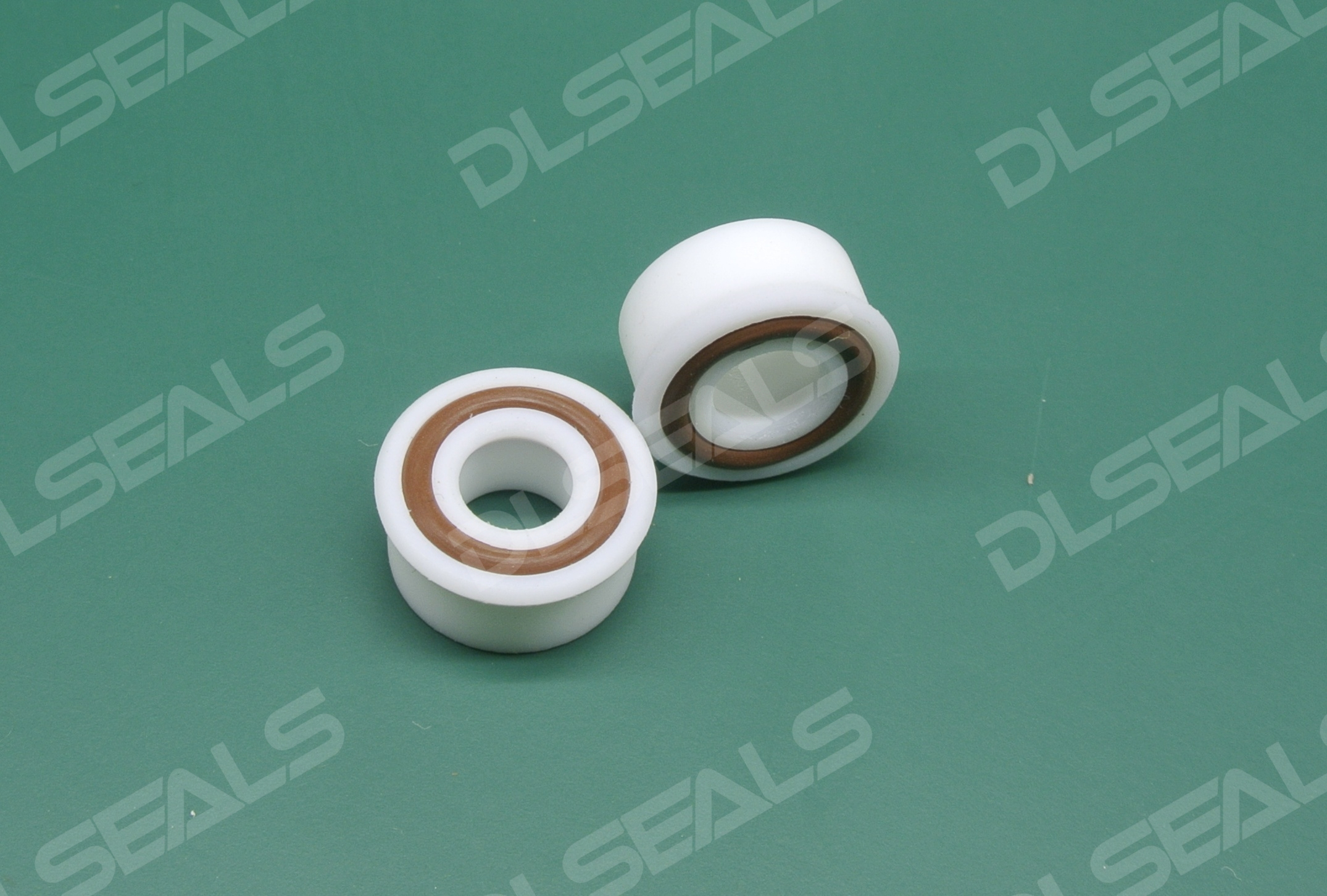
In industrial hydraulic and pneumatic systems, the reliability of sealing components directly determines the efficiency and lifespan of the entire power system. The Y-ring, named for its Y-shaped cross-section, is a typical self-sealing lip seal. Due to its unique lip structure, it has become one of the most widely used specifications in the field of reciprocating motion sealing.
1. Structural Design and Sealing Principle
The Y-ring consists of a base and sealing lips. Based on the length and thickness of the lips, they are generally classified into Wide-lip, Narrow-lip, and Universal (piston/rod) Y-rings.
-
Sealing Mechanism: Self-Tightening Effect
-
Initial Seal: After installation, the lips create a pre-compression force against the coupling surface due to interference, forming the initial seal.
-
Self-Tightening: When system pressure is applied, the medium enters the Y-groove, pushing the lips outward. As pressure rises, the contact force between the lips and the sealing surface increases linearly.
-
Dual-Lip Function: Under pressure, the two lips act on the coupling surface (e.g., piston rod or cylinder wall) and the bottom of the seal groove respectively, ensuring reliable static and dynamic sealing.
-
2. Key Performance Characteristics
-
Low Frictional Resistance: Compared to O-rings, Y-rings have a smaller contact area at low pressure, resulting in lower starting and running friction.
-
Stability: Y-rings offer excellent anti-roll performance, providing better structural stability during reciprocating motion.
-
Unidirectional Sealing: The Y-ring is a typical unidirectional sealing element. For bidirectional sealing, they are usually installed back-to-back in pairs.
-
Wear Compensation: The elasticity of the lips allows them to automatically compensate for gaps caused by wear under internal pressure, extending service life.
3. Material Selection
-
Nitrile Rubber (NBR): The most common material, featuring excellent oil resistance, suitable for standard hydraulic systems.
-
Polyurethane (PU/TPU): High hardness with superb tear and abrasion resistance. It is the preferred choice for high-pressure > 20Mpa hydraulic cylinders.
-
Fluororubber (FKM): Used for high-temperature > 200℃ or highly corrosive environments.
4. Technical Essentials for Installation
-
Gap and Extrusion: In high-pressure environments, the base may be extruded into the clearance. To prevent this, a backup ring is usually installed.
-
Orientation: Ensure the groove opening faces the pressure side. Reverse installation will lead to total seal failure.
Post time: Apr-10-2026