
In steam turbines, compressors, blowers, and other high-speed rotating equipment, shaft sealing systems must not only control fluid leakage but also accommodate shaft runout, thermal expansion, friction, and wear during startup and shutdown.
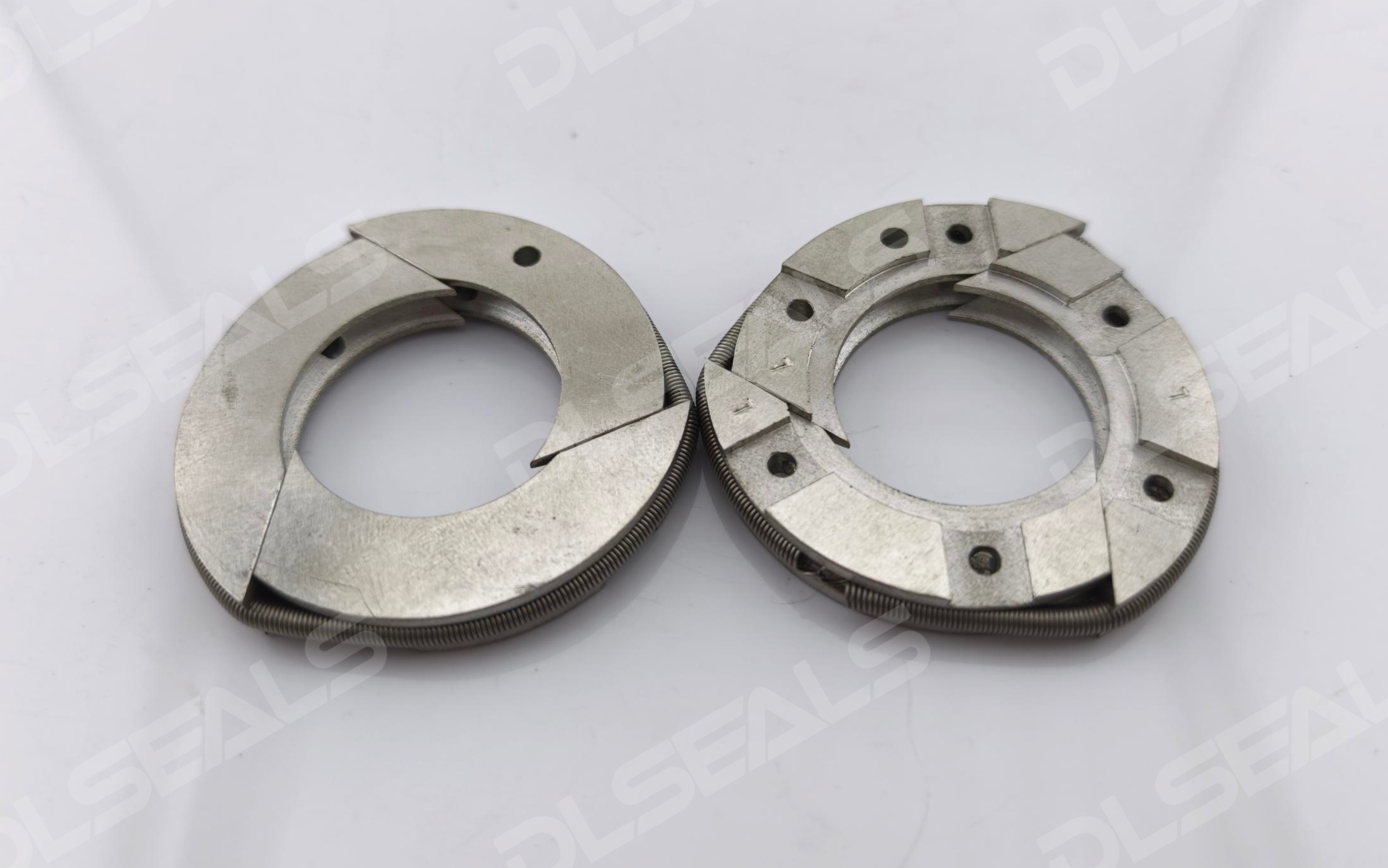
A Three-lobed seals ring made of wear-resistant sintered carbon impregnated with tin-based Babbitt alloy is a specialized rotary shaft sealing component that combines a composite friction material with a three-segment, spring-loaded design.
The seal consists of three curved segments assembled around the shaft. A circumferential garter spring installed around the outer diameter applies inward radial force, maintaining controlled contact between the sealing surfaces and the rotating shaft or sleeve.
This design combines the wear resistance and self-lubricating characteristics of sintered carbon with the conformability and anti-seizure properties associated with tin-based Babbitt alloys.
1. Structure and Sealing Principle of Three-lobed Seals Ring
A typical spring-loaded three-lobed seal ring consists of three sealing segments, an external garter spring, segment joints, and associated axial positioning components.
Three-Segment Sealing Ring
The ring is divided into three curved segments, each occupying approximately one-third of the circumference. When assembled, these segments form a complete circular sealing element.
This segmented configuration allows installation around an existing shaft, which can simplify maintenance of large rotating equipment where axial installation of a one-piece ring is difficult.
The joints between segments may feature straight cuts, stepped joints, or other engineered configurations to reduce leakage through the segment interfaces.
External Garter Spring
A circumferential groove is typically machined into the outer diameter of the three segments to accommodate a garter spring.
The spring continuously applies inward radial force, keeping the sealing segments in their intended position against the shaft surface.
As the inner sealing surface gradually wears, the spring can move the segments inward within the allowable compensation range, helping maintain sealing contact.
However, excessive spring tension may increase frictional heat and wear, while insufficient tension can lead to unstable contact or increased leakage.
Inner Sealing Surface
The inner diameter of the three-lobed seals ring serves as the primary sealing interface.
In a contact-type design, the garter spring maintains controlled radial pressure between the seal and the rotating shaft or sleeve, restricting fluid leakage along the shaft.
Unlike elastomeric seals that rely on significant elastic deformation, segmented carbon seals depend on precision-machined surfaces, controlled contact pressure, and the tribological properties of the sealing material.
Axial Positioning and Secondary Leakage Control
The three-lobed ring is normally installed inside a dedicated seal housing. Shoulders, covers, or other positioning components limit axial movement.
The segment joints and side faces must also be considered during sealing design, particularly where a pressure differential exists.
The basic operating principle can be summarized as follows:
Garter spring applies inward radial force → Three segments maintain shaft contact → Inner sealing surfaces restrict leakage → Spring movement compensates for limited wear.
2. Material Characteristics of Sintered Carbon Impregnated with Tin-Based Babbitt Alloy
The performance of a three-lobed seals ring depends on both its segmented construction and the properties of its sealing material.
Sintered carbon impregnated with tin-based Babbitt alloy is a carbon-metal composite material. A porous sintered carbon substrate is impregnated with a suitable tin-based alloy, allowing the metallic phase to penetrate connected pores within the carbon structure.
Role of the Sintered Carbon Matrix
Sintered carbon generally offers favorable wear resistance, resistance to adhesive wear, and certain self-lubricating properties.
During relative sliding between the sealing ring and shaft, these characteristics can help reduce surface damage associated with direct metal-to-metal contact.
An appropriately designed carbon matrix also provides structural rigidity and dimensional stability.
Role of Tin-Based Babbitt Alloy
Tin-based Babbitt alloys are widely recognized as antifriction materials and commonly contain tin, antimony, and copper.
They offer a degree of conformability and resistance to seizure under suitable operating conditions.
When properly impregnated into a sintered carbon matrix, the metallic phase may modify the composite’s mechanical, thermal, and tribological behavior.
However, the final performance depends on alloy composition, impregnation ratio, pore structure, and interfacial bonding quality. A higher metal content does not necessarily produce better wear resistance.
3. Main Performance Advantages
Wear Resistance and Reduced Scuffing Risk
The sealing surface of a spring-loaded three-lobed ring may experience continuous sliding contact with the rotating shaft.
The carbon-metal composite combines the inherent tribological properties of carbon with the antifriction characteristics of the impregnated alloy, potentially reducing abnormal wear and scuffing under appropriate operating conditions.
Actual wear performance must still be evaluated against shaft hardness, surface finish, contact pressure, temperature, and lubrication conditions.
Automatic Compensation for Limited Wear
One of the main structural advantages of the spring-loaded three-lobed seals ring is its ability to compensate for a limited amount of wear.
As the inner diameter gradually wears, the external garter spring can continue moving the three segments inward, helping maintain the intended contact condition.
This mechanism can reduce the loss of sealing effectiveness caused by gradual surface wear.
However, the compensation range is limited by spring travel, segment joint geometry, housing clearance, and remaining material thickness.
Convenient Installation and Maintenance
The segmented design allows the sealing ring to be assembled around the shaft rather than installed exclusively from the shaft end.
This is particularly beneficial for large turbines, compressors, and other equipment where shaft disassembly can be costly and time-consuming.
Accommodation of Limited Shaft Movement
During operation, rotating shafts may experience thermal growth, minor eccentricity, and radial runout.
The three-segment construction and external spring can provide a limited degree of radial compliance, helping the seal maintain contact under controlled shaft movement.
However, excessive shaft vibration or misalignment may still cause uneven contact pressure, accelerated wear, or segment damage.
4. Comparison with Conventional One-Piece Sealing Rings
| Feature | Conventional One-Piece Seal Ring | Spring-Loaded Three-lobed Seals Ring |
|---|---|---|
| Structure | Solid circular ring | Three separate curved segments |
| Radial loading | Depends on seal design | External garter spring |
| Wear compensation | Usually limited by structure | Limited automatic spring compensation |
| Installation | Often requires axial installation | Can be assembled around the shaft |
| Shaft movement accommodation | Depends on clearance and design | Improved through segmented construction |
| Joint leakage | No segment joints | Segment joints require leakage control |
| Typical applications | Static or dynamic sealing | Contact-type rotary shaft sealing |
The structural advantages of a three-lobed ring should be distinguished from the material advantages of the carbon-Babbitt composite. Both contribute to overall sealing performance.
5. Typical Industrial Applications
Steam Turbine Shaft Seals
Steam turbine shaft systems experience changing temperatures, rotational speeds, and vibration conditions during startup, normal operation, and shutdown.
At suitable sealing locations, a spring-loaded three-lobed ring can maintain controlled contact while providing limited wear compensation.
For positions directly exposed to high-temperature steam, the allowable temperature of the tin-based alloy-impregnated composite must be carefully verified.
Centrifugal Compressor Auxiliary Seals
Centrifugal compressor sealing systems must manage gas leakage while operating under demanding shaft-speed and pressure conditions.
Three-lobed carbon composite rings may be considered for auxiliary or separation sealing locations designed for contact-type segmented carbon seals.
Suitability must be confirmed based on gas composition, differential pressure, surface speed, and permissible leakage.
Industrial Blowers and Large Rotating Machinery
Industrial blowers, fans, and other rotating equipment may benefit from segmented shaft seals where maintenance access, limited radial compliance, and wear resistance are important.
The combination of a composite sealing material and a spring-loaded segmented structure can be useful in applications involving frequent starts and stops or moderate shaft thermal movement.
6. Key Design and Selection Considerations
Spring Tension and Contact Pressure
Garter spring tension directly influences contact pressure between the seal and shaft.
Excessive radial force can increase friction, heat generation, and wear. Insufficient force may compromise sealing stability.
Spring selection should consider shaft diameter, operating speed, pressure differential, material properties, and seal geometry.
Shaft Surface Speed and Frictional Heat
Surface speed is a critical parameter for contact-type three-lobed seals.
Higher sliding speeds can significantly increase the importance of frictional heat management.
The allowable operating speed must be established using material-specific testing and actual operating conditions rather than general carbon material data alone.
Temperature Limitations
The thermal performance of a carbon-metal composite is not determined solely by the sintered carbon substrate.
Tin-based Babbitt alloys may experience softening, creep, or metallurgical changes at elevated temperatures.
Therefore, the allowable service temperature of the impregnated composite must be verified independently.
Segment Joint Design and Leakage
The joints between the three segments represent potential leakage paths.
Joint configuration should be selected according to the operating pressure, medium, permissible leakage, and expected wear compensation.
Shaft Surface Quality
Shaft hardness, surface roughness, roundness, and radial runout strongly influence seal wear and service life.
For high-speed applications, careful control of shaft surface quality and dynamic behavior is essential.
7. Common Failure Modes and Improvement Measures
During extended operation, a three-lobed seals ring may experience inner surface wear, segment chipping, spring failure, localized overheating, or increased leakage.
Inner diameter wear is commonly associated with contact pressure, surface speed, shaft finish, and lubrication conditions.
Spring fatigue or corrosion may reduce the radial closing force, while damage to segment joints can increase leakage.
Excessive operating temperature may also affect the impregnated Babbitt alloy phase, potentially compromising dimensional stability and mechanical performance.
Improving reliability therefore requires a coordinated approach involving material selection, spring tension, joint geometry, shaft surface finish, installation accuracy, and operating conditions.
Conclusion
A Three-lobed seals ring manufactured from wear-resistant sintered carbon impregnated with tin-based Babbitt alloy combines a specialized composite sealing material with a three-segment, spring-loaded configuration.
Its defining feature is the external garter spring, which applies inward radial force to maintain controlled contact between the three sealing segments and the rotating shaft.
The segmented structure provides installation flexibility, limited radial compliance, and wear compensation, while the carbon-metal composite offers a potential means of improving friction and wear behavior.
For steam turbines, centrifugal compressors, industrial blowers, and other rotating machinery, reliable performance depends on matching the material composition, spring design, sealing geometry, and operating conditions.
Careful engineering evaluation and application-specific testing are essential to achieving stable sealing performance and extended service life.
Post time: Oct-12-2026


