
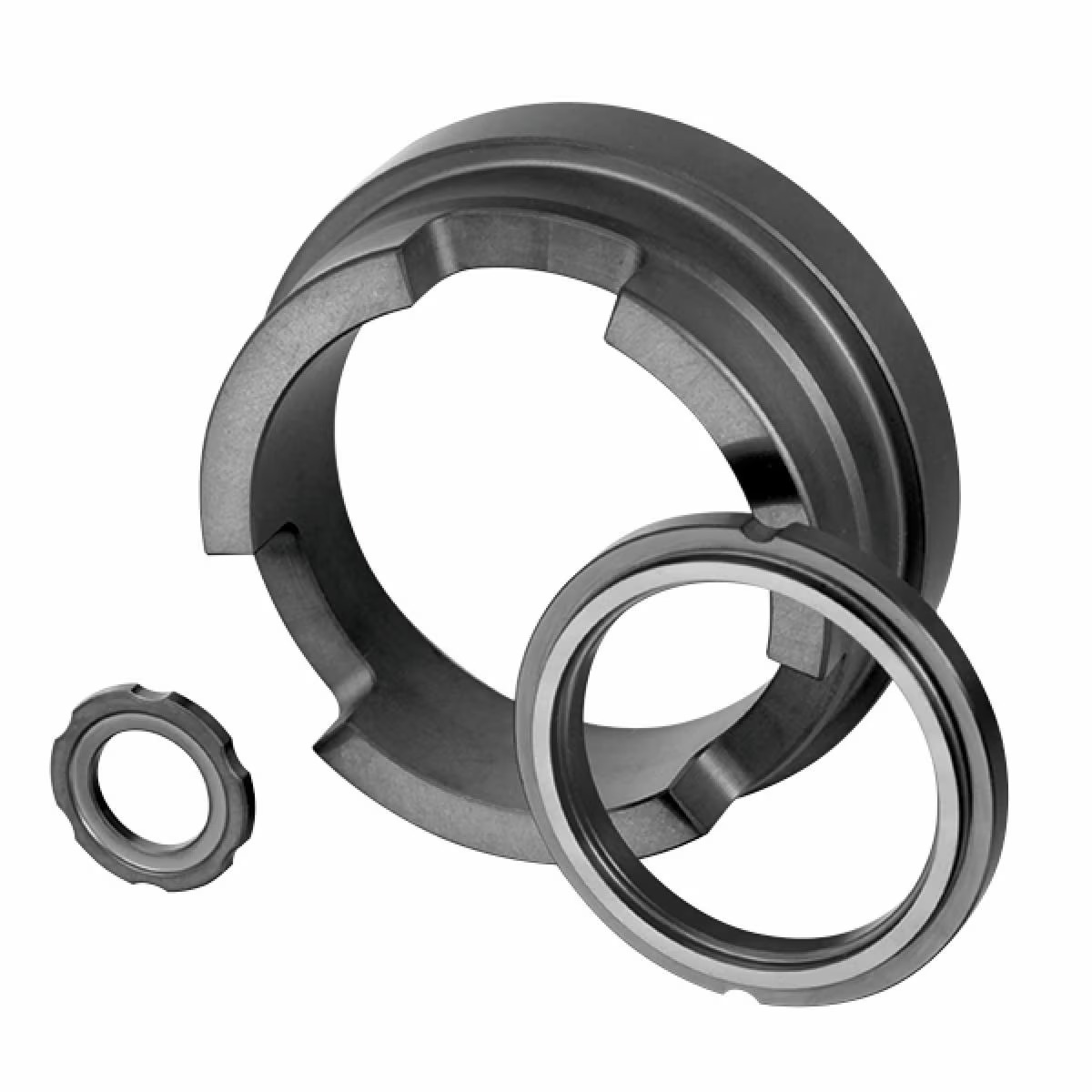
Pumps, chemical processing equipment, and mixers rely on rotating shafts to operate while keeping process fluids contained. Controlling leakage where the shaft passes through a stationary housing is an essential part of equipment design and maintenance. Mechanical seals play a key role in meeting this requirement.
Proper selection, installation, and operation of a mechanical seal can help reduce fluid leakage, extend maintenance intervals, and support reliable equipment performance.
1. What Is a Mechanical Seal?
A mechanical seal is a sealing device installed between a rotating shaft and a stationary housing. It primarily controls leakage through a pair of precision sealing faces positioned perpendicular to the shaft axis.
Elastic elements and process pressure provide the appropriate closing force, while secondary seals control leakage between other components.
Unlike packing, which seals by pressing material against the shaft surface, a mechanical seal relies mainly on the interface between a rotating face and a stationary face. When correctly selected, installed, and operated, it can provide low leakage and a long service life.
2. Main Components of a Mechanical Seal
A typical mechanical seal includes the following components:
| Component | Main Function |
|---|---|
| Rotating ring | Rotates with the shaft and forms the primary sealing interface with the stationary ring. |
| Stationary ring | Remains fixed in the housing or gland and works with the rotating ring to control leakage. |
| Elastic elements | Provide initial preload and compensate for face wear and axial movement within the seal’s design limits. |
| Secondary seals | Seal gaps between the rings and the shaft, housing, or other components. Common examples include O-rings and gaskets. |
| Drive and retaining components | Transmit torque, position the seal assembly, and maintain structural stability. |
The exact arrangement varies by seal type. For example, bellows mechanical seals can use a bellows element to provide elastic compensation.
3. How Does a Mechanical Seal Work?
At the heart of a mechanical seal are two precision-finished sealing faces: one rotates with the shaft, while the other remains stationary.
When the equipment is stopped, elastic elements provide an initial closing force to keep the faces in contact. During operation, the forces acting on the faces are determined by the combined effects of spring force, process pressure, and fluid-film forces.
In a typical liquid-lubricated mechanical seal, an extremely thin fluid film forms between the faces. This film lubricates the surfaces and reduces friction and wear. At the same time, the narrow gap restricts fluid flow, keeping leakage under control.
A mechanical seal therefore requires a proper balance between face closing force, lubrication, and leakage control. Increasing the closing force does not automatically improve performance. In seals that require liquid lubrication, insufficient liquid or dry running can cause overheating, wear, and eventual failure.
4. Common Materials Used in Mechanical Seals
Materials should be selected according to the process fluid and operating conditions. Seal-face materials and secondary sealing materials must be evaluated separately.
Seal-Face Materials
Common options include carbon graphite, silicon carbide, and tungsten carbide. Different combinations offer different friction, wear, and corrosion characteristics.
For example, carbon graphite paired with silicon carbide is suitable for many liquid applications. Fluids containing particles or abrasive matter may require an assessment of hard-face material combinations.
Secondary Sealing Materials
Common options include:
- NBR: Often used with compatible oils and oil-based fluids.
- EPDM: Often used with compatible water-based fluids and certain chemicals.
- FKM: Suitable for certain elevated-temperature and chemical applications.
- PTFE: Offers broad chemical resistance, although its use is also limited by seal design and mechanical properties.
Material selection should account for fluid composition, concentration, temperature, and the specific material grade. Suitability cannot be determined from the material name alone.
5. Typical Applications
Mechanical seals are widely used in:
- Centrifugal pumps and circulating water pumps
- Chemical pumps
- Industrial cleaning equipment
- Mixers and agitators
- Reactors
Requirements vary by application. Clean-water service generally emphasizes reliability and ease of maintenance. Corrosive fluids require careful material compatibility checks, while particle-laden fluids require an assessment of wear risks.
Flammable, toxic, or other hazardous fluids may require dual mechanical seals and an appropriate seal support system.
6. How to Select the Right Mechanical Seal
Before selecting a mechanical seal, prepare the following information:
| Selection Factor | Information Required |
|---|---|
| Equipment and installation dimensions | Equipment model, shaft diameter, seal chamber dimensions, and available installation space. |
| Process fluid | Fluid name, composition, concentration, particle content, and tendency to crystallize. |
| Operating parameters | Normal and extreme temperatures, seal chamber pressure, and rotational speed. |
| Operating mode | Continuous or intermittent duty, start-stop frequency, and possible short periods of insufficient liquid supply. |
| Support systems | Availability of flushing, cooling, or barrier-fluid systems. |
| Performance requirements | Allowable leakage, maintenance intervals, and applicable hygienic requirements. |
For replacement seals, also provide the existing seal model, drawings, photographs, or a sample. Matching appearance or shaft diameter alone does not confirm interchangeability.
7. Installation and Operating Precautions
During installation, keep the sealing faces clean and protect them from scratches, impact, and contamination. Follow the equipment or seal manufacturer’s requirements for installation dimensions and compression settings.
Before startup, ensure that seals requiring liquid lubrication are fully flooded and vented, and that any flushing and cooling systems are operating correctly.
If leakage increases or abnormal temperatures or vibration occur, investigate the seal faces, secondary seals, shaft system, and operating conditions. Avoid treating increased closing force as a universal solution.
Find a Suitable Sealing Solution for Your Equipment
Mechanical seal performance depends on the combined effects of design, materials, installation, and operating conditions. A clear understanding of the application helps achieve effective leakage control and reduced wear.
For inquiries about mechanical seals and related sealing components, contact DL SEALS with your drawings, samples, or operating parameters so that product requirements and suitable options can be evaluated.
Post time: Oct-28-2026


