
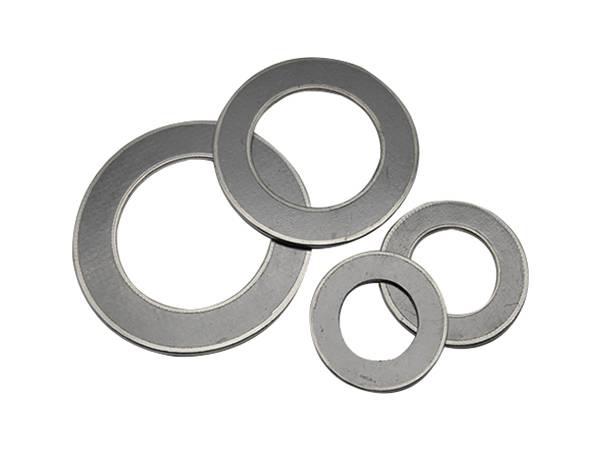
In cutting-edge industrial sectors such as aerospace, military electronics, advanced communications, and new energy vehicles, equipment often faces a dual challenge of rigorous containment. On one hand, it must prevent the leakage of internal high-temperature, high-pressure fluids or gases; on the other hand, with the rapid increase in electronic component integration, it must completely shield against ubiquitous electromagnetic interference (EMI) and prevent electrostatic discharge (ESD).
Traditional pure metal gaskets offer excellent conductivity and shielding performance but suffer from high hardness and poor compression recovery, making it difficult to achieve a perfect fluid seal. Conversely, conventional elastomer or graphite gaskets are “experts” in fluid sealing but fall short in electrical conductivity and shielding. In this context, Nickel-Coated Graphite Gaskets emerged. By perfectly fusing the high conductivity of metal with the resilience and thermal resistance of graphite, they have become an indispensable high-end composite sealing solution for complex operating conditions.
1. Core Microscopic Mechanism of Nickel-Coated Graphite Materials
The high performance of nickel-coated graphite gaskets stems from their unique core-shell micro-structure.
The base material typically consists of high-purity flake graphite or expanded graphite particles. Utilizing advanced electroless nickel plating or physical vapor deposition (PVD) technologies, a highly dense metallic nickel layer is uniformly coated onto the micron-sized graphite particles.
-
The Graphite Core: Retains the inherent characteristics of graphite—high thermal conductivity, an extremely wide temperature range, excellent self-lubricating properties, and outstanding elastoplastic deformation capability when subjected to radial compression.
-
The Nickel Shell: Nickel provides excellent electrical and magnetic permeability, along with superior corrosion and oxidation resistance. This dense metallic “jacket” delivers low contact resistance while effectively preventing the graphite lattice from oxidizing at elevated temperatures.
When these composite particles are pressed and cured into shape (typically utilizing silicone or fluorosilicone rubber as a carrier matrix) to form a gasket, the microscopic nickel layers overlap and compress against each other. This establishes a dense, three-dimensional conductive network in all directions, achieving highly efficient fluid containment and electromagnetic conduction simultaneously.
2. Key Performance Advantages of Nickel-Coated Graphite Gaskets
Compared to other conductive composites (such as silver-plated aluminum, silver-plated copper, or pure carbon black-filled materials), nickel-coated graphite gaskets demonstrate distinct technical advantages in overall cost-effectiveness and environmental adaptability:
A. Exceptional Wideband Electromagnetic Shielding (EMI Sealing)
The high magnetic and electrical permeability of nickel endows the gasket with superb shielding effectiveness. Within the wideband range of 20 MHz ~ 10 GHz, the shielding effectiveness of a qualified nickel-coated graphite gasket typically stabilizes above 80dB~110 dB. It not only blocks electrical field interference but also exhibits excellent absorption and reflection properties against demanding magnetic field interferences.
B. Superior Galvanic Corrosion Resistance (Galvanic Compatibility)
In outdoor or marine salt spray environments, conductive gaskets frequently come into direct contact with aluminum alloy enclosures (such as aerospace-grade aluminum 6061 or 7075).
-
Traditional silver-based filled gaskets (like silver-plated aluminum), despite their ultra-high conductivity, create a massive electrochemical potential difference against aluminum (often exceeding 0.8V). In humid environments, this triggers severe galvanic corrosion, destroying the aluminum enclosure.
-
In contrast, the potential difference between nickel and aluminum is significantly smaller. Nickel-coated graphite gaskets remarkably suppress galvanic corrosion at the contact interface, ensuring both shielding and structural stability during long-term outdoor operation.
C. High Resilience and Flawless Fluid Sealing
Because the matrix incorporates high-performance elastomers (such as silicone or fuel-resistant fluorosilicone rubber), the gasket deforms under minimal fastening torque, perfectly filling microscopic irregularities on the machined metal surfaces. Its compression set is extremely low, maintaining a durable sealing mating pressure even under prolonged, severe vibration or thermal cycling, effectively preventing rainwater, oil, and salt spray from penetrating the enclosure.
3. Mainstream Structural Designs and Forming Processes
Depending on spatial constraints and application requirements, nickel-coated graphite gaskets are engineered into several distinct product forms:
-
Molded Gaskets: The compound of nickel-coated graphite and conductive rubber is placed into precision molds and vulcanized under high temperature and pressure. This process is ideal for mass-producing intricately shaped custom gaskets and flat liners with high dimensional tolerances.
-
Extruded Profiles: Continuous extrusion into “O-profile”, “D-profile”, “P-profile”, or rectangular cross-section conductive rubber strips. These are commonly used around the perimeters of large telecom base station enclosures or shelter doors, supporting on-site cutting and thermal bonding.
-
Form-in-Place (FIP): Utilizing automated dispensing machines, liquid nickel-coated graphite conductive adhesive is precisely dispensed directly into the micro-grooves of metal or plastic enclosures. This process is engineered specifically for ultra-compact electronic devices like smartphones and microwave modules, where assembling traditional gaskets is impractical.
4. Typical Engineering Application Scenarios
Due to their “triple-threat” characteristics of shielding, corrosion resistance, and fluid sealing, nickel-coated graphite gaskets have become standard configurations across several industries:
-
Commercial Communications and 5G/6G Base Stations: Used for sealing outdoor RRU (Remote Radio Unit) enclosures, microwave antennas, and filter interfaces. They endure years of sun, rain, and thermal cycling while blocking RF leakage in the megahertz and gigahertz ranges.
-
New Energy Vehicles (EV/HEV): Applied to the sealing of die-cast aluminum enclosures for powertrain systems (motor controllers, On-Board Chargers [OBC], Battery Management Systems [BMS]). They prevent high-voltage electromagnetic radiation from interfering with onboard radar and control wiring while delivering IP67/IP68 dust and water protection.
-
Airborne and Shipborne Military Electronics: Serving as dual environmental and electromagnetic barriers between internal modules in naval vessel cabinets or high-vibration military aircraft avionics systems exposed to high salt spray.
5. Conclusion and Future Outlook
By compounding the “softness of graphite” with the “rigidity of metallic nickel” at a microscopic scale, nickel-coated graphite gaskets perfectly resolve the engineering pain point of compromising between fluid sealing and electromagnetic protection in modern complex industries.
As electronic devices trend toward higher frequencies (the millimeter-wave era), smaller volumes, and more stringent heat dissipation, modification research into nickel-coated graphite gaskets is extending in two directions: first, developing ultra-low closure force materials to suit micro-enclosures with electroplated plastic shells; second, further optimizing the orientation of the graphite core to enhance vertical thermal conductivity, gradually upgrading it into a supreme multi-functional material that integrates “sealing, shielding, and thermal management.”
Post time: Jun-22-2026


