
In modern industry, ammonia serves as a vital raw material for fertilizer manufacturing and chemical synthesis, as well as the core refrigerant for large-scale industrial cooling systems. However, ammonia is inherently highly toxic, strongly irritating, flammable, and corrosive. Any pipeline leak can easily trigger severe safety accidents and environmental disasters.
In ammonia piping systems, the sealing points (such as flanges, valve packing, and threaded joints) are often the weakest links in the safety chain. Scientifically and rigorously selecting the right sealing materials is the absolute core to achieving the goal of “zero leakage.”
1. The Dual Challenges of Ammonia Media on Sealing Materials
When selecting sealing materials for ammonia pipelines, two core levels of challenges must be addressed simultaneously:
1.1 Strong Alkalinity and Chemical Incompatibility
Ammonia dissolves instantly in water to form ammonium hydroxide, a strong alkali. It exerts a fatal Stress Corrosion Cracking (SCC) effect on certain metals, particularly copper and copper alloys. Therefore, copper-containing materials are strictly prohibited anywhere in the sealing assembly. For non-metallic seals, the material must maintain molecular structure stability without swelling, dissolving, hardening, or embrittling in highly alkaline environments.
1.2 Spanning Extreme Temperature Ranges
-
Liquid Ammonia / Industrial Refrigeration: Systems operate year-round at low temperatures down to -33℃ to -40℃ or even lower. Sealing materials must possess excellent low-temperature embrittlement resistance to maintain resilience under cold contraction.
-
High-Temperature Synthesis: High-temperature, high-pressure environments in ammonia synthesis or gasification stages require sealing materials with exceptional thermal creep resistance.
2. Analysis of Core Sealing Materials for Ammonia Pipelines
Based on varying working conditions, flange types, and pressure ratings, mainstream ammonia sealing materials are categorized into non-metallic soft gaskets, metallic composite gaskets, and specialized packing.
2.1 Modified PTFE / Expanded PTFE (ePTFE)
Polytetrafluoroethylene (PTFE), often called the “King of Plastics,” features near-perfect chemical corrosion resistance.
-
Advantages: Completely inert to ammonia gas and ammonium hydroxide, with a very low coefficient of friction. Expanded PTFE (ePTFE) overcomes the “cold flow” drawback (the tendency to creep and deform under high pressure) of traditional PTFE through directional stretching, providing superb resilience and tightness.
-
Applicable Conditions: Widely used in medium-to-low pressure ammonia pipelines and liquid ammonia storage tank flanges. Performs exceptionally well at ambient and low temperatures (above -40℃).
2.2 Flexible Graphite
Flexible graphite is the premier non-metallic choice for high-temperature applications.
-
Advantages: Features an extremely wide temperature range (-200℃to 450℃ or higher), excellent creep resistance, and self-lubricating properties.
-
Precautions: Pure graphite has low tensile strength and is highly fragile. In ammonia pipelines, reinforced graphite gaskets with internal stainless steel tanged or mesh inserts (such as 304 or 316L SS) are typically required to enhance blowout resistance.
2.3 Spiral Wound Gaskets (SWG)
For medium-to-high pressure ammonia pipelines (such as Class 300 and above), metallic composite gaskets are the standard configuration.
-
Structure: Constructed by alternately winding a V-shaped stainless steel strip (304 or 316L) with a filler strip (flexible graphite or modified PTFE), usually equipped with an outer centering ring and an inner ring.
-
Advantages: Capable of withstanding severe pressure and temperature fluctuations with robust mechanical vibration resistance and high structural strength.
2.4 Valve Applications: PTFE and Graphite Packing
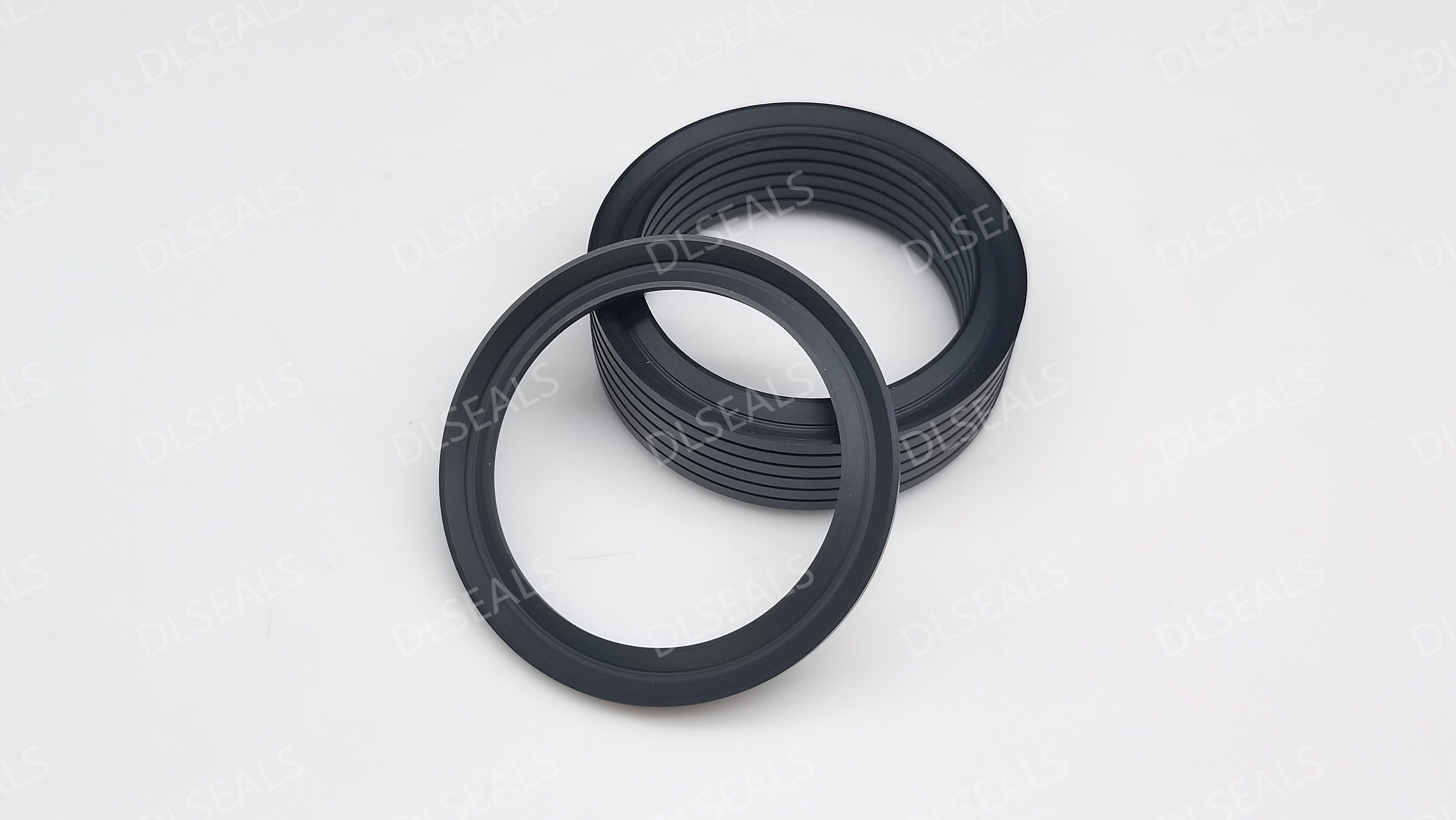
Dynamic sealing at the valve stem is equally critical. This typically involves PTFE V-ring packing (for low-temperature, low-friction valve requirements) or braided flexible graphite packing (for high-temperature, high-pressure isolation valves), supplemented by anti-extrusion rings to guarantee long-term sealing under frequent cycling.
3. Ammonia Seal Selection Matrix (Quick Reference)
For direct engineering selection guidance, refer to the following operating condition matrix:
| Operating Condition | Temperature Range | Recommended Material | Gasket Configuration | Remarks |
| Liquid Ammonia / Low-Temp Refrigeration | -40℃~ 80℃ | Expanded PTFE (ePTFE) / Modified PTFE | Full face or ring-type soft gasket | Guard against low-temperature cold flow. |
| Medium/Low Pressure Ammonia Lines | Ambient 150℃ | Reinforced Flexible Graphite / Modified PTFE | Tanged metal insert or soft gasket | Balance of cost-efficiency and safety. |
| High-Press / High-Temp Processes | > 150℃ or > 4.0 MPa | 316L + Flexible Graphite | Spiral Wound Gasket (with Inner & Outer Rings) | Excellent impact and creep resistance. |
| Critical High-Pressure Segments | Extreme High Pressure | Stainless Steel (304/316) | Kammprofile / Ring Joint Gasket (RTJ) | Relies on metal-to-metal line contact hard sealing. |
4. Engineering Pitfall Guide for Material Selection and Installation
Choosing the right material is only the first step; practical engineering must strictly adhere to the following principles to prevent failure:
⚠️ Absolute Absolute Ban: Never use copper, brass, bronze, or asbestos materials.
Ammonia aggressively corrodes copper, leading to catastrophic brittle fractures in a short time. Furthermore, traditional asbestos gaskets have long been phased out due to environmental hazards and aging vulnerabilities.
-
Strictly Limit Non-Metallic “Cold Flow”: When using standard PTFE, bolt pre-load must be tightly controlled to prevent the material from being “squeezed out” of the flange face, causing leaks. This is why modified PTFE or graphite spiral wound gaskets are preferred.
-
Flange Sealing Face Matching: When selecting graphite spiral wound gaskets, it is best to use Raised Face (RF) or Male-and-Female (MFM) flange faces to provide adequate sealing compression.
-
Precise Bolt Pre-load: A torque wrench must be used during the installation of ammonia piping. Insufficient pre-load fails to establish an initial seal, while excessive pre-load crushes the gasket (especially graphite and PTFE), causing premature seal failure.
5. Conclusion
Sealing material selection for ammonia pipelines is a systematic discipline blending material chemistry, mechanics, and on-site engineering. In practical applications, no single solution fits all scenarios. Custom designs must be tailored precisely to temperature, pressure, and fluid state (gas/liquid). By employing a stepped selection strategy of “modified PTFE + reinforced graphite + spiral wound gaskets” paired with standardized installation practices, a rock-solid, “zero-leakage” barrier can be built for industrial ammonia systems.
Post time: Jun-29-2026


