
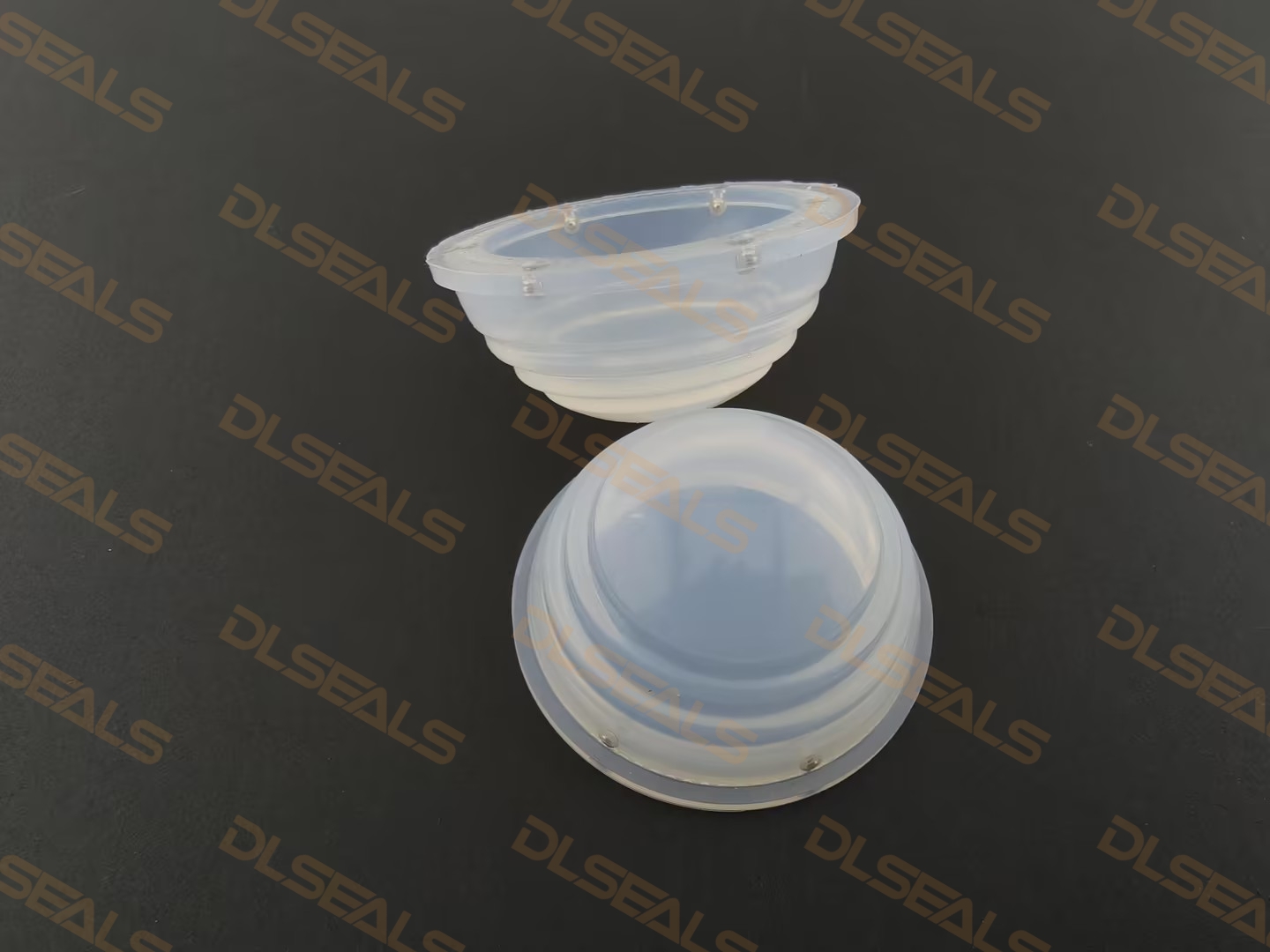
In the fields of industrial automation, robotic end-of-arm tooling (EOAT), and precision material handling, custom silicone suction cups have long evolved beyond simple consumable spare parts. They serve as the critical “tactile ends” that directly determine line efficiency, gripping stability, and product yield rates.
Standard suction cups often fall short when dealing with oddly shaped workpieces, special surface textures, or extreme high/low-temperature environments. This article dives deep into the core advantages, key design factors, and application scenarios of custom silicone suction cups to help you select the ideal custom solution for your production needs.
1. Why Choose “Custom” Silicone Suction Cups?
While off-the-shelf suction cups offer convenient procurement, they frequently encounter issues such as insufficient suction force, part dropping, surface scratching, poor airtightness, or short service life in complex industrial environments. The core value of custom silicone suction cups lies in being tailor-made:
-
Superior Surface Fit: Custom lip profiles and geometries ensure optimal airtightness for curved, concave-convex, rough, or ultra-thin/fragile workpieces (e.g., semiconductor wafers, thin films).
-
Tailored Material Formulations: Choose from food-grade, conductive, anti-static (ESD), high/low-temperature resistant, or chemically resistant silicone compounds based on operating conditions.
-
Seamless Structural Integration: Custom mounting interfaces and thread configurations match your existing robotic EOAT seamlessly, simplifying installation.
2. Key Design Elements of Custom Silicone Suction Cups
To engineer a high-efficiency, durable custom silicone suction cup, precision design across several critical dimensions is required:
A. Silicone Material Selection
-
Hardness (Shore A): Typically ranges from 30° to 70°. Softer silicone (30°–40°) conforms well to contoured surfaces, while harder silicone (60°–70°) provides greater structural support and stability during high-speed motion.
-
Functional Additives:
-
Anti-static/Conductive: Ideal for electronics and semiconductor handling to prevent electrostatic discharge (ESD) damage.
-
Mark-Free/Low Outgassing: Used for optical glass and display panels to prevent residue or marks after suction.
-
Food/Medical Grade (FDA Compliant): Suited for automated picking in food packaging and medical devices.
-
B. Suction Cup Structural Design
-
Flat Suction Cups: Ideal for flat, rigid workpieces requiring fast response times.
-
Bellows (Corrugated) Suction Cups: Provide height compensation and cushioning, perfect for uneven surfaces or workpieces with height variations.
-
Lip Geometry: Thin lip edges deliver superior flexibility and sealing; dual-lip designs offer extra airtightness on rough or irregular surfaces.
C. Airway and Skeleton Insert Technology
For applications involving heavy loads or frequent high-speed impacts, silicone-overmolded metal insert technology can be utilized. Securely bonding brass, aluminum, or stainless steel inserts with silicone maintains flexible suction sealing while delivering strong structural connection strength.
3. Typical Application Scenarios
| Industry | Target Workpiece | Key Custom Solution Focus |
| Electronics & Semiconductors | Wafers, IC chips, phone cover glass | Anti-static (ESD), mark-free grip, high coplanarity |
| Food & Pharmaceuticals | Pastries, pouch packaging, medicine bottles | FDA food-grade certification, easy to clean, delicate handling |
| Automotive & Stamping | Body panels, curved sheet metal | Oil resistance, bellows cushioning, high tear strength |
| Packaging & Logistics | Cardboard boxes, plastic bags, irregular items | Adaptability to porous/rough surfaces, high airflow suction |
4. Custom Development Process
A high-quality custom silicone suction cup undergoes a rigorous development workflow:
-
Requirement Analysis: Evaluating workpiece material, weight, surface roughness, cycle speed, and working environment (temperature, chemical exposure).
-
3D Design & Simulation: Drafting suction cup and insert geometries, simulating deformation and stress distribution under vacuum.
-
Mold Development: Utilizing high-precision CNC machining for molds to ensure dimensional accuracy and uniform wall thickness.
-
Prototyping & Testing: Performing pull-off force tests, sealing tests, fatigue life tests, and mark-free/ESD verifications.
-
Mass Production & QC: Strictly controlling silicone vulcanization time and temperature to guarantee lot-to-lot consistency.
Conclusion
As manufacturing advances toward high precision and intelligence, custom silicone suction cups are no longer just gripping tools—they are vital components for optimizing cycle times and product yield. Partnering with an experienced manufacturer capable of custom formulation and engineering ensures reliable, high-performance gripping for your complex operational needs.
Post time: Jul-31-2026


