
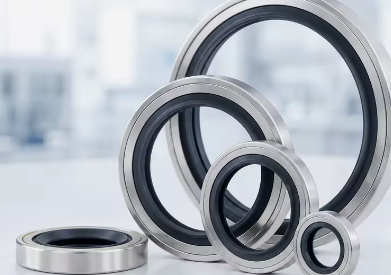
In high-end mechanical transmissions, high-speed rotation, and highly corrosive environments, traditional rubber oil seals frequently fail due to high friction, poor temperature resistance, or aging and cracking. The PTFE (Polytetrafluoroethylene) + Stainless Steel Dual-Lip Unidirectional Oil Seal was engineered specifically to solve these tough industrial challenges.
By seamlessly combining the ultra-low friction properties of PTFE—often called the “King of Plastics”—with the rigid, robust strength of a stainless steel skeleton, this sealing solution plays a crucial role in preventing media leakage and shielding equipment from external contaminants.
Core Design and Material Advantages
The superior performance of this oil seal stems from its precise material selection and structural architecture:
1. Material Pairing: Strength Meets Smoothness
-
PTFE Sealing Lip: Features an extremely low coefficient of friction (0.04–0.1) and a broad operating temperature range from -200°C to +260°C. It offers exceptional resistance to almost all strong acids, alkalis, and organic solvents. Thanks to its excellent self-lubricating properties, it resists burning even during dry-running startup phases.
-
Stainless Steel (SS304 / SS316) Casing: Provides high structural rigidity for the outer ring, ensuring dimensional stability under high rotational speeds or pressure surges. Furthermore, it completely eliminates the rust and corrosion issues typical of carbon steel casings.
2. Dual-Lip Unidirectional Structure
-
Primary Sealing Lip (Main Lip): Facing inward toward the system, it reliably blocks internal media such as lubricating oil or coolant from leaking. The lip is often engineered with hydrodynamic return threads (left-hand or right-hand) that actively pump micro-leakages back inside using the shaft’s rotation.
-
Secondary Sealing Lip (Dust Lip): Facing outward, positioned in tandem or directly behind the main lip. Its primary task is to intercept dust, moisture, and debris, preventing fine particles from abrading the main lip and shaft surface.
Performance Comparison: PTFE vs. Traditional Rubber Seals
| Performance Metric | Traditional Rubber Seal (NBR / FKM) | PTFE + Stainless Steel Dual-Lip Seal |
| Max Surface Speed | ~15 – 20 m/s | Up to 30 – 40 m/s |
| Pressure Resistance | ~0.05 MPa (Low Pressure) | Up to 1.5 – 3.0 MPa |
| Chemical Compatibility | Limited to specific oils/greases | Resistant to acids, alkalis, solvents & food-grade media |
| Dry-Running Capability | Poor (Lip burns easily) | Excellent (PTFE self-lubricating properties) |
| Service Life | Short (Limited by rubber aging) | 3x to 5x longer service life (Anti-aging) |
Typical Application Scenarios
Thanks to its pressure tolerance, high-speed performance, and high chemical stability, this oil seal is widely used across high-end industrial equipment:
-
Screw Air Compressors & Blowers: Where main shafts operate at extreme linear speeds and traditional seals overheat. Dual-lip PTFE seals provide long-lasting, wear-resistant oil retention.
-
New Energy Vehicles & ICE Engines: Applied in crankshafts, turbochargers, and electric drive units, handling frequent start-stops and high rotational speeds.
-
Chemical Pumps, Pharmaceutical & Food Processing: Excellent for systems requiring resistance to corrosive cleaning agents or compliance with FDA sanitary standards, where stainless steel and virgin PTFE ensure high purity and safety.
-
Hydraulic Motors & Gearboxes: Ideal for environments with internal operating pressure and severe external dust, where dual-lip protection delivers “internal oil retention + external dust prevention.”
Installation and Maintenance Guidelines
Note: PTFE is a plasto-elastic material without the high elasticity of conventional rubber. It requires specific care during installation and maintenance:
Shaft Hardness: The shaft contact surface should ideally be hardened to HRC 55–60 with a surface roughness of Ra 0.2 – 0.4 um to prevent shaft wear.
Specialized Installation Tools: A conical assembly sleeve must be used during installation. Avoid applying direct impact force or using sharp tools, which can permanently deform or damage the PTFE lip.
Run-In Period (Memory Effect): Upon initial installation, the PTFE lip undergoes a brief run-in phase to conform perfectly to the shaft surface; minor initial dampness is normal during this phase.
Post time: Jul-27-2026


