
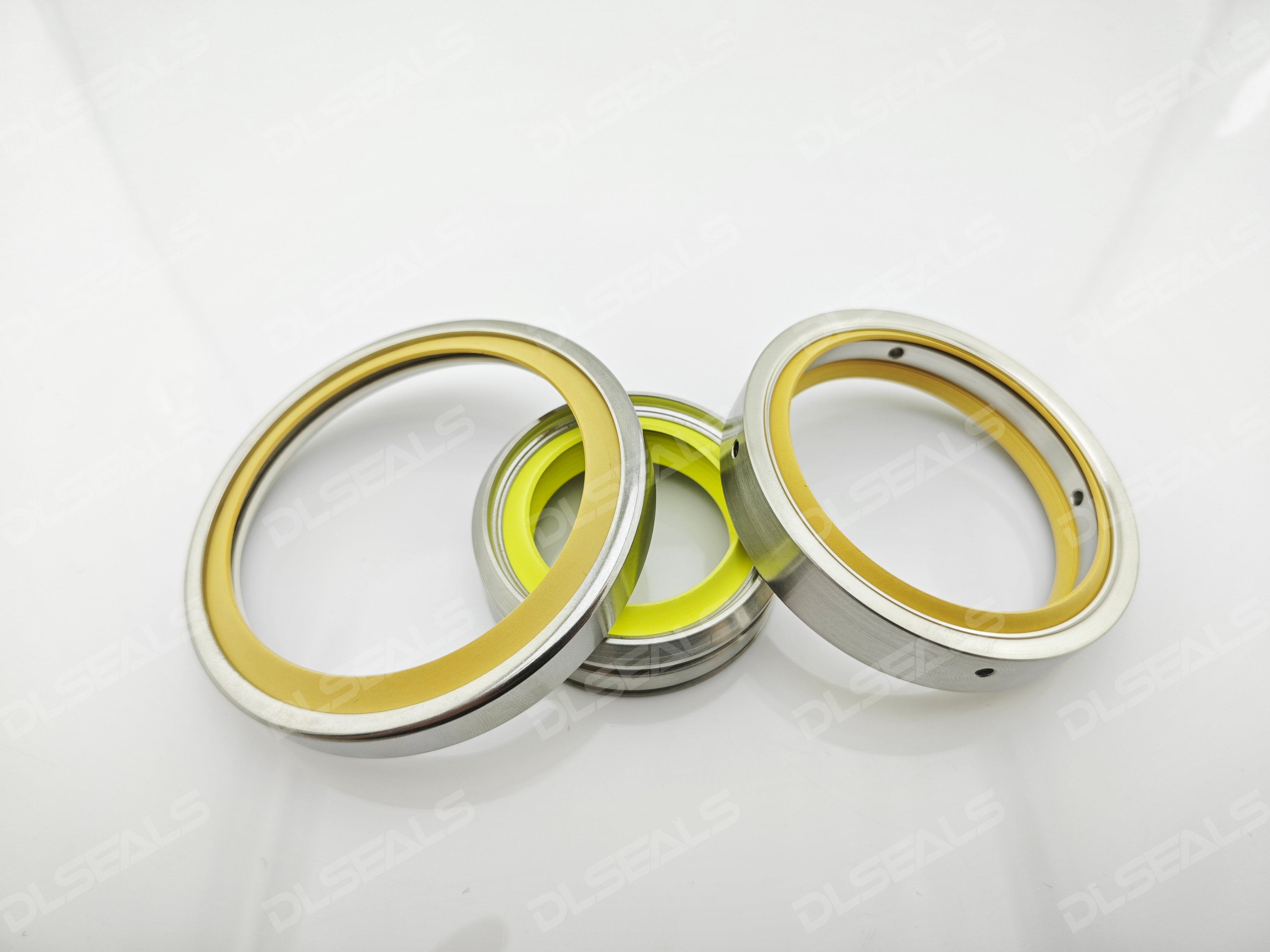
Rotary shaft oil seals are among the most widely used sealing components for rotating shafts. They are commonly found in gearboxes, motors, hydraulic equipment, pumps, construction machinery, automotive systems, and industrial transmission equipment. When selecting an oil seal, engineers often focus on dimensions and rubber compound while overlooking the influence of the metal case material on overall sealing reliability.
Common options include standard carbon-steel-cased oil seals and stainless-steel-cased oil seals. The TC oil seal is one of the most widely used standard oil seal designs, while stainless-steel skeleton oil seals are generally selected for applications involving moisture, corrosive environments, or higher requirements for corrosion resistance.
So, when should you choose a standard TC oil seal, and when is a stainless-steel case a better choice?
1. What Is the Difference Between a TC Oil Seal and a Stainless-Steel Oil Seal?
A TC oil seal typically features a rubber-covered metal case, one or more sealing lips, and a garter spring that provides radial sealing force. This design is mature, widely standardized, and relatively economical, making it one of the most common rotary shaft sealing solutions in industrial equipment.
A stainless-steel skeleton oil seal has a similar basic structure, but its internal metal case is made from stainless steel, such as 304 or 316 stainless steel. The main purpose is to improve corrosion resistance in humid, salt-spray, and corrosive environments.
Therefore, the main difference is not the sealing principle itself, but the environmental resistance provided by the case material.
| Comparison | Standard TC Oil Seal | Stainless-Steel Oil Seal |
|---|---|---|
| Case material | Typically carbon steel or similar metal | Typically 304/316 stainless steel |
| Basic construction | Rubber + metal case + spring | Rubber + stainless-steel case + spring |
| Normal industrial environments | Suitable | Suitable |
| Wet environments | Moderate | More suitable |
| Salt-spray environments | More susceptible to corrosion | Better corrosion resistance |
| Corrosive environments | Requires careful material selection | Generally more suitable |
| Cost | Relatively low | Relatively higher |
| Standard machinery | Economical choice | May be unnecessary |
| Food, marine, chemical equipment | Application-dependent | More commonly considered |
It is important to note that a stainless-steel case does not mean the entire oil seal is corrosion-resistant. The sealing lip is normally made from an elastomer and is the component directly exposed to the medium. Therefore, the rubber compound must also be selected according to the operating medium and temperature. NBR, FKM, EPDM, and other elastomers have significantly different chemical resistance.
2. When Should You Choose a Standard TC Oil Seal?
For normal, dry, non-corrosive industrial environments, a standard TC oil seal is often sufficient.
Typical applications include:
- Standard gearboxes
- Electric motors
- Industrial gear drives
- General mechanical transmission systems
- Hydraulic equipment
- Agricultural machinery
- General construction machinery
- Standard pumps
When the equipment is not continuously exposed to water, salt spray, or corrosive chemicals, a standard TC oil seal generally provides a good balance of performance and cost.
This is particularly true for standardized equipment produced in volume, where the oil seal dimensions are already established and the operating environment is stable. Upgrading every oil seal to a stainless-steel case may provide little practical benefit if corrosion is not a significant risk.
A simple selection principle is:
Normal environment + cost-sensitive application + no significant corrosion risk → standard TC oil seal is usually appropriate.
3. When Should You Choose a Stainless-Steel Skeleton Oil Seal?
When the oil seal is exposed to significant amounts of water, humidity, salt spray, cleaning fluids, or corrosive media, the advantages of a stainless-steel case become more important.
3.1 Continuous Exposure to Water or High Humidity
A conventional carbon-steel case may corrode when exposed to moisture for extended periods.
Typical applications include:
- Water pumps
- Water treatment equipment
- Cleaning equipment
- Food-processing machinery
- Outdoor machinery
- Equipment operating in humid workshops
Severe corrosion of the metal case may affect structural integrity, installation stability, and the fit between the oil seal and housing.
For long-term wet environments, a stainless-steel case can reduce this risk.
3.2 Marine and Salt-Spray Environments
Marine equipment, port machinery, and offshore systems are commonly exposed to salt spray and high humidity.
Chloride-containing environments can be highly corrosive to carbon steel, so corrosion resistance becomes an important consideration for the oil seal case.
Typical applications include:
- Marine transmission systems
- Offshore equipment
- Port machinery
- Seawater pumps
- Offshore wind equipment
- Coastal outdoor machinery
For these applications, stainless-steel cases are often considered to improve environmental durability.
3.3 Chemical Environments
If the area around the oil seal is exposed to chemical leakage, vapors, splashes, or cleaning chemicals, the corrosion resistance of the case should be included in the material selection process.
However, one point is particularly important:
Selecting a stainless-steel case does not mean that the oil seal is automatically compatible with all chemicals.
The complete sealing system should be evaluated based on:
Case material + elastomer material + spring material + operating temperature + chemical concentration.
For example, 304 and 316 stainless steel do not have identical corrosion resistance in every chemical environment. The specific medium must therefore be considered when selecting the case material.
4. Why Are Stainless-Steel Cases Often Considered for Food and Pharmaceutical Equipment?
Food, beverage, and pharmaceutical equipment may require frequent cleaning and can be exposed to hot water, cleaning agents, and humid environments.
In these applications, an oil seal may need to satisfy requirements related to:
- Water resistance
- Cleaning-agent compatibility
- Corrosion resistance
- Hygiene
- Temperature resistance
- Material compliance
For this reason, stainless-steel-cased oil seals can be advantageous in such equipment.
However, stainless steel alone does not make an oil seal “food grade.” For food or pharmaceutical applications, the elastomer, lubricant, metal components, manufacturing process, and applicable regulatory or certification requirements must all be evaluated.
5. Do Not Select the Case Material Without Considering the Rubber Compound
This is one of the most frequently overlooked points in oil seal selection.
For example, even if an oil seal uses a stainless-steel case, an NBR sealing lip that is incompatible with the working medium may still swell, harden, soften, or lose its elasticity.
A complete rotary shaft oil seal selection should therefore consider:
Working medium → temperature → rotational speed → pressure → shaft/housing dimensions → elastomer → case material → lip design → spring material → surface treatment.
Common elastomer options include:
| Material | Typical Characteristics | Typical Applications |
|---|---|---|
| NBR | Good resistance to mineral oils, economical, well-balanced properties | Hydraulic oil, lubricants, gear oils |
| FKM | High-temperature resistance and good oil/chemical resistance | High-temperature oils, chemical equipment, automotive applications |
| EPDM | Good resistance to water, steam, and certain polar media | Water, coolants, selected chemicals |
| ACM | Good resistance to high-temperature oils and aging | Automotive and high-temperature oil sealing |
| PTFE | Low friction, high-temperature resistance, excellent chemical resistance | High-performance rotary sealing |
Therefore, the stainless-steel case addresses corrosion resistance of the metal structure; it does not replace elastomer selection.
6. A TC Oil Seal Is Not Automatically a Low-Performance Oil Seal
A common misconception is that a stainless-steel oil seal must have better overall performance than a TC oil seal simply because stainless steel is used.
In reality, the two designs address different engineering requirements.
If a machine operates in a dry, normal industrial environment and the standard metal case already meets the requirements, switching to stainless steel does not automatically improve the oil seal’s wear resistance, temperature resistance, or chemical compatibility.
Oil seal service life is influenced by many factors, including:
Elastomer compound, lip geometry, shaft surface condition, lubrication, rotational speed, temperature, pressure, and installation quality.
The primary advantage of a stainless-steel case is its improved corrosion resistance and environmental durability when those properties are actually required.
Therefore, engineering selection should focus on the actual operating conditions rather than simply choosing the more expensive material.
7. How Can You Quickly Decide Which Type to Use?
A practical selection approach is:
Normal industrial environment:
A standard TC oil seal is usually sufficient.
Long-term exposure to water or humidity:
Consider a stainless-steel case, particularly when corrosion resistance is important.
Seawater or salt-spray environment:
Consider a corrosion-resistant case and also evaluate the elastomer and spring materials.
Chemical environment:
Do not evaluate the case alone. Check the compatibility of the elastomer, case, and spring with the actual chemical medium.
Food, pharmaceutical, and cleaning equipment:
Pay attention to stainless-steel materials, elastomer selection, hygiene requirements, and applicable regulations.
Standard gearboxes, motors, and mechanical drives:
When there is no significant corrosion risk, a standard TC oil seal is often the more economical solution.
8. The Key to Rotary Shaft Oil Seal Selection
There is no absolute “better” choice between a TC oil seal and a stainless-steel skeleton oil seal.
The main advantages of a TC oil seal are its mature design, broad availability, standardized dimensions, and cost-effectiveness. The primary advantage of a stainless-steel case oil seal is improved resistance to corrosive and humid environments.
The correct approach is to select the oil seal according to the actual operating conditions rather than simply treating stainless steel as an upgraded version of a standard oil seal.
For a complete sealing solution, engineers should consider:
Oil seal design + elastomer + case material + spring material + dimensions + lip configuration + operating conditions.
Only when these parameters are properly matched can a rotary shaft oil seal provide stable sealing performance and an appropriate service life.
Post time: Sep-16-2026


