
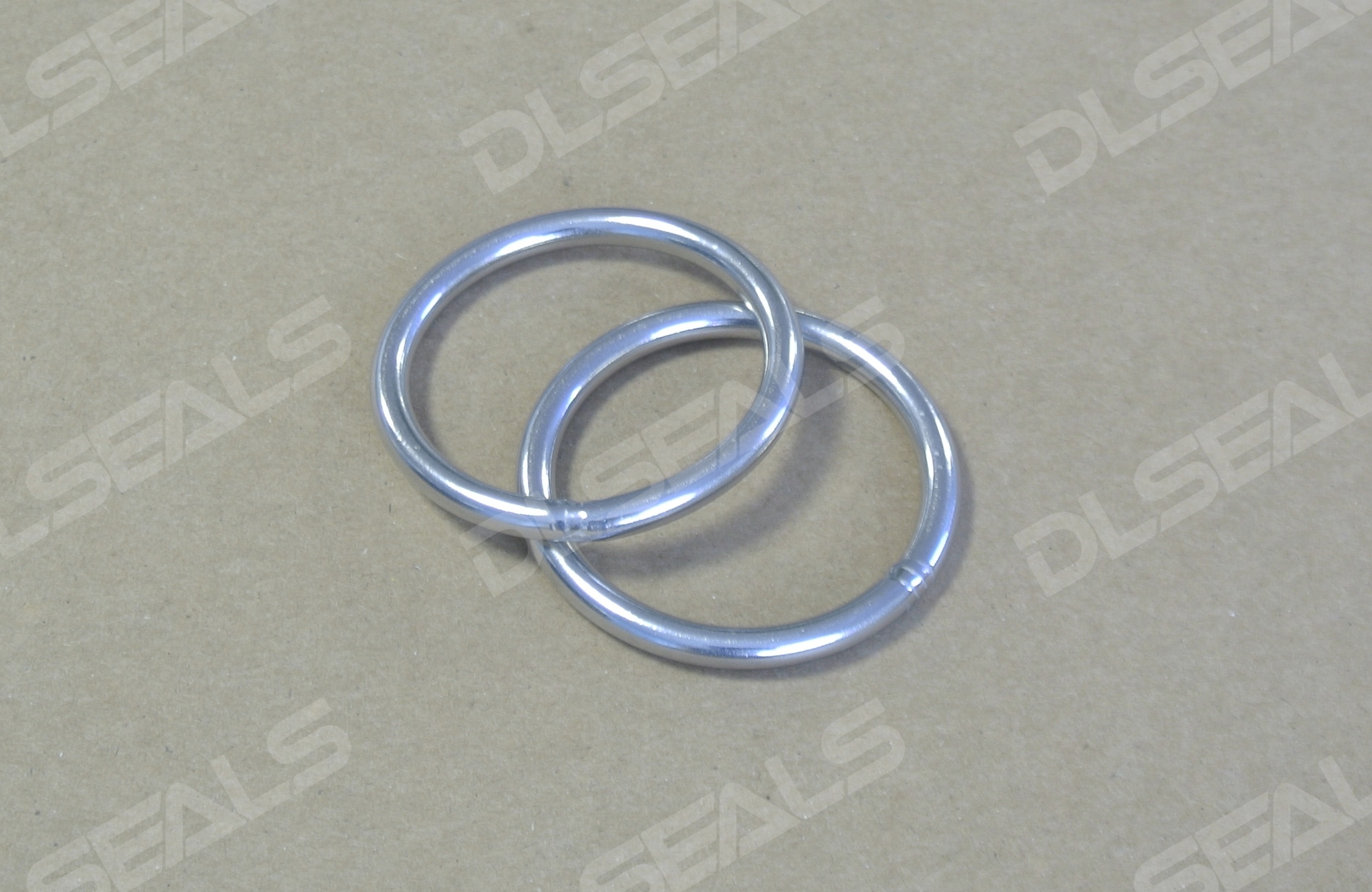
Metal seals are widely used in high-temperature, high-pressure, vacuum, corrosive, and other demanding environments, including aerospace, semiconductor equipment, vacuum systems, petrochemical equipment, energy systems, and high-temperature industrial machinery. Compared with elastomer seals, metal seals offer higher temperature resistance, chemical resistance, and long-term stability. However, their sealing performance is more sensitive to groove dimensions and machining accuracy.
For metal O-rings, C-rings, E-rings, and similar products, the seal itself is only one part of the sealing system. Proper groove design determines whether the seal can generate sufficient contact stress, accommodate thermal expansion and pressure changes, and maintain reliable sealing performance during long-term operation.
How Are Metal Seal Grooves Different from Conventional Rubber O-Ring Grooves?
Rubber O-rings primarily rely on elastic deformation and initial compression to generate sealing pressure. Metal seals, by contrast, generally rely on plastic or elastic-plastic deformation, spring-back, or specially designed cross-sections to generate high local contact stress at the sealing interface.
Therefore, metal seal grooves cannot simply be designed according to conventional rubber O-ring standards.
The groove design should consider:
Seal cross-section, compression, groove depth, groove width, sealing clearance, contact position, operating temperature, and pressure variations.
Excessive deviation in any of these parameters can prevent the seal from establishing stable contact pressure.
Compression Is a Core Design Parameter
For most metal sealing structures, determining the appropriate compression is one of the first steps in groove design.
If compression is insufficient, the contact stress generated by the metal seal may be too low, resulting in leakage under low pressure or vacuum conditions or when the equipment experiences slight deformation.
Excessive compression, however, may cause:
- Excessive plastic deformation of the metal seal;
- Significantly higher installation force;
- Excessive local stress;
- Difficult disassembly;
- Reduced reusability;
- Damage to the groove or sealing surfaces.
Therefore, groove depth should be accurately determined based on the seal cross-section, designed compression, and seal structure rather than relying solely on installation experience.
For resilient metal C-rings and E-rings, the spring-back capability of the seal itself must also be considered. In these designs, the groove affects not only the initial compression but also the seal’s ability to maintain contact force during temperature and pressure changes.
Groove Width Must Provide Sufficient Deformation Space
Metal seals deform during compression, either radially or axially, depending on their structure. Therefore, groove width should not simply match the seal cross-section.
If the groove is too narrow, the seal may have insufficient space to deform and may contact the groove sidewalls excessively, creating abnormal stress.
If the groove is too wide, the seal may shift during installation, particularly in vertical installations, vibrating equipment, or applications involving repeated assembly and disassembly. This can affect accurate positioning of the seal relative to the sealing surfaces.
Therefore, groove width should satisfy three basic requirements:
Provide proper installation space, allow the designed deformation of the seal, and prevent unnecessary lateral interference.
For metal seals with different cross-sectional designs, the appropriate groove width should be determined according to the specific product design and operating pressure.
Sealing Clearance Directly Affects High-Pressure Reliability
For high-pressure metal sealing systems, sealing clearance is a critical design parameter.
Under pressure, a metal seal may deform toward the low-pressure side. If the clearance is excessive, the seal may experience extrusion or excessive deformation, eventually causing leakage or permanent damage.
Therefore, groove design for high-pressure applications should consider:
Operating pressure, material yield strength, seal cross-section, mating clearance, and the effect of temperature on material properties.
Where necessary, extrusion resistance can be improved by reducing sealing clearance, adding support structures, or optimizing the seal cross-section.
For ultra-high-pressure equipment, finite element analysis can be used to evaluate the stress and deformation of the seal under actual operating pressure.
Groove Radii Should Not Be Overlooked
The radii at the groove bottom and sidewalls may appear to be minor details, but they are important for metal seals.
An excessively small radius can make machining difficult and create stress concentrations. Sharp edges and burrs may also damage the seal during installation.
On the other hand, an excessively large radius can affect seal positioning and the available compression space.
Therefore, suitable transition radii should be designed for the groove bottom, sidewalls, and entrance according to the seal structure, and all burrs should be properly removed.
This is particularly important for thin-wall metal seals and C-ring or E-ring designs with thin sealing lips.
Surface Finish Also Affects Sealing Performance
Metal seals generally rely on the sealing interface to form a continuous barrier. Therefore, the surface condition of the groove and mating sealing surfaces directly affects the final leakage rate.
Obvious machining marks, scratches, pits, corrosion, or other surface defects may create leakage paths even when the seal dimensions are correct.
However, smoother is not always better. Different metal seal designs have different surface-finish requirements. For seals with coatings, plating, or soft-metal jackets, the compatibility between surface microstructure and the sealing material must also be considered.
The groove design should therefore define:
- Surface roughness of the sealing area;
- Machining direction and surface lay;
- Surface hardness;
- Flatness;
- Concentricity;
- Control requirements for sealing-surface defects.
For high-vacuum and high-gas-tightness applications, sealing-surface machining quality is often more critical than in conventional industrial sealing applications.
Temperature Changes Must Be Considered in Groove Design
Metal seals are frequently used in high-temperature equipment, making thermal expansion an important design consideration.
When the seal, flange, and housing are made from different materials, they may expand by different amounts as temperature changes. If the groove does not provide sufficient allowance for this dimensional change, sealing pressure may vary significantly.
As temperature increases, some designs may experience additional compression; as temperature decreases, material contraction may reduce contact pressure.
Therefore, high-temperature metal sealing systems should not be evaluated only at room temperature. The actual dimensional relationship at operating temperature should also be analyzed.
For high-temperature, vacuum, or thermal-cycling equipment, thermal expansion calculations or finite element analysis are recommended to evaluate the complete sealing system rather than the seal alone.
Different Metal Seals Require Different Groove Designs
Although metal O-rings, C-rings, and E-rings are all metal seals, their operating mechanisms differ, and so do their groove requirements.
Metal O-rings primarily generate contact pressure through cross-sectional compression and are relatively sensitive to groove dimensions, compression, and sealing clearance.
Metal C-rings generally have a certain degree of elastic spring-back and generate sustained sealing force through their lip structure. The groove must allow the lips to deform and recover properly.
Metal E-rings incorporate multiple sealing lips and an elastic structure. They can provide multiple sealing interfaces, but their groove dimensions, installation orientation, and available axial space are more demanding.
Therefore, a single groove design should not be applied to all metal seals. The design should be tailored to the seal cross-section, material, operating pressure, temperature, and motion conditions.
Groove Design and Installation Method Must Be Considered Together
Metal seals are generally more sensitive to installation conditions than elastomer seals.
Groove entrances should avoid sharp edges. During installation, the seal should not be twisted, scratched, or locally deformed. For directional C-ring and E-ring designs, the installation orientation must also be consistent with the pressure direction.
If equipment requires frequent disassembly, the design should consider seal removal and whether the seal is suitable for repeated installation.
It is particularly important to note that not all metal seals are reusable. Crush-type metal seals undergo permanent deformation during installation and generally cannot guarantee the original sealing performance when reused.
Therefore, whether the seal is intended for single use or repeated installation should be determined during the groove-design stage.
Basic Checklist for Metal Seal Groove Design
| Design Item | Key Considerations | Design Objective |
|---|---|---|
| Groove depth | Match seal cross-section and compression | Establish initial sealing pressure |
| Groove width | Provide sufficient deformation space | Prevent lateral interference |
| Sealing clearance | Evaluate extrusion risk under pressure | Improve pressure resistance |
| Groove radius | Avoid sharp edges and stress concentration | Prevent seal damage |
| Surface roughness | Sealing-surface machining quality | Reduce leakage risk |
| Flatness / concentricity | Geometric accuracy of mating surfaces | Ensure uniform loading |
| Thermal expansion | Dimensional changes of different materials | Maintain sealing force during thermal cycling |
| Installation space | Assembly and removal conditions | Prevent installation damage |
| Pressure direction | Direction of seal loading | Optimize sealing behavior |
| Reuse requirements | Determine whether the seal can be reused | Select suitable seal and groove design |
Conclusion
The performance of a metal seal depends not only on the seal material and cross-sectional design. The groove is also a core element determining the final sealing performance.
A reliable groove design must consider compression, groove width, sealing clearance, surface roughness, radii, installation method, and changes in temperature and pressure. For high-temperature, high-pressure, and vacuum applications, material behavior and finite element analysis may be required to verify actual seal deformation and contact pressure.
Metal O-rings, C-rings, E-rings, and other designs should not simply share one standard groove. Each sealing structure should be matched to its specific operating conditions.
An effective metal sealing system is essentially an integrated optimization of seal design + groove design + sealing-surface design + operating-condition analysis. Only when these elements are properly matched can metal seals fully deliver their advantages in high-temperature, high-pressure, vacuum, and special-media environments.
Post time: Sep-14-2026


