
1 Functional Synergistic Mechanism of Composite Components
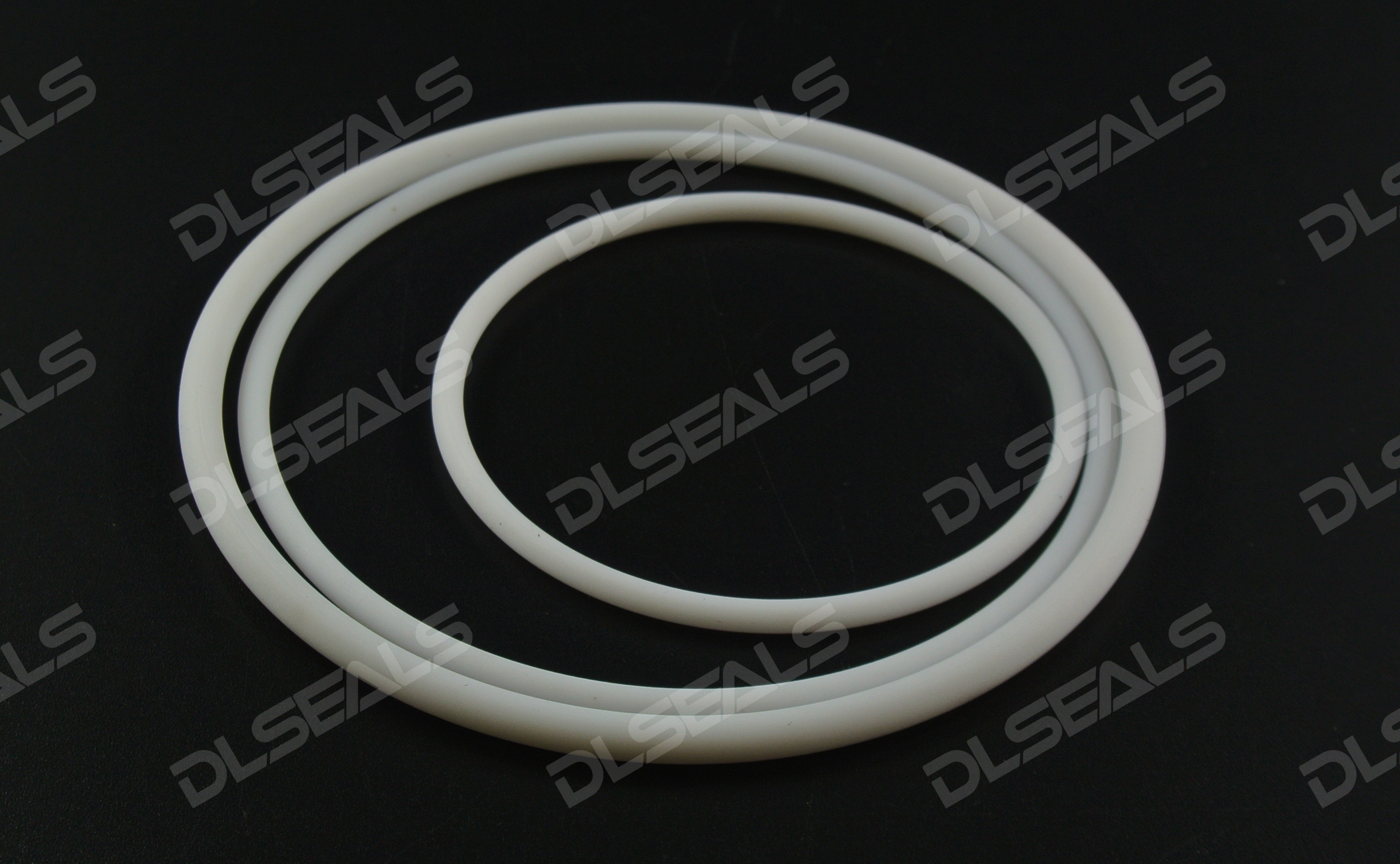
The PTFE+15% glass fiber+5% molybdenum disulfide+NBR70 O-ring is a high-performance sealing solution designed for harsh operating conditions. Through the functional complementarity of each component, this composite material achieves a comprehensive performance balance difficult to attain with single materials.
Pure PTFE has an extremely low friction coefficient (0.05-0.1) and excellent chemical stability, but suffers from drawbacks such as poor wear resistance, low mechanical strength, and significant creep. Adding 15% glass fiber greatly improves the material’s wear resistance, with wear resistance increasing by nearly 500 times compared to unfilled PTFE, and the limiting PV value increasing by approximately 10 times. The addition of 5% molybdenum disulfide further reduces the friction coefficient and enhances the material’s self-lubricating properties.
NBR70, as the base material, provides necessary elastic deformation capability, enabling the O-ring to form an effective seal under compression. NBR70 has good resistance to mineral oils, lubricants, fuels, and other non-chemical media, with a long-term use temperature of up to 100°C and 40 days of use at 120°C. This composite combination leverages PTFE’s low friction characteristics, the reinforcing effect of glass fiber, the solid lubricating properties of molybdenum disulfide, and the elastic sealing advantages of NBR.
2 Significant Improvement in Tribological Performance
The combination of PTFE+15% glass fiber+5% molybdenum disulfide provides the most notable enhancement in tribological performance. Studies show that the friction coefficient of glass fiber-filled PTFE composites is lower than that of pure PTFE during the stable wear stage. Molybdenum disulfide, as a functional filler, further reduces the friction coefficient, with an average friction coefficient reduction of 33.3% under a 392N load.
This tribological improvement stems from three main mechanisms: first, glass fiber increases the material’s tensile strength and creep resistance, inhibiting the destruction of PTFE’s banded structure; second, molybdenum disulfide forms a lubricating film on the friction surface, reducing direct contact; third, appropriately filled HNTs (halloysite nanotubes) and GF can create a micro-nano synergistic effect, reducing the composite’s wear rate by 32.7%.
Regarding wear mechanisms, pure PTFE mainly exhibits adhesive wear, while the composite material’s wear mechanism shifts to abrasive wear as the primary mode, with the wear surface changing from large flaky debris to a combination of small flakes and particles. The addition of molybdenum disulfide also provides some solid lubricating protection during prolonged dry friction after oil loss, preventing O-ring friction and wear failure.
3 Enhancement of Mechanical Properties and Sealing Stability
PTFE+15% glass fiber+5% molybdenum disulfide significantly improves the material’s mechanical properties. The addition of glass fiber gives the composite higher tensile strength, dimensional stability, and resistance to cold flow. Research indicates that appropriately filled HNTs-GF/PTFE composites show increases of 40.0%, 2.3%, and 7.1% in fracture elongation, tensile strength, and flexural strength, respectively, compared to GF/PTFE composites.
For sealing applications, these mechanical improvements directly translate to longer service life and better sealing stability. The NBR70 matrix provides initial elastic sealing, while the PTFE composite layer bears the main responsibility for friction and wear. This division of labor allows the O-ring to maintain good performance even under dynamic sealing conditions.
In terms of pressure adaptability, this composite material can be used in medium to high pressure (10-40MPa) conditions, offering a broader application range than seals relying solely on NBR. The material’s extrusion resistance is also enhanced, reducing the likelihood of deformation under high pressure.
4 Temperature Adaptability and Environmental Resistance
Temperature is a key factor affecting seal performance. PTFE itself has a wide operating temperature range (-30°C to +260°C), while NBR70 has relatively lower temperature resistance (long-term use temperature of 100°C). In practical applications, the composite’s upper temperature limit is constrained by NBR70, but the PTFE/glass fiber/molybdenum disulfide layer provides additional thermal insulation and protection.
Regarding chemical compatibility, PTFE offers excellent resistance to most chemical media, while NBR70 is compatible with petroleum-based oils but not suitable for phosphate ester-based hydraulic fluids or gear oils containing polar additives. The PTFE coating can partially protect the NBR matrix from chemical attack, but strong oxidizers and certain aromatic solvents may still cause erosion or swelling of the NBR portion.
It is noteworthy that glass fiber-reinforced PTFE composites are not suitable for alkaline media, and molybdenum disulfide, containing high levels of active sulfur, can easily corrode copper. Caution or protective measures are required in systems containing copper components.
5 Application Scenarios and Selection Recommendations
PTFE+15% glass fiber+5% molybdenum disulfide+NBR70 O-rings are particularly suitable for high-speed reciprocating seals, high-pressure hydraulic systems, and sealing applications under high-temperature conditions. Typical applications include hydraulic-pneumatic combination seals, guide rings, combination wipers, and oil-free lubricated compressor piston rings.
The following factors should be considered during selection: for low-pressure (<10MPa) conditions, ordinary NBR O-rings may suffice; but for medium to high-pressure (10-40MPa) conditions, this composite material demonstrates significant advantages. In dynamic sealing applications, its performance far exceeds that of single-material seals.
Regarding installation and maintenance, care must be taken during O-ring installation to prevent damage from sharp edges and threads, with a 15º to 30º lead-in angle recommended at the shaft and bore ends. Regularly clean seal grooves and sliding tracks to avoid dust affecting sealing performance, but avoid direct high-pressure water jet spray on the seals to prevent deformation.
6 Summary and Outlook
Through material composite technology, PTFE+15% glass fiber+5% molybdenum disulfide+NBR70 O-rings successfully overcome the limitations of single materials, achieving comprehensive improvements in tribological performance, mechanical strength, and sealing stability. With advances in materials science, more customized composite formulations for specific operating conditions may emerge in the future, further expanding the application boundaries of seals.
For engineers selecting this composite material, actual working conditions—including pressure, temperature, chemical nature of the medium, and motion state—should be comprehensively evaluated to fully leverage its performance advantages and ensure reliable and efficient operation of the sealing system.
Post time: Jan-08-2026