
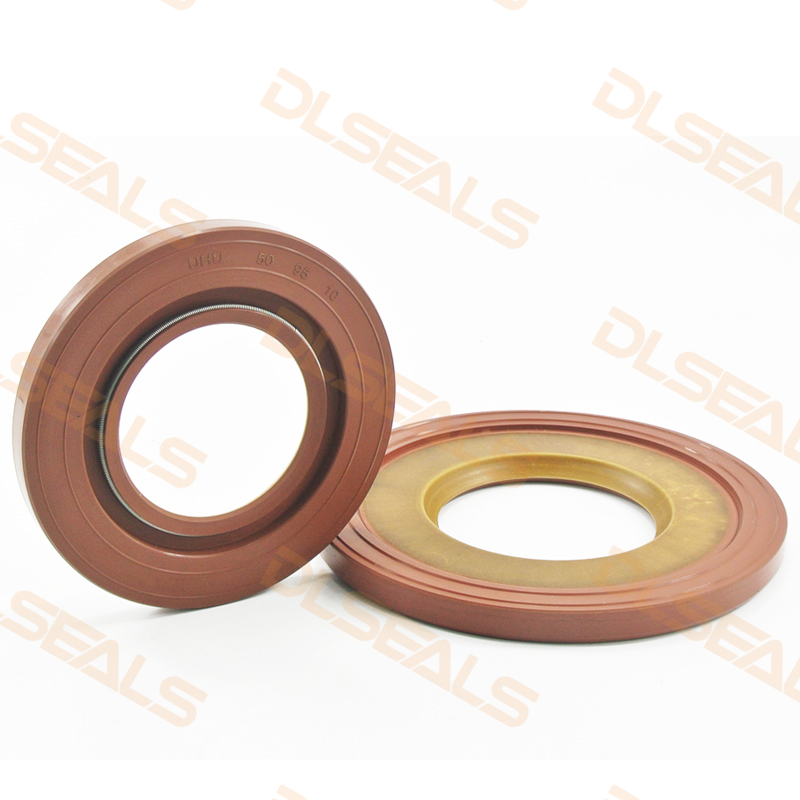
In industrial equipment operating under high temperatures, high speeds, aggressive media, or low-friction requirements, conventional rubber oil seals may be limited by their temperature resistance, chemical compatibility, and friction characteristics. PTFE oil seals offer excellent temperature resistance, chemical resistance, low friction, and self-lubricating properties, making them an important solution for demanding rotary sealing applications.
Unlike conventional rubber oil seals, PTFE oil seals typically use a PTFE sealing lip combined with a metal case, spring, or other supporting structures. Through precision machining and specialized lip designs, they can maintain reliable sealing performance under high-speed rotation, elevated temperatures, and complex media conditions.
Material Characteristics of PTFE Oil Seals
PTFE is a high-performance engineering material known for its low coefficient of friction and excellent chemical stability. One of its most important advantages is its low friction, which can effectively reduce frictional heat between the sealing lip and shaft under suitable lubrication conditions. This makes PTFE particularly suitable for high-speed rotating shafts.
PTFE also provides excellent resistance to a wide range of chemicals, including many acids, alkalis, solvents, oils, and other aggressive media. This makes PTFE oil seals suitable for chemical equipment, pumps, compressors, gearboxes, and specialized fluid-handling systems.
Another important advantage is its wide operating temperature capability. However, the actual allowable operating temperature of a PTFE oil seal cannot be determined simply by referring to the theoretical temperature range of virgin PTFE. Seal structure, filler composition, shaft speed, pressure, medium, and heat dissipation conditions can all affect the actual operating temperature.
Pure PTFE also has a certain tendency toward cold flow and creep. For this reason, industrial PTFE oil seals generally use filled PTFE compounds rather than pure PTFE. Fillers such as glass fiber, carbon fiber, graphite, and bronze can be added to improve wear resistance, dimensional stability, and resistance to deformation.
PTFE Oil Seal Structure and Design
The performance of a PTFE oil seal depends not only on the material but also on its sealing lip design.
Common configurations include single-lip, double-lip, and sealing structures with an additional dust lip. Depending on the pressure and medium conditions, different lip angles, preload structures, and hydrodynamic features can be designed to provide a more stable sealing interface during rotation.
For high-speed applications, the contact pressure between the sealing lip and shaft must be carefully controlled. Excessive contact pressure increases friction and heat generation, while insufficient pressure may result in leakage. Therefore, the design must achieve a balance between sealing performance, friction, temperature rise, and service life.
Some PTFE oil seals use a metal case to provide structural support and a spring to maintain continuous lip preload. This allows the sealing lip to compensate for a certain degree of wear and minor shaft eccentricity.
For higher-pressure applications, additional support structures or combined sealing designs can be used to prevent excessive deformation or extrusion of the PTFE sealing lip under pressure.
PTFE Oil Seals vs. Conventional Rubber Oil Seals
Compared with conventional rubber oil seals such as NBR and FKM, the main advantage of PTFE oil seals is not that they outperform rubber seals in every application, but that they offer greater adaptability under high-temperature, high-speed, chemically aggressive, and low-friction conditions.
Rubber oil seals provide excellent elasticity and relatively low manufacturing costs, making them suitable for general rotary shaft sealing. PTFE has lower elastic recovery than rubber, so PTFE oil seals rely more heavily on precise lip geometry, preload design, and proper shaft surface conditions.
In simple terms:
General applications and cost-sensitive designs → Rubber oil seals are often more economical.
High temperature, high speed, aggressive media, or low-friction requirements → PTFE oil seals often provide greater advantages.
Therefore, PTFE oil seals should not be regarded simply as direct replacements for conventional rubber oil seals. They are high-performance rotary sealing solutions developed for more demanding operating conditions.
Typical Applications
Thanks to their material properties and structural flexibility, PTFE oil seals can be used in a wide range of industrial equipment, including:
- High-speed motors
- Gearboxes and reducers
- Hydraulic equipment
- Vacuum equipment
- Pumps and compressors
- Chemical processing equipment
- Food processing equipment
- Pharmaceutical equipment
- Automotive and new energy systems
- Semiconductor equipment
- Aerospace equipment
- High-temperature and high-speed rotating machinery
PTFE oil seals are particularly valuable in applications involving high-speed rotation, low-friction requirements, dry or minimally lubricated conditions, and aggressive chemical media.
Key Factors for PTFE Oil Seal Selection
Selecting a PTFE oil seal requires more than simply matching the seal dimensions. The actual operating conditions should be evaluated comprehensively.
The first considerations are the shaft diameter, housing dimensions, and available installation space, which determine the basic dimensions and structure of the seal.
The next factors are shaft speed and direction of rotation. For high-speed applications, the sealing lip geometry and PTFE compound require particular attention. For unidirectional rotation, directional hydrodynamic features can also be incorporated to improve dynamic sealing performance.
Operating temperature, pressure, and medium are equally important. Different PTFE compounds provide different levels of wear resistance, thermal conductivity, creep resistance, and chemical compatibility. The material should therefore be selected according to the specific operating environment.
In addition, shaft surface roughness, hardness, concentricity, and runout can directly affect seal life. Even a high-performance PTFE material may experience premature wear or leakage if the shaft surface is scratched, unevenly worn, or subject to excessive radial runout.
Conclusion
The key advantages of PTFE oil seals include low friction, high-temperature resistance, excellent chemical resistance, and strong performance in high-speed rotary applications. However, the overall performance of a PTFE oil seal is determined not only by the PTFE material itself, but also by the compound formulation, lip geometry, spring preload, metal case design, and shaft surface conditions.
For rotary sealing applications involving high temperatures, high speeds, aggressive media, or low-friction requirements, the PTFE material and seal structure should be selected according to the actual operating conditions rather than simply replacing a conventional rubber oil seal with a PTFE version.
Post time: Sep-02-2026


