
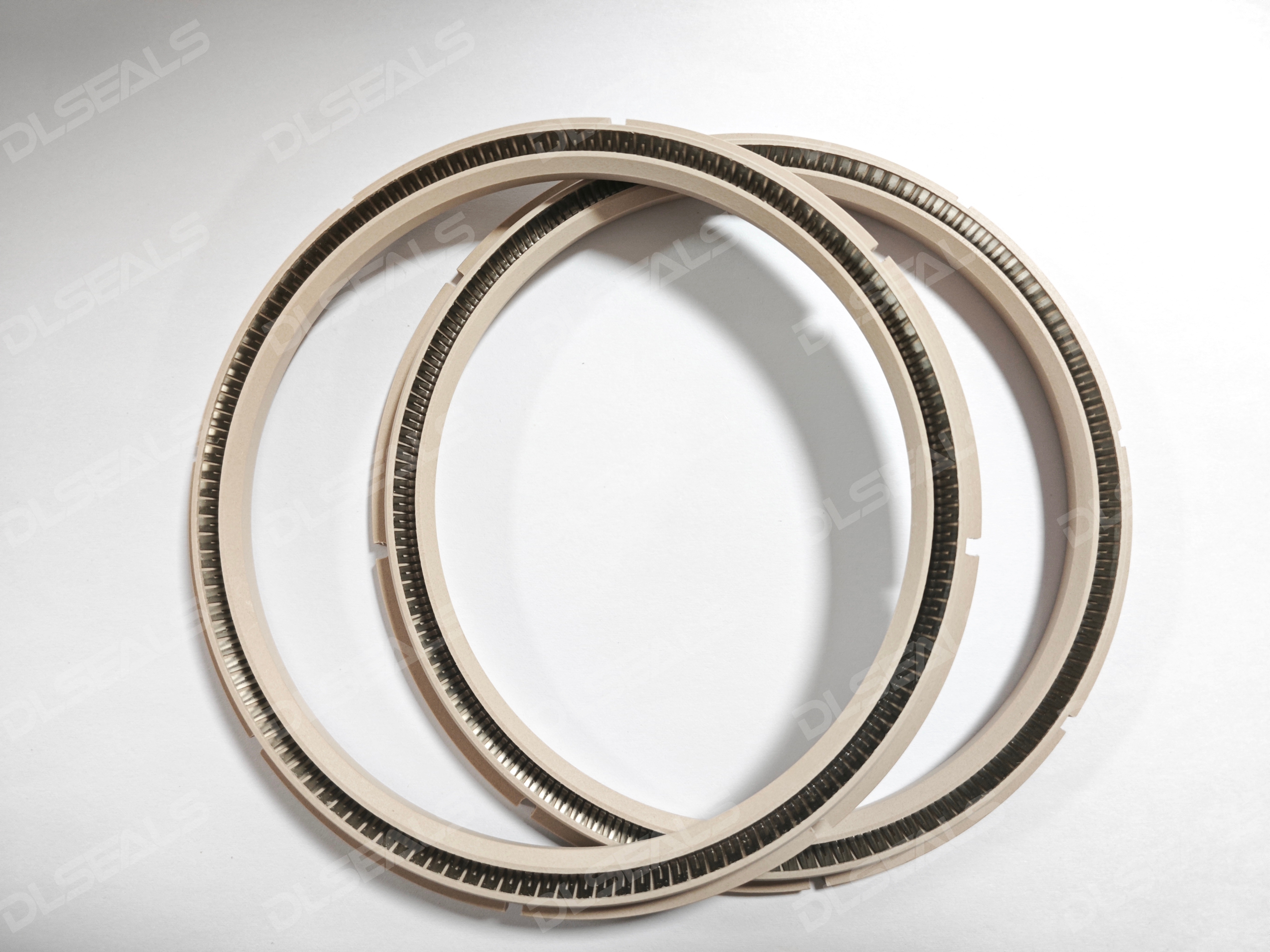
In industries such as oil and gas production, mining, slurry transportation, dredging, marine engineering, and chemical processing, sealing systems often operate in one of the most challenging environments: sand-containing and abrasive media applications.
Unlike clean liquids or gases, abrasive media not only require seals to withstand temperature, pressure, and chemical exposure, but also demand exceptional resistance to wear caused by solid particles. In many cases, seal failures are not the result of material aging but are caused by continuous erosion, scratching, and abrasion from sand particles. Therefore, selecting the right sealing material is critical for maximizing equipment reliability, extending service life, and reducing maintenance costs.
How Sand Particles Affect Sealing Performance
Solid particles suspended in the fluid continuously impact sealing surfaces during operation. When the particles possess high hardness, they act as abrasives that gradually wear away the seal interface.
Common wear mechanisms include:
- Erosive wear
- Abrasive wear
- Scoring wear
- Particle embedding wear
Quartz sand, for example, has a Mohs hardness of approximately 7, significantly harder than most elastomers and many engineering plastics. Once abrasive particles enter the sealing interface, they can damage the contact surface and lead to:
- Increased surface roughness
- Reduced contact pressure
- Higher leakage rates
- Premature seal failure
In high-velocity flow conditions, the wear rate can increase dramatically, resulting in rapid deterioration of sealing performance.
Key Factors in Selecting Seal Materials for Abrasive Media
When choosing sealing materials for sand-laden fluids, engineers typically focus on several critical properties.
Wear Resistance
Wear resistance is the most important consideration.
The material must withstand continuous abrasion and particle impact without excessive material loss. Poor wear resistance often leads to rapid seal degradation and increased maintenance requirements.
Mechanical Strength
In high-pressure applications, sealing materials must maintain structural integrity.
Materials with insufficient strength may experience:
- Cold flow
- Extrusion
- Permanent deformation
These issues can compromise sealing effectiveness and shorten service life.
Particle Accommodation Capability
Some softer materials can absorb or embed fine particles within their surface, reducing damage to the mating hardware.
This characteristic is particularly valuable in dynamic sealing applications where particle contamination cannot be avoided.
Chemical Compatibility
Sand-containing media are frequently combined with aggressive fluids such as:
- Crude oil
- Produced water
- Seawater
- Drilling mud
- Chemical additives
- Acidic or alkaline solutions
As a result, sealing materials must also provide excellent chemical resistance.
Performance of Common Seal Materials in Sand-Containing Applications
PTFE (Polytetrafluoroethylene)
PTFE is widely used in chemical processing because of its outstanding chemical resistance and low friction coefficient.
However, virgin PTFE has several limitations:
- Relatively poor wear resistance
- Susceptibility to cold flow
- Reduced dimensional stability under high pressure
For this reason, it is generally recommended only for light abrasive applications.
Common reinforced grades include:
- Glass-filled PTFE
- Carbon-filled PTFE
- Graphite-filled PTFE
These modified materials can significantly improve wear resistance compared to virgin PTFE.
PEEK (Polyether Ether Ketone)
PEEK is one of the most widely used high-performance materials for abrasive sealing environments.
Its advantages include:
- Excellent wear resistance
- High mechanical strength
- Outstanding dimensional stability
- Continuous service temperatures up to approximately 250°C
PEEK is commonly used to manufacture:
- Valve seats
- Back-up rings
- Guide rings
- Wear rings
In oilfield equipment, high-pressure ball valves, plug valves, and hydraulic fracturing systems, PEEK often provides substantially longer service life than conventional PTFE materials.
Carbon Fiber Reinforced PEEK (CF-PEEK)
CF-PEEK is considered an advanced solution for severe abrasive applications.
Compared with unfilled PEEK, CF-PEEK offers:
- 30% to 100% higher wear resistance
- Improved dimensional stability
- Greater load-bearing capability
It is widely used in:
- High-pressure ball valve seats
- Fracturing tree sealing systems
- Wellhead equipment
- Subsea production systems
For applications involving continuous quartz sand erosion, CF-PEEK can significantly extend maintenance intervals and reduce operating costs.
UHMWPE (Ultra-High Molecular Weight Polyethylene)
UHMWPE is recognized for its exceptional abrasion resistance.
Key benefits include:
- Extremely low friction coefficient
- Excellent impact resistance
- Good particle embedding capability
It is frequently used in mining, slurry transport systems, and dredging equipment.
However, its operating temperature is typically limited to approximately 80°C, making it most suitable for low-temperature abrasive environments.
Polyurethane (PU)
Polyurethane is commonly used in hydraulic sealing systems.
Its primary advantages include:
- High elasticity
- Excellent tear resistance
- Good abrasion resistance
Typical applications include:
- Hydraulic piston seals
- Rod seals
- Wiper seals
Although PU performs well in abrasive hydraulic systems, its temperature resistance may be insufficient for some high-temperature oil and gas applications.
Elastomeric Materials
Common elastomers include:
- NBR (Nitrile Butadiene Rubber)
- HNBR (Hydrogenated Nitrile Butadiene Rubber)
- FKM (Fluoroelastomer)
These materials primarily provide elastic sealing performance.
Their strengths include:
- Excellent sealing conformity
- Good particle tolerance
- Reliable static sealing capability
However, in highly abrasive environments, elastomers alone often wear rapidly and therefore are typically combined with wear-resistant back-up rings or anti-extrusion elements.
Why Metal Seals Are Used in Severe Abrasive Applications
In applications with extremely high concentrations of hard particles, conventional soft sealing materials may not provide adequate service life.
Examples include:
- Hydraulic fracturing flowback systems
- High-density mineral slurry pipelines
- Oil sands production facilities
- Dredging and excavation equipment
Under these conditions, metal-to-metal sealing solutions are often preferred.
Common surface technologies include:
- Tungsten carbide (WC) coating
- Chromium carbide coating
- Stellite hardfacing
- Cemented carbide sealing surfaces
Although metal seals may offer slightly lower tightness compared with soft seals, they can deliver dramatically longer service life under severe abrasive conditions.
Recommended Seal Materials for Different Abrasive Media Conditions
The following guidelines can assist engineers in selecting appropriate sealing materials:
| Operating Condition | Recommended Materials |
|---|---|
| Low sand concentration, ambient temperature | NBR, UHMWPE |
| Moderate sand concentration, oil & gas service | Filled PTFE, PEEK |
| High sand concentration, high-pressure service | CF-PEEK, Reinforced PEEK |
| High-temperature abrasive environments | PEEK, PI, Metal Seals |
| Extreme erosion and abrasion conditions | Tungsten Carbide Hard Seals, Metal-to-Metal Seals |
It is important to note that seal life depends not only on the material itself but also on particle size, particle concentration, flow velocity, pressure, temperature, and mating surface hardness. Therefore, sealing materials, seal design, and surface engineering should be optimized as an integrated system.
Conclusion
In sand-containing and abrasive media applications, wear resistance has become a more critical factor than corrosion resistance in determining seal performance and service life. As oil and gas exploration moves into harsher environments and mining operations handle increasingly abrasive slurries, advanced materials such as PEEK, CF-PEEK, reinforced PTFE, and metal sealing systems are increasingly replacing traditional sealing solutions.
By selecting the appropriate seal material and engineering the sealing system for the specific abrasive environment, operators can significantly reduce leakage risks, extend maintenance intervals, and improve equipment reliability. As industrial applications continue to evolve, specialized sealing solutions for abrasive media will remain a key area of innovation in sealing technology.
Post time: Jun-05-2026


