
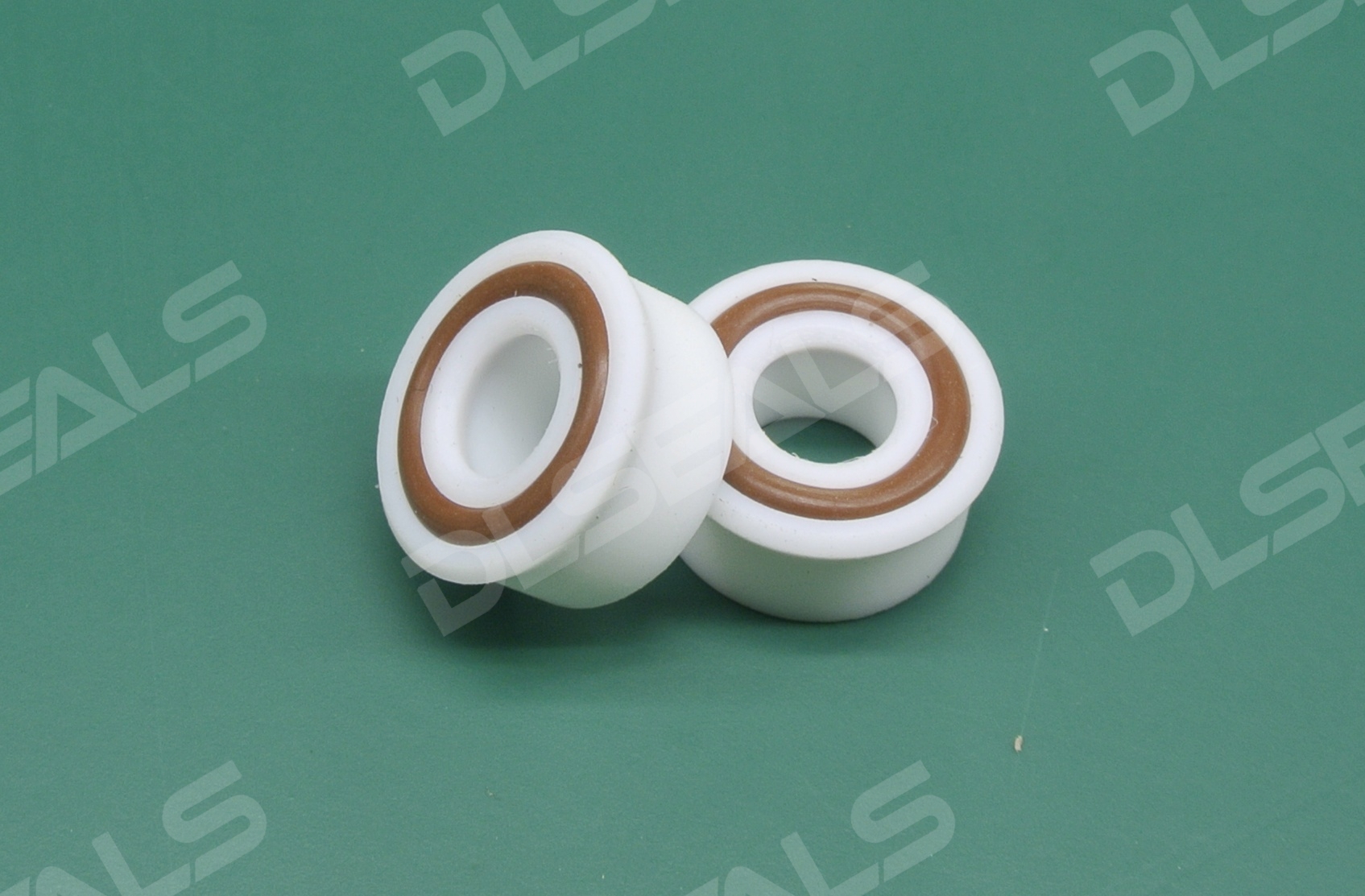
In modern industrial fluid control and sealing engineering, traditional rubber and elastomeric seals increasingly show their limitations due to severe media corrosiveness, drastic system temperature fluctuations, and the prevalence of high-pressure operating conditions. Polytetrafluoroethylene (PTFE) seals—commonly referred to as the “King of Plastics”—have become indispensable core sealing components in petrochemicals, semiconductor manufacturing, medical devices, and high-precision equipment, thanks to their unparalleled chemical inertness, extremely wide temperature range, and remarkably low friction coefficient.
1. Core Performance Advantages of PTFE Material
The ability of PTFE seals to maintain stable performance under extreme conditions stems primarily from the strong C–F bonds in their molecular structure:
-
Extremely Wide Temperature Range: Operates stably from -200°C to +260°C, handling both cryogenic liquid nitrogen environments and high-temperature steam or thermal oil.
-
Exceptional Chemical Stability: Exhibits complete chemical inertness to nearly all strong acids, bases, powerful oxidizers, and organic solvents, except for molten alkali metals and elemental fluorine under high temperature and pressure.
-
Self-Lubricating with Low Friction: Features a very low dynamic and static friction coefficient (0.04–0.10), ensuring smooth operation under dry or unlubricated conditions and preventing stick-slip phenomena.
-
Weathering Resistance and Low Water Absorption: Displays excellent weatherability, radiation resistance, and near-zero water absorption, retaining its performance over long-term storage and service.
2. Limitations of Virgin PTFE and Modification Technologies
While virgin PTFE offers outstanding physical and chemical properties, its high cold flow (creep), low wear resistance, and insufficient tensile strength limit its direct use in high-pressure or high-speed reciprocating applications. To enhance its overall mechanical performance, filled modification is widely employed in engineering:
| Material Type | Core Advantage After Modification | Typical Application Scenarios |
| Bronze Powder | Significantly reduces creep; greatly improves thermal conductivity, hardness, and wear resistance | Glyd rings for heavy-duty hydraulic cylinders, wear rings, guide sleeves |
| Glass Fiber | Enhances compressive strength and wear resistance; lowers thermal expansion coefficient and creep | Sealing gaskets for chemical pipeline valves, general valve seats |
| Carbon Fiber / Graphite | Excellent self-lubrication; superior friction resistance; high extrusion resistance | Seal rings for oil-free compressors, high-speed rotary shaft seals |
| Molybdenum Disulfide (MoS₂) | Reduces breakaway friction force; increases surface hardness | Seals for high-frequency reciprocating motion |
3. Typical PTFE Seal Structures and Engineering Applications
By combining modification technologies with precision machining, PTFE seals have evolved into several classic industrial structural forms:
1. Spring-Energized Seals (Omniseal / Variseal)
-
Structural Composition: Composed of an outer modified PTFE seal jacket combined with an internal corrosion-resistant metal spring (such as V-shaped, U-shaped, or C-shaped springs).
-
Dual Protection Mechanism:
-
Modified PTFE Seal Jacket: Directly contacts the sealing media and metallic mating parts (shaft/bore), providing a low-friction, corrosion-resistant dynamic or static contact surface.
-
Metal Spring: Installed inside the jacket to supply continuous, permanent spring pre-load, effectively compensating for sealing force decay caused by wear, temperature shifts, or PTFE cold flow (creep).
-
-
Working Principle: Uses the internal spring for initial pre-load, combined with system fluid pressure to achieve self-sealing.
-
Applications: LNG cryogenic valves, aerospace hydraulic valves, semiconductor etching equipment, and other extreme environments.
2. Combination Seals (Glyd Rings / Step Seals)
-
Structural Features: Composed of a PTFE step ring combined with a rubber O-ring that provides elastic pre-load.
-
Working Principle: The O-ring delivers stable radial elasticity to press the PTFE seal ring against the sealing surface, maintaining high-pressure sealing integrity while taking advantage of PTFE to minimize reciprocating friction.
-
Applications: Main hydraulic cylinders for excavators, injection molding machine clamping cylinders, and hydraulic cylinder piston/piston rod seals.
3. Expanded PTFE (ePTFE) Gaskets
-
Structural Features: Formed through a specialized stretching process that creates a porous, micro-fibrous network structure.
-
Working Principle: Retains full PTFE chemical resistance while gaining superior flexibility and creep resistance, conforming seamlessly to rough or uneven flange surfaces.
-
Applications: Enamel reactors, glass pipeline flanges, and strong acid/alkali storage tank sealing.
4. Design, Processing, and Installation Practices
-
Precision Machining: PTFE has low thermal conductivity and a high thermal expansion coefficient. Sharp cutting tools and effective thermal control are required during machining to prevent dimensional tolerances from exceeding limits due to localized overheating.
-
Groove and Chamfer Design: When assembling PTFE seals, the shaft end and groove entrance must feature a 15°–30° lead-in chamfer with all burrs thoroughly removed to prevent sharp edges from damaging the PTFE sealing lips.
-
Specialized Installation Tools: For PTFE combination seals in closed grooves, specialized expansion and resizing tools must be used during installation. After the PTFE component is expanded and fitted into the groove, a resizing sleeve restores its original dimensions to maintain the required initial sealing stress.
As new materials and manufacturing processes evolve, modified PTFE seals continue to advance toward high-pressure, high-frequency, ultra-low-temperature, and zero-contamination applications, serving as vital foundational components for modern high-end equipment.
Post time: Aug-10-2026


