
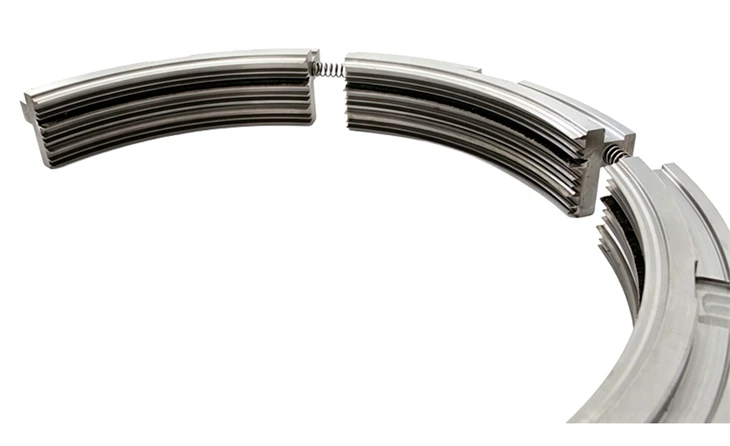
Turbine shaft seals are critical sealing components used in turbines, steam turbines, gas turbines, expanders, and other rotating equipment. They are typically installed between the rotating shaft and stationary housing to minimize media leakage while preventing external air, dust, or other contaminants from entering the equipment. Unlike static seals, turbine shaft seals operate under complex conditions involving high rotational speeds, temperature variations, pressure differentials, and vibration. Therefore, sealing material, structural design, shaft surface quality, and installation accuracy all have a significant impact on sealing performance.
Working Principle of Turbine Shaft Seals
The primary function of a turbine shaft seal is to establish a stable sealing interface between the rotating shaft and stationary housing. During high-speed rotation, the seal must maintain effective sealing while controlling friction and heat generation.
Depending on the design, turbine shaft seals can be classified as contact seals, non-contact seals, or combined sealing systems.
Contact shaft seals generally use a sealing lip, sealing ring, or elastic element to maintain a certain contact pressure against the shaft surface, forming a dynamic seal during rotation. They offer relatively compact designs and good sealing performance at lower speeds. However, friction, heat generation, and wear must be carefully controlled at high rotational speeds.
Non-contact seals use extremely small clearances, labyrinth structures, or specially designed flow paths to restrict media leakage. Since the sealing elements do not continuously contact the shaft, friction and wear are significantly reduced, making these designs suitable for high-speed rotating equipment.
Some high-performance turbines also use multi-stage sealing systems, in which multiple sealing elements progressively reduce pressure and leakage to improve overall sealing performance.
Material Selection for Turbine Shaft Seals
Material selection is one of the key factors affecting shaft seal service life. Temperature resistance alone is not sufficient for material selection. The operating medium, pressure, shaft speed, friction, lubrication conditions, and thermal expansion must also be considered.
For general temperature and speed conditions, NBR and FKM can be used in certain rotary shaft sealing applications. However, conventional rubber materials may have limitations under high-temperature, high-speed, or aggressive chemical conditions.
PTFE and modified PTFE compounds offer low friction, excellent chemical resistance, and a wide operating temperature range, making them widely used in high-performance rotary shaft seals. Fillers such as carbon fiber, glass fiber, graphite, and bronze can be added to improve wear resistance, dimensional stability, and thermal conductivity.
PEEK and other high-performance engineering plastics are suitable for demanding applications involving higher temperatures, pressures, or wear requirements. For extreme temperatures or highly specialized media, metallic seals or other specialty materials may be required.
Effects of High-Speed Rotation on Shaft Seals
One of the major differences between turbine shaft seals and conventional static seals is that shaft seals must continuously withstand friction and centrifugal effects caused by rotation.
As shaft speed increases, frictional heat generated at the sealing interface also increases. If heat dissipation is insufficient, the sealing lip temperature may rise rapidly, potentially causing material hardening, softening, thermal aging, or accelerated wear.
Therefore, high-speed shaft seal design should consider:
- Shaft speed and peripheral velocity
- Sealing lip contact pressure
- Coefficient of friction
- Lubrication and cooling conditions
- Shaft surface roughness and hardness
- Wear resistance of the sealing material
- Heat dissipation capability of the seal
For high-speed turbines, simply increasing sealing contact pressure is not necessarily an effective way to improve sealing performance. Excessive contact pressure may reduce initial leakage but can also significantly increase friction and temperature, ultimately shortening seal service life.
Common Failure Causes of Turbine Shaft Seals
Turbine shaft seal failures are generally caused by a combination of sealing material, shaft surface condition, installation accuracy, and operating conditions rather than by a single factor.
Wear is one of the most common problems in rotary shaft seals. Long-term high-speed operation gradually wears the sealing lip, reducing contact pressure and eventually increasing leakage.
Thermal damage is often associated with high rotational speed, insufficient lubrication, or poor heat dissipation. When the sealing area exceeds the material’s long-term temperature capability, sealing performance can deteriorate significantly.
Shaft surface damage can also directly affect seal life. Scratches, corrosion, excessive roughness, or shaft eccentricity may cause rapid wear of the sealing lip.
In addition, shaft radial runout, installation misalignment, and equipment vibration can cause periodic deformation of the sealing lip. When the seal cannot adequately follow shaft movement, localized leakage and abnormal wear may occur.
How to Select a Turbine Shaft Seal
Turbine shaft seals should not be selected based solely on shaft diameter. Proper selection should begin with the actual operating conditions, including the medium, temperature, pressure, shaft speed, shaft diameter, direction of rotation, and lubrication conditions.
For high-speed rotating equipment, particular attention should be paid to the friction and wear characteristics of the sealing material and its allowable peripheral speed. For high-temperature applications, long-term temperature resistance and thermal stability are critical. For corrosive media, chemical compatibility should be a primary consideration.
The shaft hardness, surface roughness, concentricity, and radial runout should also be evaluated. If the equipment has significant eccentricity or vibration, simply replacing the seal with a higher-grade material may not solve the leakage problem.
For high-temperature, high-speed, high-pressure, or poorly lubricated applications, high-performance materials such as PTFE and PEEK can be considered. Multi-stage, non-contact, or combined sealing structures may also be used to reduce the operating load on individual sealing elements.
Conclusion
Turbine shaft seals are typical dynamic sealing components whose performance depends not only on the seal itself but also on shaft speed, temperature, pressure, medium, lubrication, shaft surface condition, and equipment accuracy.
In practical applications, a softer material does not necessarily provide better sealing, and greater sealing pressure does not necessarily result in longer service life. High-speed turbines require an integrated approach covering material selection, sealing structure, friction, heat dissipation, and equipment operating conditions.
For demanding applications involving high temperature, high speed, poor lubrication, or specialized media, sealing materials and structures should be selected according to the actual operating parameters. This helps control leakage while reducing friction, heat generation, and wear, resulting in more stable and longer-lasting shaft sealing performance.
Post time: Sep-18-2026


