
As industrial equipment continues to evolve toward higher speeds, greater reliability, and longer service life, conventional rotary shaft oil seals are increasingly challenged by demanding operating conditions. In applications involving high rotational speeds, insufficient lubrication, shaft misalignment, vibration, or contamination from dust and abrasive particles, traditional straight-lip oil seals may experience accelerated wear, lubricant leakage, and premature sealing failure.
To address these challenges, the Wave Lip Rotary Oil Seal has been developed. Unlike conventional sealing lips, the wave lip design incorporates a specially engineered undulating profile that optimizes contact pressure distribution and lubricant flow. This innovative geometry significantly improves sealing efficiency, reduces friction and heat generation, and extends seal life, making it an ideal solution for automotive, industrial, agricultural, and heavy-duty rotating equipment.
What Is a Wave Lip Rotary Oil Seal?
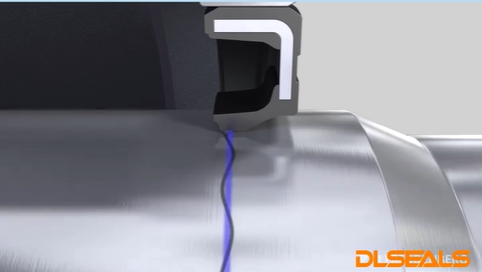
A Wave Lip Rotary Oil Seal is a radial shaft seal featuring a specially designed wave-shaped sealing lip. Although its overall construction is similar to that of a standard rotary shaft oil seal—including a metal case, elastomer sealing element, garter spring, and sealing lip—the primary difference lies in the unique geometry of the lip itself.
Instead of forming a continuous linear contact with the shaft, the wave-shaped lip creates multiple alternating contact zones around the shaft circumference. This design enhances lubricant circulation within the sealing interface and establishes a more stable hydrodynamic lubrication film during shaft rotation.
The result is improved sealing performance, reduced frictional losses, and greater resistance to wear under dynamic operating conditions.
Working Principle of a Wave Lip Rotary Oil Seal
Like conventional radial shaft seals, the Wave Lip Rotary Oil Seal operates as a contact-type dynamic seal. However, its sealing performance is enhanced through the combined action of elastic preload, hydrodynamic lubrication, and pressure-balanced wave geometry.
After installation, the garter spring continuously applies a uniform radial force to the sealing lip, ensuring constant contact with the rotating shaft. As the shaft begins to rotate, a microscopic lubricant film—typically only a few micrometers thick—is formed between the sealing lip and the shaft surface.
The wave-shaped profile creates alternating high- and low-pressure zones along the sealing edge. As the shaft rotates, these pressure variations generate a localized hydrodynamic pumping effect that actively circulates lubricant within the sealing interface. Instead of allowing lubricant to migrate toward the atmosphere, the wave lip continuously redirects it back toward the lubricant side of the system.
This self-generated pumping action not only improves oil retention but also maintains a stable lubricating film, reducing direct rubber-to-metal contact. Consequently, friction, operating temperature, and sealing lip wear are all significantly reduced.
In addition, the periodic wave geometry distributes contact stress more evenly around the shaft circumference. This minimizes localized stress concentrations that often occur with conventional straight-lip seals, resulting in smoother operation and longer service life.
Key Advantages of Wave Lip Rotary Oil Seals
Enhanced Hydrodynamic Pumping Performance
The most significant advantage of the wave lip design is its superior hydrodynamic pumping capability. The wave geometry continuously guides lubricant back toward the oil side, providing more effective oil retention than conventional sealing lips, particularly at high shaft speeds.
This improved pumping action helps minimize lubricant leakage while maintaining optimal lubrication within the sealing interface.
Reduced Friction and Lower Operating Temperature
Unlike traditional straight sealing lips that apply uniform contact pressure around the entire shaft circumference, the wave lip distributes pressure more efficiently.
The improved lubricant circulation reduces the likelihood of dry friction and decreases the coefficient of friction, leading to lower operating temperatures. Reduced heat generation also slows elastomer aging and significantly extends seal life.
Better Compensation for Shaft Misalignment
In practical applications, rotating shafts inevitably experience minor runout, eccentricity, or vibration. Conventional sealing lips may develop localized wear due to uneven contact pressure under these conditions.
The wave lip design offers greater flexibility and adaptive sealing performance, allowing the sealing lip to accommodate slight shaft movements while maintaining consistent sealing pressure. This results in improved sealing stability and reduced wear over extended operating periods.
Longer Service Life
By combining optimized pressure distribution, improved lubrication, and lower friction, Wave Lip Rotary Oil Seals generally achieve a considerably longer operational life than conventional oil seals.
For equipment operating continuously or in applications where maintenance downtime is costly, the extended service life provides significant economic benefits by reducing replacement frequency and maintenance costs.
Typical Applications
Wave Lip Rotary Oil Seals are particularly suitable for applications requiring high sealing reliability under demanding operating conditions, including:
- High-speed electric motors
- Gearboxes and reducers
- Industrial pumps
- Compressors
- Fans and blowers
- Automotive transmissions
- Agricultural machinery
- Construction equipment
- Industrial automation systems
- New energy vehicle drive units
These seals are especially effective in applications involving continuous operation, limited lubrication, slight shaft misalignment, or stringent leakage control requirements.
Material Selection
The performance of a Wave Lip Rotary Oil Seal depends not only on its lip geometry but also on the sealing material selected for the application.
NBR (Nitrile Rubber) provides excellent resistance to mineral oils and offers a cost-effective solution for general industrial applications.
FKM (Fluoroelastomer) delivers outstanding resistance to high temperatures, fuels, and aggressive chemicals, making it suitable for demanding automotive and industrial environments.
HNBR (Hydrogenated Nitrile Rubber) combines excellent wear resistance with superior mechanical strength, making it ideal for high-speed, heavy-load, and shock-loaded equipment.
For food processing, pharmaceutical, or chemically aggressive environments, materials such as Silicone Rubber (VMQ) or PTFE composite sealing elements may also be selected according to specific operating requirements.
How to Select the Right Wave Lip Rotary Oil Seal
Selecting the appropriate Wave Lip Rotary Oil Seal requires evaluating the entire operating environment rather than focusing solely on shaft size. Key factors include rotational speed, operating temperature, system pressure, lubricant type, shaft surface finish, contamination level, and expected service life.
For conventional low-speed applications operating under clean conditions, a standard radial shaft oil seal is often sufficient. However, for equipment running at high rotational speeds, under continuous duty cycles, or in applications where leakage must be minimized, a Wave Lip Rotary Oil Seal offers significant performance advantages.
Proper shaft hardness, surface roughness, concentricity, and installation accuracy are equally important. Even the highest-quality seal cannot achieve optimal performance if the shaft or housing does not meet recommended engineering tolerances.
Therefore, selecting both the appropriate sealing material and lip design is essential for maximizing sealing reliability and extending equipment life.
Conclusion
Wave Lip Rotary Oil Seals represent an important advancement in rotary sealing technology. By replacing the conventional straight sealing lip with an engineered wave-shaped profile, these seals significantly improve lubricant circulation, enhance hydrodynamic pumping performance, reduce friction, lower operating temperatures, and distribute contact pressure more evenly.
Compared with conventional rotary shaft oil seals, Wave Lip Rotary Oil Seals provide superior sealing performance, greater resistance to shaft misalignment, and substantially longer service life, particularly in high-speed and demanding industrial applications.
As industrial equipment continues to pursue higher efficiency and lower maintenance costs, advanced sealing technologies such as Wave Lip Rotary Oil Seals are becoming an increasingly preferred solution for OEM manufacturers and maintenance engineers alike.
DLSEALS offers a comprehensive range of Wave Lip Rotary Oil Seals manufactured from NBR, HNBR, FKM, PTFE, and other advanced materials. With extensive engineering experience and custom design capabilities, DLSEALS provides reliable sealing solutions tailored to a wide variety of industries, helping customers improve equipment reliability while reducing maintenance costs and downtime.
Post time: Jun-26-2026


