
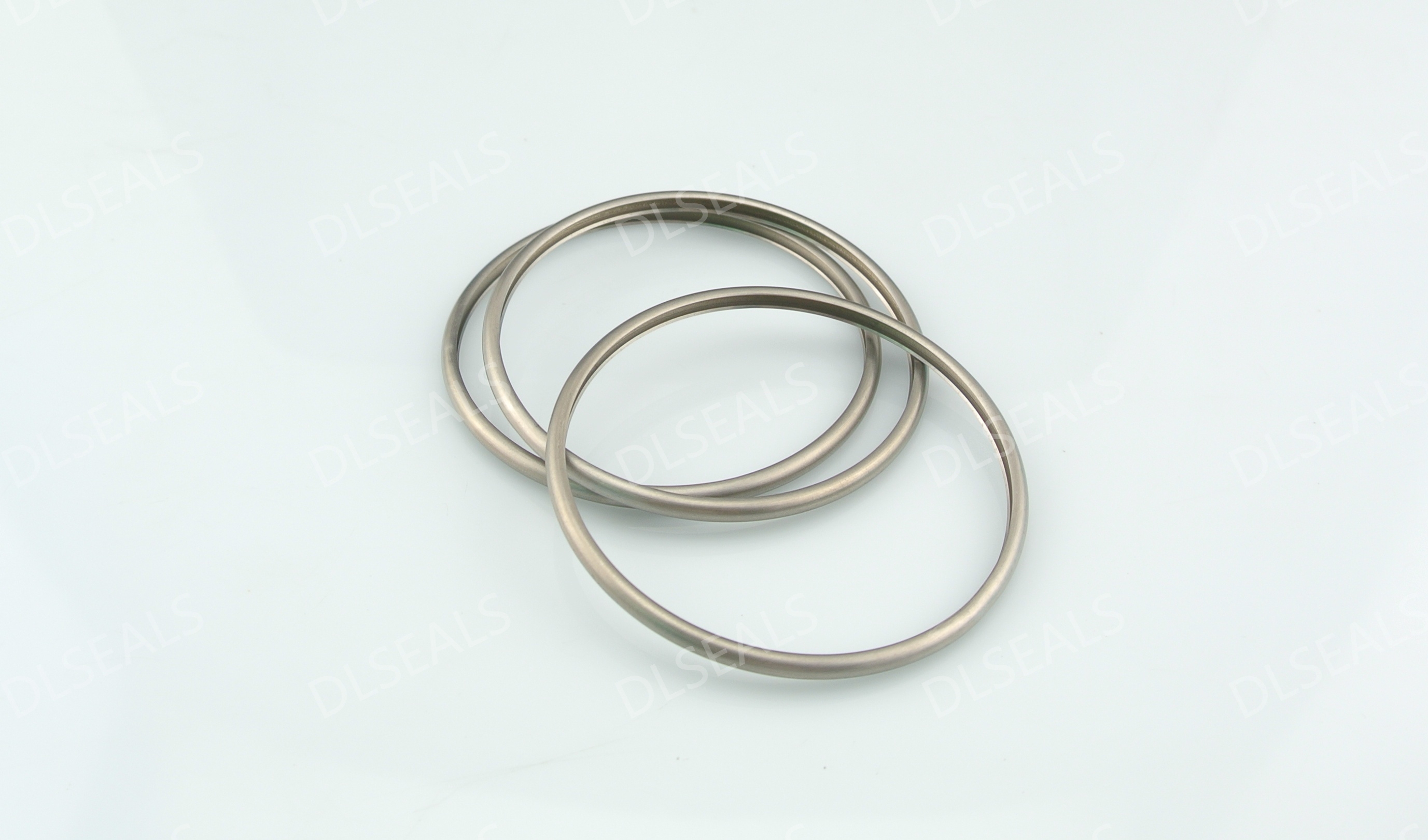
In the research, development, and design of modern high-performance diesel engines, the cylinder head gasket (sealing structure) is subjected to the most severe coupled thermal-mechanical loads in the entire engine. Due to the differences in physical properties between the cast iron engine block and the aluminum alloy cylinder head, highly challenging displacements and deformations occur under high temperatures, high pressures, and dynamic cyclic impacts.
To address the extreme operating conditions of 700–800°C peak temperature, 100 MPa cyclic pulse pressure, and the cast iron / aluminum alloy dissimilar metal combination, the Metal C-Ring static seal, with its unique structural elasticity and springback capacity, serves as an ideal solution to prevent cylinder combustion pressure leakage.
1. Operational Challenges and Mechanism Analysis
Prior to analyzing the application of Metal C-Rings, three core challenges posed by these operating conditions must be defined:
-
Thermal Stress and Thermal Expansion Mismatch (Thermal Tension / Shear Deformation):
The linear thermal expansion coefficient of the cast iron cylinder block is approximately $10 \sim 12 \times 10^{-6} /\text{K}$, whereas that of the aluminum alloy cylinder head reaches $22 \sim 24 \times 10^{-6} /\text{K}$. At peak temperatures of 700–800°C, the expansion of the aluminum cylinder head is significantly higher than that of the cast iron block, resulting in severe relative thermal displacement and shear forces at the sealing interface. Furthermore, as the tensile and yield strengths of aluminum alloys drop sharply above 200–250°C, excessive localized clamping force cannot be applied, as it would easily cause plastic indentation on the aluminum head groove surface.
-
100 MPa Alternating Impact Pressure (Dynamic Sealing Gap Separation):
Diesel combustion pressure exhibits high-frequency and high-fluctuation pulse characteristics. A peak cyclic pressure of 100 MPa causes slight elastic elongation of the cylinder head bolts, inducing micrometer-scale alternating gap separation between the cylinder head and engine block. Traditional hard packings or conventional metal gaskets lack self-energizing capability and recovery rates, making them extremely vulnerable to micro-leakage or erosion under such dynamic gap fluctuations.
-
High-Temperature Diesel Combustion Gas Erosion:
Combustion exhaust gas contains complex oxides, unburned carbon particles, and sulfides. Under extreme temperatures of 800°C, it exhibits strong thermal oxidation and corrosiveness; hence, the sealing substrate material must possess exceptional high-temperature oxidation resistance and creep resistance.
2. Working Principle and Self-Energizing Mechanism of Metal C-Rings
A Metal C-Ring is a curved metal tube or formed ring with an open cross-section, where the opening faces toward the high-pressure side (i.e., inside the combustion chamber).
        High-Pressure Side (Combustion Chamber 100 MPa)
             ────►
           │   ╭────┐
           │  │     │  ◄── Metal C-Ring Wall
Cylinder   │  │  ◄─── High-Pressure Entry (Opening Inward)
  Head     │  │     │
(Aluminum) │   ╰────┘
             ────►
        Low-Pressure Side (Atmosphere / Water Jacket)
-
Initial Pre-tightening Seal: During installation, pre-tightening force applied via cylinder head bolts causes the C-Ring to undergo elastic flattening deformation. The outer arc surfaces of the C-Ring closely adhere to the upper and lower sealing surfaces of the groove, forming the initial sealing contact pressure.
-
Pressure-Assisted Sealing Effect: As the 100 MPa diesel combustion pressure surges into the interior of the C-Ring, the high-pressure medium acts on the inner wall of the C-Ring, generating an outward expansion force. The higher the system pressure, the greater the outward expansion force of the C-Ring, thereby automatically compensating for the minute bolt-stretch gap separation caused by the 100 MPa combustion impact force.
-
High Springback Compensation Capacity: Compared to solid metal gaskets, C-Rings possess substantial springback recovery rates. Even when micrometer-scale dynamic gap fluctuations occur between the engine block and cylinder head due to thermal expansion/contraction and pressure waves, the C-Ring maintains continuous contact pressure to prevent exhaust gas leakage.
3. Key Material Selection and Structural Design Specifications
To ensure long-term stable operation under extreme conditions, materials and processes must be customized:
3.1 Substrate Material Selection (High-Temperature Creep Resistance and Elasticity Retention)
At high temperatures of 700–800°C, conventional stainless steels (such as 304 or 316) rapidly undergo stress relaxation and lose elasticity.
-
Recommended Materials: Inconel 718 (nickel-based precipitation-hardening alloy) or Inconel X-750.
-
Advantages: Inconel 718 maintains exceptionally high yield strength, creep resistance, and excellent elastic modulus even at high temperatures up to 700–800°C, making it the preferred choice for withstanding high-temperature cyclic stress.
3.2 Surface Plating / Coating Design (Micro-Roughness Infill and Aluminum Substrate Protection)
-
Hardness Mismatch Issue: Inconel alloys are significantly harder than aluminum alloys. Direct contact would cause the hard C-Ring to dig into the softened aluminum groove bottom, damaging the surface.
-
Coating Solution: Electroplate a layer of soft, high-temperature-resistant metal, such as Silver Plating (or gold/platinum in ultra-demanding conditions), or apply specialized high-temperature coatings on the outer surface of the C-Ring.
-
Function 1: Under pre-tightening force, the soft silver layer undergoes plastic flow to fill microscopic machining marks on the cast iron and aluminum grooves, achieving zero leakage.
-
Function 2: Serves as a buffer layer to protect the relatively soft aluminum cylinder head groove from indentation.
-
Function 3: Prevents fretting wear caused by contact between dissimilar metals at high temperatures.
-
4. Installation and Sealing Groove Engineering Practice
| Parameter Item | Design Requirement / Recommended Value | Description |
| Groove Location | Preferably machined in the cast iron block (or aluminum head) | Groove depth must be precisely controlled to allow reasonable compression (typically 15%–25% of ring cross-sectional diameter). |
| Groove Roughness | $Ra \le 0.4 \sim 0.8\ \mu\text{m}$ | An extremely smooth sealing surface reduces reliance on coating thickness and improves microscopic conformance. |
| C-Ring Opening Direction | Must face the high-pressure side (inside the cylinder) | If installed in reverse, system pressure will compress the ring away from sealing surfaces, resulting in seal failure. |
| Clamping Pressure Control | Determined via precise bolt pre-tightening calculations | Must ensure sufficient initial contact pressure for silver layer flow without exceeding the allowable compressive stress of aluminum at high temperatures. |
5. Summary and Outlook
In the combined structure of a cast iron cylinder block and an aluminum alloy cylinder head, facing the 700–800°C extreme high temperature and 100 MPa high-frequency pulse pressure of the diesel combustion environment, the silver-plated Inconel 718 metal C-ring represents a reliable and technically mature static sealing solution.
Its core advantages lie in:
-
Perfectly accommodating alternating gap separations caused by 100 MPa pressure waves via a pressure-assisted self-energizing mechanism;
-
Compensating for unequal thermal expansion between cast iron and aluminum alloy using the high elasticity of nickel-based high-temperature alloys;
-
Solving microscopic roughness filling and aluminum surface protection through soft outer surface plating.
In the design process, finite element thermo-mechanical coupled analysis (FEA) should be strictly performed to accurately calculate bolt pre-tightening force, groove dimensional tolerances, and high-temperature springback curves of the C-Ring, ensuring efficient, zero-leakage, and reliable engine operation throughout its service life.
Post time: Aug-05-2026


