
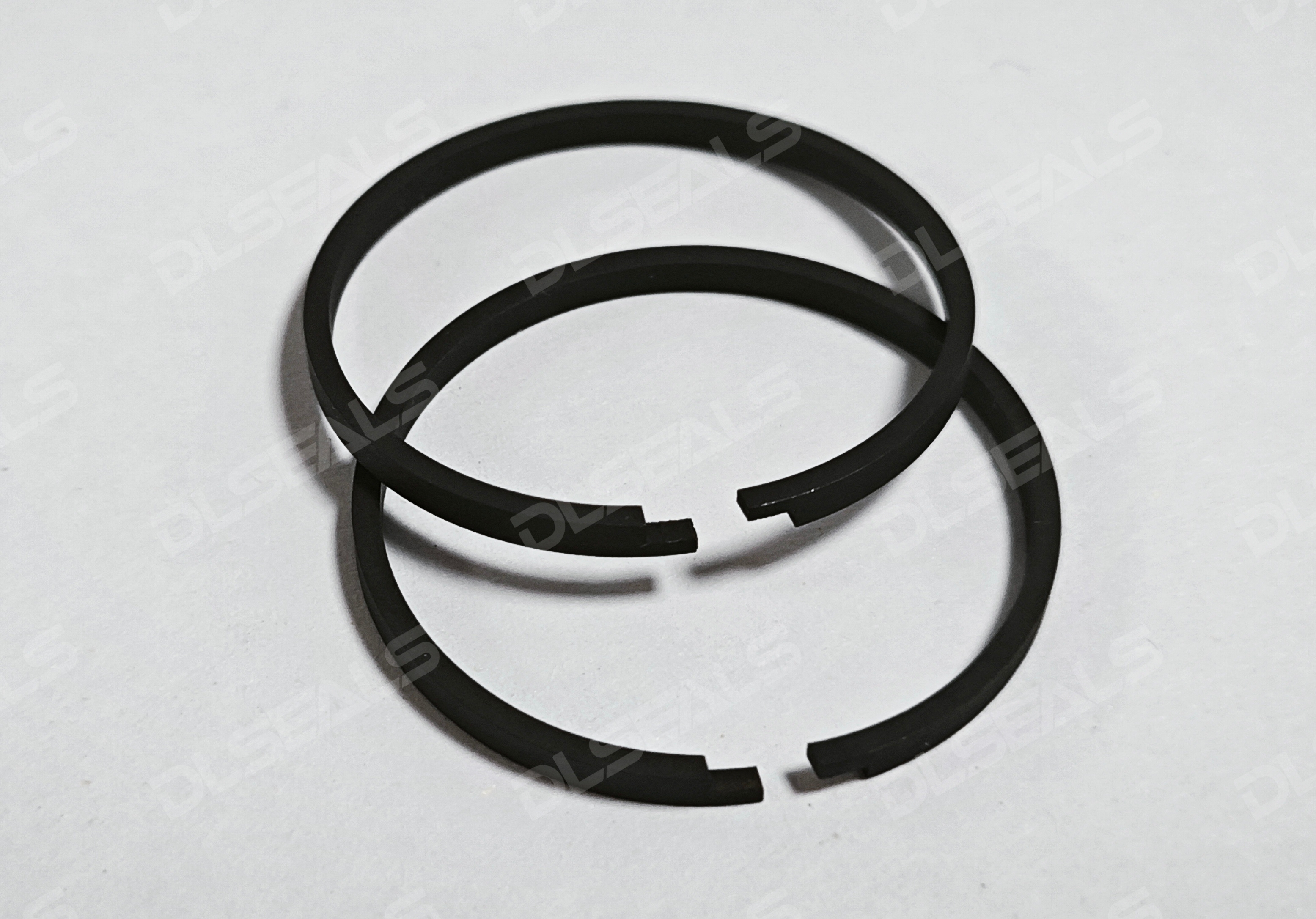
Under high-pressure and high-speed operating conditions, piston rings endure extremely severe mechanical stress and thermal loads. High pressure generates significant backpressure behind the ring, drastically increasing the normal force between the ring and the cylinder wall. Meanwhile, high-speed reciprocating motion elevates the linear velocity of the tribological pair, significantly increasing frictional heating. This threatens to breakdown the lubricating oil film, triggering scuffing, galling, or abnormal wear. Consequently, proper material selection is the cornerstone of ensuring reliable gas sealing, oil control, and long service life.
Selection and Evolution of Base Materials
Traditional gray cast iron exhibits relatively low tensile strength (typically between 200–300 MPa), making it highly susceptible to bending fatigue failure under modern high-pressure and high-speed conditions. As a result, its use has largely been relegated to secondary roles. Today, three primary base materials dominate the industry:
-
Ductile Iron (Nodular Cast Iron): Spherical graphite treatment increases tensile strength to 600–800 MPa while providing favorable elastic modulus and impact resistance. Ductile iron rings are widely used for the first compression ring in heavy-duty diesel engines and high-output gasoline engines.
-
Martensitic Stainless Steel / Si-Cr Alloy Steel: Steel rings offer exceptionally high yield strength (>1000 MPa) and superior resistance to thermal fade. Under equivalent structural strength requirements, steel rings can be designed thinner and lighter. This significantly reduces reciprocating inertia at high speeds and minimizes “ring flutter” within the piston groove.
-
Powder Metallurgy: Sintering processes allow flexible control over material porosity and alloying elements. Self-lubricating or hard phases can be uniformly incorporated into the microstructure, yielding excellent seizure resistance and high customizability.
Key Surface Treatments and Coating Technologies
Under extreme high-pressure and high-speed environments, base materials alone cannot fully eliminate wear and cylinder scuffing. Advanced surface modification and coating technologies are mandatory:
| Coating Type | Representative Process / Material | Core Advantages | Suitability for High-Pressure & High-Speed |
| Chrome Plating / Porous Chrome | Porous Hard Chrome | Micro-porous network retains lubricating oil, reducing dry friction risk. | Suitable for high loads; however, hardness degrades due to annealing at extreme temperatures. |
| Nitriding | Gas / Plasma Nitriding | Forms a high-hardness (>900 HV) nitrided layer with exceptional thermal stability. | Significantly improves scuffing resistance; a standard treatment for steel piston rings. |
| Thermal Spray Coatings | Molybdenum-based (Mo Spray), CKS (Chromium-Diamond) | Molybdenum has an extremely high melting point and self-lubricating properties, preventing high-temperature scuffing. | Outstanding resistance to heavy mechanical loads and thermal shock; widely used in heavy-duty engines. |
| Physical Vapor Deposition (PVD) | Diamond-Like Carbon (DLC), CrN / TiN Coatings | Ultra-high hardness (>2000 HV) combined with an extremely low friction coefficient. | Substantially reduces frictional losses and heat generation; top choice for extreme high-speed and high-pressure setups. |
Systemic Matching Principles for Material Selection
Designing piston ring materials for high-pressure and high-speed applications requires adhering to key tribological principles:
-
Tribological Compatibility: The coating hardness and surface morphology must pair seamlessly with the cylinder liner material (e.g., cast iron, aluminum-silicon alloy, or coated liners) to prevent premature, aggressive wear on the liner wall.
-
Thermal Conductivity and Expansion: High frictional heat must dissipate rapidly through the piston ring into the cooled cylinder wall. Selecting high-thermal-conductivity materials and precisely calculating thermal expansion coefficients prevents end-gap closure and subsequent ring seizure at elevated temperatures.
-
Balancing Weight Reduction and Structural Stiffness: Transitioning to high-strength steel enables thinner cross-sections (axial ring thinning). This maintains required radial tangential force while substantially decreasing reciprocating mass and parasitic friction losses.
As powertrain design trends toward higher power density and thermal efficiency, piston ring material selection is rapidly evolving toward a hybrid paradigm: high-strength steel substrates coupled with nanocomposite PVD/DLC coatings.
Post time: Sep-03-2026


