
Abstract & Operating Context
In semiconductor manufacturing equipment (such as etching, CVD, deposition, and vacuum transfer chambers), core structural components like columns/pedestals perform critical functions, including structural support, positioning, and heat transfer. The internal cavity of the column must maintain a high vacuum level (10-7 Pa), while the external environment remains at atmospheric pressure and may come into contact with various corrosive process gases. This white paper systematically analyzes the structural selection and material compatibility of static sealing systems for this specific operating condition.
Core Operating Parameters:
-
Internal Pressure: 10-7 Pa(High / Ultra-High Vacuum)
-
External Pressure: Atmospheric Pressure ( 0.1 MPa differential pressure)
-
Working Media: Air and potential corrosive semiconductor process gases
-
Operating Temperature: 110℃
-
Seal Type: Static Seal
-
Industry Grade: Semiconductor Grade (Ultra-high cleanliness, extremely low outgassing and particle generation)
Section 1: Technical Challenges & Design Factors
-
Outgassing Control under High Vacuum (10-7 Pa): In ultra-high vacuum environments, gas desorption from material surfaces and volatile organic compounds severely degrade ultimate vacuum levels. Sealing materials must exhibit extremely low moisture and organic outgassing rates.
-
Corrosion Resistance & Particle Contamination Control: Halogenated process gases (CF4, Cl2, NF3) cause severe degradation in standard elastomers. Material degradation leads to particle generation and wafer contamination.
-
High Differential Pressure Sealing Integrity: The pressure differential across the column reaches 0.1 MPa. Maintaining tight sealing interfaces under high vacuum requires total prevention of micro-leaks and “virtual leaks.”
Section 2: Sealing Options & Material Analysis
2.1 Semiconductor-Grade FFKM O-Rings (Preferred Balance)
For designs prioritizing ease of maintenance and cost-effectiveness, semiconductor-grade FFKM O-rings represent the most mature industry standard.
-
Material Properties: Fully fluorinated polymer backbone and side chains provide chemical inertness comparable to PTFE, resisting almost all corrosive etching and cleaning gases.
-
Vacuum Optimization: Specially processed via high-temperature secondary vulcanization and vacuum baking (Outgassing Control) to achieve minimal outgassing and ultra-low ionic extractables.
-
Key Advantages: Excellent elastic recovery, easy installation, moderate flange surface finish requirements, and minimal compression set at 110℃.
2.2 PTFE Spring-Energized Seals (Pan-Seals)
For applications requiring zero elastomer outgassing or absolute chemical barrier, PTFE spring-energized seals offer an outstanding static sealing solution.
-
Structure: Modified PTFE jacket energized by an internal corrosion-resistant metallic spring (Hastelloy C-276 or Inconel 718).
-
Key Advantages:
-
Zero Elastomer Volatiles: PTFE contains no plasticizers or vulcanizing agents, resulting in near-zero outgassing.
-
Creep Compensation: The internal metal spring provides continuous radial force, overcoming cold flow (creep) under long-term static pressure and ensuring reliable contact stress at $10^{-7}\text{ Pa}$.
-
Universal Chemical Inertness: Modified PTFE resists virtually all semiconductor process chemistries.
-
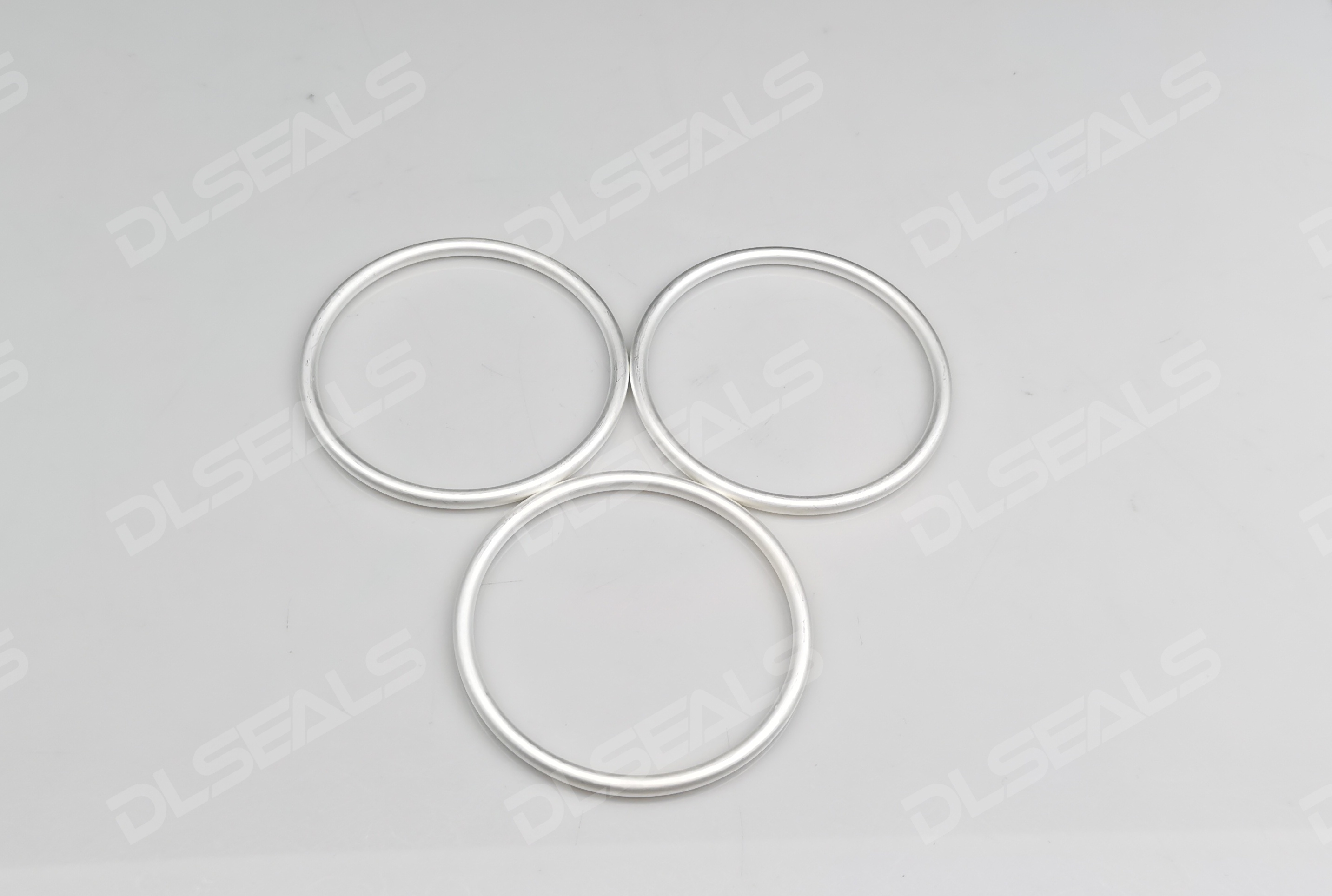
2.3 Coated Metal Seals (Metal O-Rings / C-Rings)
For non-demountable core ultra-high vacuum joints, metal seals provide the ultimate leakage prevention.
-
Structure: Stainless steel (316L) or nickel-base alloy (Inconel 718) tubing coated with silver, gold, or thin PTFE to conform to surface imperfections.
-
Key Advantages: Zero gas permeability through the seal body and long-term immunity to thermal aging at 110℃.
-
Limitations: Requires extremely high seating load and fine flange surface finish (Ra < 0.4 um).
Section 3: Comprehensive Comparison Table
| Sealing Solution | Core Material | Corrosion Resistance | Outgassing (10−7 Pa) | Installation / Machining | Recommendation |
| Semiconductor FFKM O-Ring | Perfluoroelastomer (High-purity) | Very High (All Process Gases) | Excellent (Post-baked) | Standard O-groove, Easy Maintenance | ★★★★★ (Preferred) |
| PTFE Spring-Energized Seal | Modified PTFE + Hastelloy Spring | Top Tier (Fully Inert) | Superior (Zero Volatiles) | Special Groove, Moderate Load | ★★★★☆ (High Cleanliness) |
| Coated Metal C/O-Ring | Inconel 718 + Gold/Silver Plating | Top Tier (Plating-dependent) | Zero Permeation / UHV | High Bolt Load & Fine Finish Required | ★★★☆☆ (UHV Critical) |
Section 4: Conclusion & Recommendations
-
Primary Recommendation: Use semiconductor-grade ultra-clean FFKM O-rings. This option offers the optimal balance between low outgassing, chemical resistance, ease of installation, and maintenance efficiency.
-
Secondary Recommendation: For extreme corrosive exposure or ultra-strict organic outgassing constraints, select modified PTFE spring-energized seals (with Hastelloy springs).
Post time: Jul-29-2026


